Jan Gatewood’s
Wildest Dreams
The Artist, Skater, and Model on Painting Jokes
- Text: Sam Hockley-Smith

Pasadena. Hollywood. West Hollywood. Glendale. Burbank. “I was just like, I feel fine here. Every place,” the visual artist Jan Gatewood says, talking about his earliest days in Los Angeles, and how they paved the way for his current artistic practice—young, structureless, looking for a new beginning without any expectations.
In the book Everything Now, the author Rosecrans Baldwin describes LA like this: “For my part, it is the only place in the United States where I can stand anywhere and feel like I am in the middle of everything, and also like I am nowhere at all.” That line, unintentionally echoed by Gatewood to me over Zoom, is a telling portrait not just of a city of baking blacktop, of endless stretches of solitude surrounded by oblivious civilization, but also how a person can find or lose direction in those aimless days, can learn to create with what’s available.

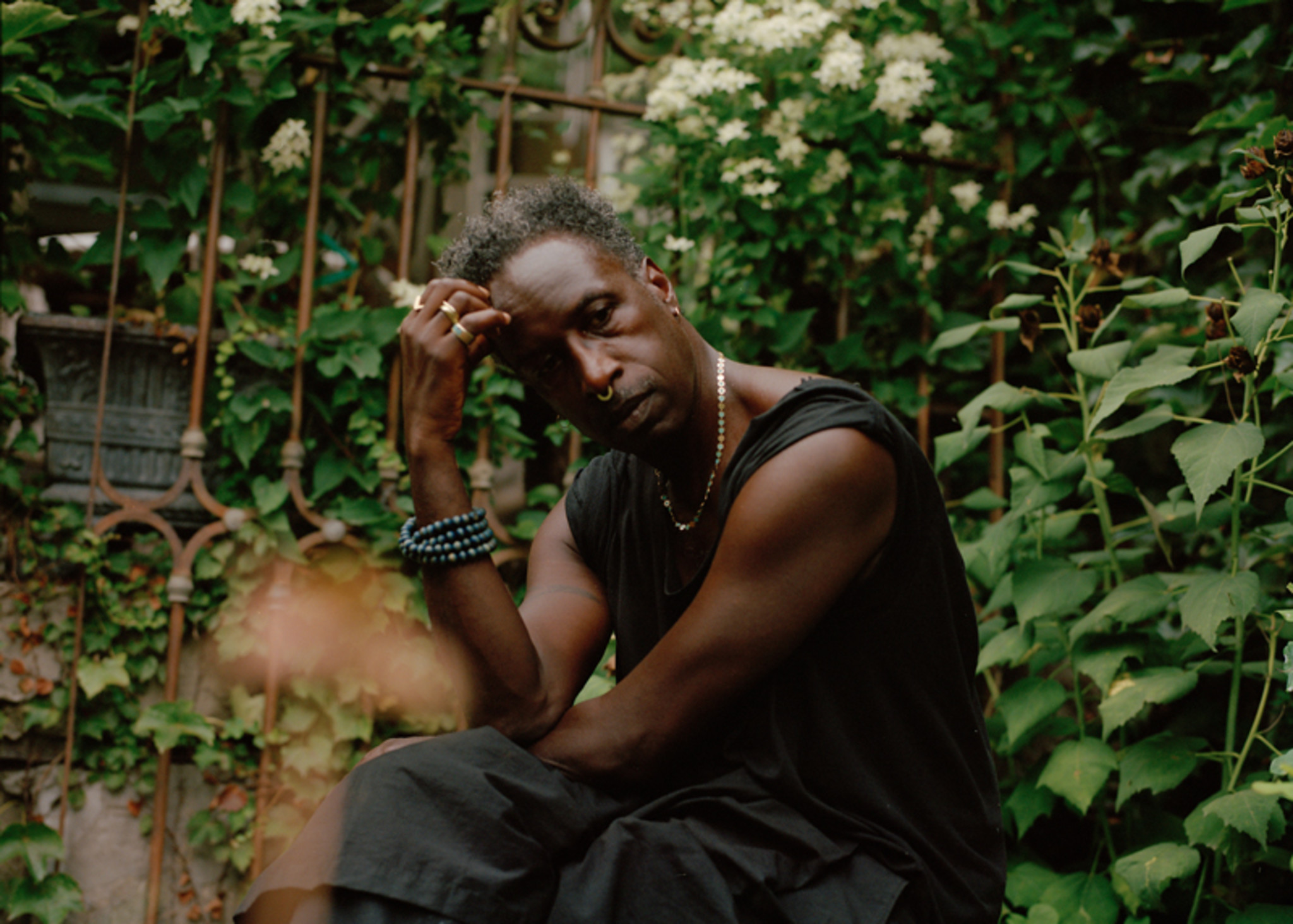
Top Image: Portrait by Calvin Reboya.
For Gatewood, his career has constantly straddled this line, exploring the outer regions of the recognizable through art that is as aesthetically pretty as it is weird. Sometimes he’s highly visible, modeling for Calvin Klein or other brands, his eyebrows cast upward in perpetual skepticism. Other times, he’s more anonymous. Working quietly in his studio on surreal images that straddle the line between collage, found art, and illustration. He’s collaborated on a t-shirt with Sonya Sombreuil’s highly-coveted art-fashion line Come Tees. One of his more abstract pieces—pastel washes augmented by stark black shapes that look like they’ve been stamped onto the paper—sits in Dries Van Noten’s West Hollywood boutique. Yet his life looks and feels much like it always has, which is a testament to the way he’s been able to fit into the worlds he admires without losing himself.
Gatewood’s childhood and teenage years in Aurora, Colorado were idyllic in the way that those years can be suffused with grit and edge, but still feel largely innocent. “It's really suburban, very boring, not a whole lot of interesting stuff going on, but I was very fortunate in the fact that I just had the best group of friends growing up,” Gatewood says. “We all were obsessed with skateboarding, and still are.”
When you’re a kid, skating is the closest to freedom that you can get. Parking lots become destinations. Ledges outside of anonymous office buildings become hangout spots. “It created a sense of autonomy in me early on,” Gatewood says. “It allowed me to access the world in a much different way, it was just the perfect guide to get me out into the world.” It is, indirectly, how Gatewood ended up in Los Angeles. After high school, he and his best friend took a road trip out West. His parents really wanted him to go to college, but he wasn’t so sure. While in LA, he felt its magnetic pull. “ [LA] felt like home right away. Maybe it was something intuitive saying I should be here, but I hadn’t discovered that yet.” After an attempt at college in Colorado, Gatewood dropped out and headed back to Los Angeles.

Jan Gatewood, Track 17 - Prayer (Skit)... Disparate but still shooting for that, 2021. Oil pastel, oil stick and fabric dye on paper. 28 in x 22 in. Courtesy of Jack Hanley Gallery.

Jan Gatewood, gorFlluB, a callback & a rip, 2020. Oil pastel, oil stick, fabric dye, industrial salt, & fabric spray paint on paper. 22 in x 28 in. Courtesy of the artist.
There are certain moments in life—no matter how small they initially seem—that act as direct catalysts for everything else that’ll come after. For Gatewood, it was when his roommate moved out, leaving behind canvases, acrylic paints, colored pencils and other “basic art supplies.” “I would come home after work and just goof around with that stuff,” says Gatewood. “I had a good time making abstract paintings, and I didn’t think much of it because I didn’t really know anything about art, or the galleries in LA, and I definitely didn’t know any artists.”
If his sudden access to art supplies got him interested in art, it was a week-long trip to New York that solidified Gatewood’s path. It is not worth doing the dance of comparing New York and Los Angeles–topographic realities and creative scenes are fairly different in both places—but Gatewood, roaming free in Los Angeles, experimenting with art when he wasn’t at his job or skating with his friends—was shunted into a place of extreme focus when he went to New York.
“One of the days I was there, this deli [Frankel’s] opened in Brooklyn, and at the opening there were a bunch of gallerists and artists—I just felt something being around these people,” Gatewood says. He learned they were associated with the Los Angeles gallery Moran Moran, which has exhibited the work of Dash Snow, Eve Fowler, Brian Belott, and many more. “As soon as I got back to LA, I was like, whatever they’re doing, I want to do it,” Gatewood says. After sending the gallery an email asking if he could hang out there and possibly help out, Gatewood ended up with an internship.
In the absence of any formal learning structure, Gatewood existed in a perpetual state of experimentation. Gluing sheets of paper together to change their thickness, painting over his own collages and then collaging on top of them, scouring the streets of LA for any found object that caught his eye. When the freedom got to be too free, he started limiting himself, creating a structure within which to work. “Eventually I began collecting different kinds of tobacco to use, and then just different kinds of paper,” Gatewood says. “I would also try to use things that had some life to them at some point. There's a couple of times where I used lizards that shriveled up from the heat. It was a lot of stuff, but I decided to whittle it down so I could speak about the work better.”
He does not classify it this way himself, but Gatewood’s self-imposed material limitations, his reticence to enter into art school, and his ability to fold his practice of art making into his daily life is what has made him so successful as an artist. There’s a palpable sense of freedom in Gatewood’s work. In his first solo show, Alas! Mocktails to Infinity, which ran at the LA gallery Smart Objects from the end of 2020 through the beginning of the year, caricatures of animals and amphibians are pasted against explosions of soft color and texture. A formless universe of pastel acts as a backdrop for a drawing of, say, a frog. It’s sort of just hanging there, suspended in the absurdity of nothingness. “There was kind of a long road to that work, but I always think about people going to art school and learning a specific way,” Gatewood says. “So I was like, oh, man, if I was in school, I would have had to take a drawing class. And I hate drawing. Let me just figure out how to try to get some basic drawing skills. I decided I needed to compile some material that I would care about drawing.” What he ended up with was a bunch of animals that seemed to exist simultaneously in the recognizable world and in a more surreal, playful universe.
For his solo show, each piece of paper was hung on a wire that threaded throughout the gallery so that visitors could see both sides of each piece, weaving in-between them as they traversed the space. They could see the way the industrial salt added grain and grit, or how squeezes of lemon juice caused paint to waterfall over itself, blurring into an acidic sharpness that adds an implicit edge to a soft smudge. “When you’re walking around, the work begins to glisten...to glimmer, a little bit.” Gatewood says. When you can see how the pieces come together, some of the mystery of art creation falls away. Gatewood is coming at the art world from outside, self-taught, muddling his way through the process in search of a style and focus that he finds appealing. Why would he not want to, at least in the abstract, be a potential guide for someone else?

Installation photograph from Gatewood's solo exhibition at Smart Objects titled Alas! Mocktales to Infinity. Courtesy of Smart Objects.

Jan Gatewood, One liner - Lambullghini… produce/reuse, 2021. Oil pastel, oil stick, fabric dye, industrial salt, fabric spray paint, and bleach on paper. 22 in x 28 in (unframed). Courtesy of the artist

Jan Gatewood, Amanda's Breakfast, a faithful guest, 2020. Oil stick, oil pastel, fabric dye, bleach, and industrial salt on paper. 28 in × 22 in. Courtesy of the artist.
Gatewood’s work—the frog with the car on its belly, the fishcopter, the boxing glove holding a knife aloft, the dolphin that appears to be licking an acid tab with a devil on it, itself a recurring image—is all surreal and funny, but each piece is given a title that is often so specific, so clumsy, that you can’t help but start to dig for meaning in it. That dolphin painting, for example, is titled Captain Miserable. One image from the show—a piece of paper with the word “DRAWING” smeared across it, the letters sitting above a halved lemon with a flag planted in it, is titled The Answer Here is in the Andy Milonakis Show theme song, referring to a comedy song by the adolescent-faced adult comedian. The first line of that song is: “I got peas on my head, but don’t call me a pea head.” You can take absolutely nothing from that, or it can mean everything.
People tend to have trouble with humor in all types of art. When humor is introduced into formally serious art, it’s difficult to figure out if an artist is being serious, or if they’re being ironic. One road implies that a lot of work and consideration has gone into the piece, the other seems to say that it’s one note. Gatewood’s work elides this conundrum by blatantly embracing humor, while also putting on display the time consuming process that goes into creating each piece. “The first thing I wanted to be in my life was a comic. But I realized I'm not funny—that and I don't have the writing brain, I don't think,” he says. “As I was thinking through the show, I was like, I want to think through this like I am a comic and this might be my hour special.”
In speaking about his process, and how it intertwines with comedy as a form, Gatewood is actually talking about the power of communication, and how that power can fluctuate when the veils of perception are erected, or broken down, or manipulated. Whether it's his animal paintings or his abstract collages, or the dada titles of his pieces, Gatewood is speaking his own language. He’s giving us all the tools to understand what he’s trying to say, but he’s not providing direct answers. A lizard, alive and scurrying across the hot Southern California cement is very obviously a lizard, but when it’s smashed and dried up, it becomes something more blank—a whole story of conflict and chaos can rise up around that crusted over vestige of life.
Sam Hockley-Smith is a writer and editor living in Los Angeles. His work has appeared in The FADER, The New York Times Magazine, Pitchfork, NPR, Entertainment Weekly, GQ, Vulture, Bandcamp Daily, and more.
- Text: Sam Hockley-Smith
- Date: September 7th, 2021