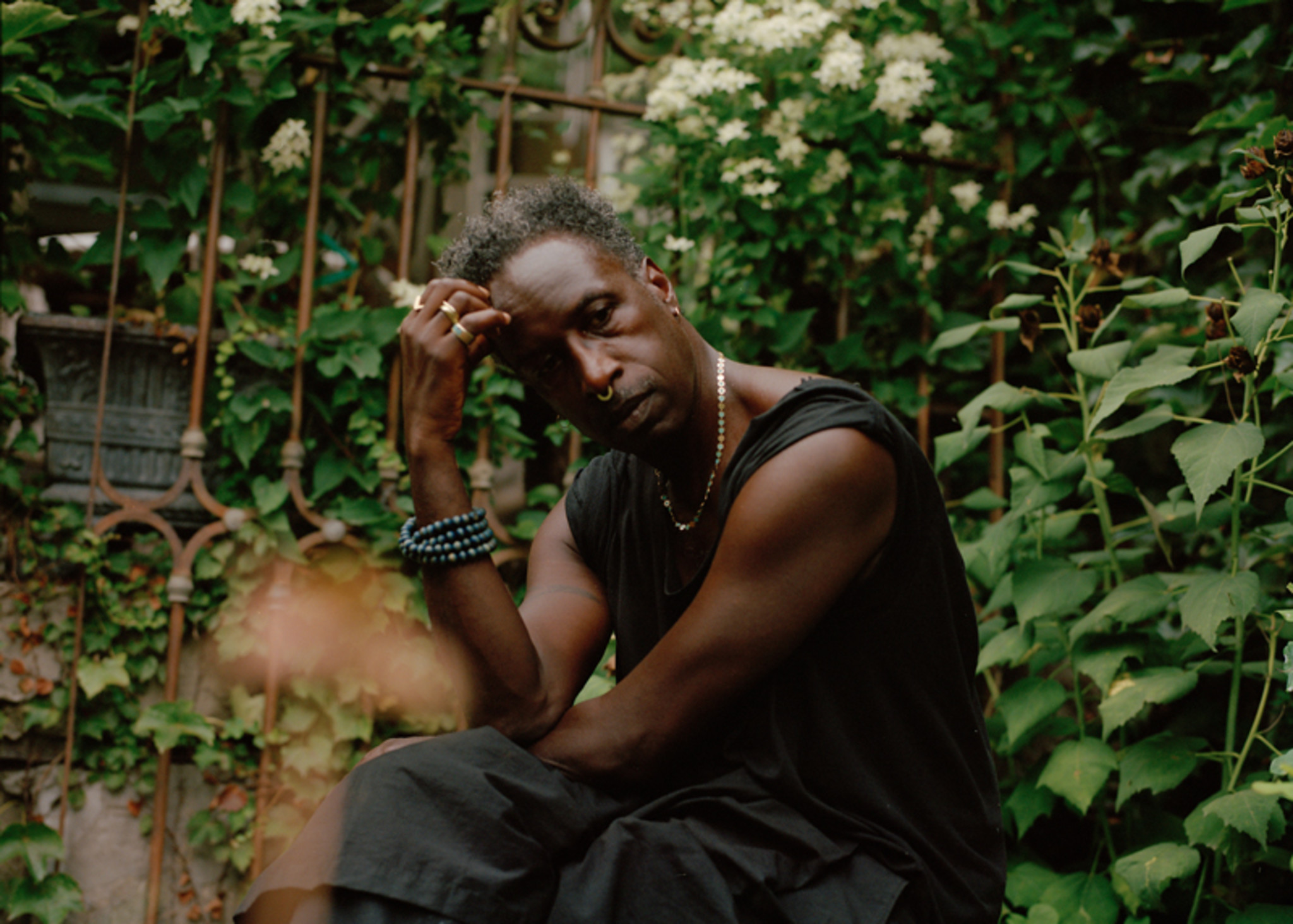
Léa Dickely Finds Beauty in the Uncanny
A conversation with the co-founder of Kwaidan Editions about her art practice.
- Written by: Chris Gayomali

A long time ago, before Léa Dickely co-founded her brand Kwaidan Editions—in Japanese, ”kwai” loosely translates to strange or mysterious; “dan,” narrative; so: “strange stories”— she would occasionally meet with the designer Rick Owens as a consultant. At the time, the dark lord of fashion was in the market for ambitious and out-there ideas, so Dickely, in her telling, would show up with a suitcase full of samples and experimental textiles: stuff that might allow for storytelling through fabric and embroidery.
“It was like I could bring him little presents,” she said.
In 2016, Dickely would co-found Kwaidan Editions with her longterm partner, the designer Hung La (the pair would later go on to start Lu’u Dan), and the brand operated on a similar wavelength of strangeness, finding beauty in the uncanny. (The name Kwaidan was inspired, in no small part, by the 1965 horror film directed by Masaki Kobayashi.)
The brand very quickly found its footing. By 2018, Kwaidan Editions was a finalist for the LVMH Prize, and during the pandemic, Kwaidan was praised by Vogue for the “strain of kink that underlines their work” defined by a “trademark sense of provocation.”


Also during the pandemic, Dickely, a fine arts major, started painting again, in some ways resurrecting a practice that had backgrounded itself to allow space for clothes. For four years straight, she painted every day: haunting images of figures obscured in head-to-toe latex, dreamy distortions of humanity plucked from some netherworld.
Kwaidan Editions is currently on pause, as La is focused on Lu’u Dan (Dickely helps out part time). But she sees her art practice as a continuation of Kwaidan, exploring the dark penumbra of her own subconscious. I talked to Dickely recently about it after the couple got back from their summer vacation.
Chris Gayomali
Léa Dickely
How was your Hawaii trip?
We went to Maui. It was beautiful. I mean, it’s obviously paradise, right? I also felt like it was quite eerie. The nature was very strange to me, but very beautiful.
Strange in what way?
I don’t know. I think I had a little bit of island fever. I didn’t expect that. I didn’t expect that at all, but it was a really nice holiday. I mean, I feel really lucky to be able to go to such a place.
I feel like the commercial part of Maui kind of throws me off a little bit, where the colonial undertones shade everything.
It feels very Americanized. Sometimes it feels like you’re in LA. [laughs]
Have you been able to get back into your art practice since getting back, or have you just been trying to get everything in order?
Yeah, I just moved into my new studio. That’s been the main thing, and then just also getting back into the business a little bit and just getting the ball rolling again. So I haven’t really painted that much since, but I am just getting started.
I’d love to talk about how your art practice fits into designing and fashion for you. So when you were originally conceiving of Kwaidan Editions, I see the dark, ghostly undertones of everything. What was the thing that you were excited to start making when you first started?
It was a very different time. That was eight years ago now, and back then I think we were just really excited to start something, so we didn’t really have a huge plan of which story we wanted to tell. I knew it was going to be on the darker side of things. I knew I didn’t want something so feminine. So we got everything aligned with suppliers and the structure, and we just wanted to get going and see where things would lead us.
When I started shooting the lookbooks, around COVID, that’s when things started to be more—I don’t know how to say—but they had more flavor. They started to tell more of a story, I think.
Before that, we just wanted to really make a good product and be more on the luxury side of things, with the Phoebe Philo years and all that. So it was—I think it took us a bit of time to establish the DNA. And then when COVID hit, that’s when I also kind of reconnected with my art practice. So I started painting a lot more, and I think that’s when the two practices clicked again.

What do you see as being the connective DNA between the fashion side of the brand and your art practice? What sort of associations come up in the word cloud for you?
I studied fine art in school, and I think that’s when I really developed my artistic identity, that's when I really figured out what I wanted to talk about. That's when I discovered everything about subjects like the uncanny, the Freud uncanny, this whole kind of darker side of things. Between art and fashion, it's always been this kind of dance for me. So I would go to one and then go to the other and then back.
After fine arts, I went to Antwerp, and then I developed more of a fashion sense and how I could translate what I developed in fine arts into fashion, and then kind of always go between the two like this. I think the older I get, I just want them to be really linked now—to really have a conversation in the same space.
How does the uncanny manifest in the clothes you design?
We were a bit new to the whole thing, so I don’t think it came across at the beginning. But then, as time went on, we started using latex, which in a lot of ways invites you into a subculture that makes its whole world. And then mixing it with the kitsch side of things, like flower prints that I would design. For me, that whole kitsch thing is really ingrained in me from my grandparents.
The house they lived in was insane. When I show pictures to people, they can’t believe how crazy it was. There was absolutely no empty surface. Everything was covered with a pattern, with a flower, with something. And for me, there’s this interesting kind of conversation, between that really kitsch, really heavily decorated kind of dark piece and latex and what that means on the other side and how the two kind of mix. I think it's always really interesting for me.
How did you get your start in fashion?
After art school I went into textile and print design. So I was very much into working on embroidery projects for Dior, for example, with technology, and then working as a print designer for McQueen or Balmain, which was not a good fit for me. And I worked with Rick Owens, which was probably the best one. It was the most interesting job I’ve had outside of the brand.
Was there anything that was super surprising about working with Rick?
I was not working there full time. I was a consultant, I suppose. So I never really met anyone else other than Rick there, which was really interesting. I was just working with him directly, and he just really wanted to have someone to propose ideas to him and come up with cool stuff. So I would just come to him with a suitcase full of samples and trials and experimentation, like textile stuff—stuff that you couldn’t really find anywhere else.
That sounds amazing.
He was always excited to see what could be an interpretation of his brand through embroidery and textile work.
That was really inspiring because I was totally free. Also very difficult because you have to be really on point. It was super interesting to really develop the language for a brand through ideas and samples. And I mean, he’s amazing to work for. He’s the best boss you could ever imagine.
Were you a club kid, back in the day?
Oh, no, I wasn’t. I wasn’t at all. While Hung was partying in London or whatever, I was just studying fashion and being really—I was a nerd. I was a fashion nerd.

I love that.
I was obsessed when I was a kid. I mean, I decided to do fashion at age 13. I was driven.
Who were the designers for you that were informative at 13?
It was Versace and Mugler. Those two were my gods. I wrote them letters. I wanted to try and get insights or whatever. I don’t think ever got my letters. [_laughs]
Now that you mentioned it, in the pattern work, especially, I kind of see the Versace opulence, the sparkles of it in there.
Yeah. If you pay attention, you can see it. When he died, I was devastated. I couldn’t believe it.
I was looking at some of your oil on canvas paintings, especially of the ones that have the wallpapers and the floral motifs or whatever. Your use of shadows on the corners, and it’s kind of like insinuating what’s unseen.
It’s really about everything that’s maybe not shown and everything that you feel that’s not seen, that’s invisible, that’s hidden, that’s kept secret. All of these things are really interesting to me, and I like to find ways to bring them up somehow to hint at.

Can you tell me about the white dog painting? Whose dog is that?
Actually, my dog. His name was Paivar, and he was a greyhound. This was based on a photo that was taken probably 20 years ago, and it was a picture my dad took. I just love this image so much because it’s actually the only animal subject. Everyone else is under some sort of layer or something, but it’s the only one who’s actually kind of staring and being present there. So I really like—and all the textures, obviously the decor—something that I really enjoy painting.
I really loved this series of the Phantoms you did. There’s such a weird dignity to the way they’re presented too. It’s kind of like superheroes.
They look like aliens to me more than anything. Bodies completely covered in this material. You don’t even know if someone’s actually in there; it’s just like this shadow. And there’s an attraction to that kind of storm, in how shiny it is, and painting that is really also something that I really enjoy. But yeah, the superhero thing, I think that’s actually quite interesting. I never thought of that, but it does come across as that a little bit. But it’s also extracting them out of their context a little bit and just refocusing on the shape and the volume of it and the absence too. Because again, you don’t know. Yes, there’s an envelope of it. But who knows what’s inside, really?
I imagine the approach to those is very different from, say, the way you approach the mask series, which looks like the paintings were done in a much more visceral way…
So the masks—it is almost the opposite—where the phantoms, for example, are much more built and constructive images. There’s absolutely no preparation for the masks; it’s just pure visceral expression. I don’t know what’s going to come out. When everything else is really contained and covered in some sort of pattern or texture, this is raw. There’s no filter anymore, even though they’re called masks.

The one mask painting that I can’t stop looking at is the one where it looks a little bit like a kabuki mask, the white one. That one is just so haunting to me.
That’s based on a picture I found. I think it’s from a Japanese movie about aliens. That’s what I love about it too, is that you can’t tell exactly if it’s an actual mask, a person’s face, or the alien. I really like that kind of ambiguity.
Were you able to ever work on clothing with that same sense of freedom as you were with the mask series?
No, I wish. That’s kind of what I would like to actually introduce, but fashion is much more complex as a structure because there are so many more people involved. So the gestures a lot of the times are kind of lost. There were so many people in between that it sometimes becomes a little stale.
I imagine there’s a lot of weird outside pressures too, to make something that is a little bit more resistant to experimentation.
Exactly. That’s something I’d like to actually explore more and have both—have something really free and experimental and have the commercial stuff that you need.


And then I wanted to ask you about these “Pleasures” images. It seems like a dramatic departure, but you also do have that same wallpaper motif in a lot of your other paintings too.
This is more like an ongoing project. But I wanted to kind of integrate textile into the whole project because painting feels sometimes a little flat. And I mean, with fashion being a fashion designer, texture—and also I was a textile designer before doing the brand, so I’m quite heavily interested in all kinds of techniques and embroideries and all this. The one on the bottom right is an actual sample, so that was embroidered…
Oh wow.
But all the other ones, I like to really make large panels of walls even where the walls have this 3D motif coming through.
I would hate to be tripping on something and in a room staring at this. I could see all the faces jumping out at me.
[Smiles] I know.

Chris Gayomali is the editor of SSENSE.
- Written by: Chris Gayomali
- Images/Photos Courtesy Of: Léa Dickely
- Date: August 27, 2025