After 20 Years,
Thom Browne
Is Way More
Than Just Suits
In a career-spanning interview, the beloved designer considers two decades in fashion.
- Interview: Steff Yotka
- Photography: Jesper Lund
- Styling: Marissa Baklayan

It would be too simple to sum up Thom Browne as “the guy with the shrunken gray wool suits.” It wouldn’t be incorrect—that uniform silhouette has turned Browne’s label into a nearly $500 million business today—but it would belie the power of Browne’s vision. Because the gray wool suit isn’t the end of Browne’s business. It’s the beginning, the square one upon which a universe has been built.
“It was the one thing that I wanted to make at the beginning, and it was the one thing that I wanted to do for myself in a different, new way that I thought I could build upon,” he says, wearing (of course) a gray wool suit in his his gray marble office in New York’s gray Garment District.
And build he did. Over the past 20 years he has outfitted First Ladies and LaLiga players. His work has been exhibited in the Metropolitan Museum of Art and seen on Selling Sunset. He made a smartphone with Samsung and a hamburger offered at Barneys New York. Sometimes his fashion shows last over an hour in Paris’s Opera Garnier and sometimes they are presentations that take all of ten minutes as models cross Fifth Avenue in New York. An outfit can be a sweatshirt or it can be a gown with over 30,000 hand-covered tulle sequins inspired by the snake from The Little Prince.
The magic of a Browne product is that no matter what form it takes, it is outstanding. You can’t ignore it. You can’t look away. You simply must know more.
“The one thing that I’m proud of is that it has stayed really true,” Browne says. “Even the conceptual ideas, it’s always really been based around something that is so true.” The trueness, of course, is the key to Browne’s success—soon to be chronicled in a 20-year retrospective book written in collaboration with his partner Andrew Bolton, the chief curator of the Costume Institute at the Metropolitan Museum of Art.
Here, the designer weighs in on the past 20 years—and how he wants to spend the next 20.
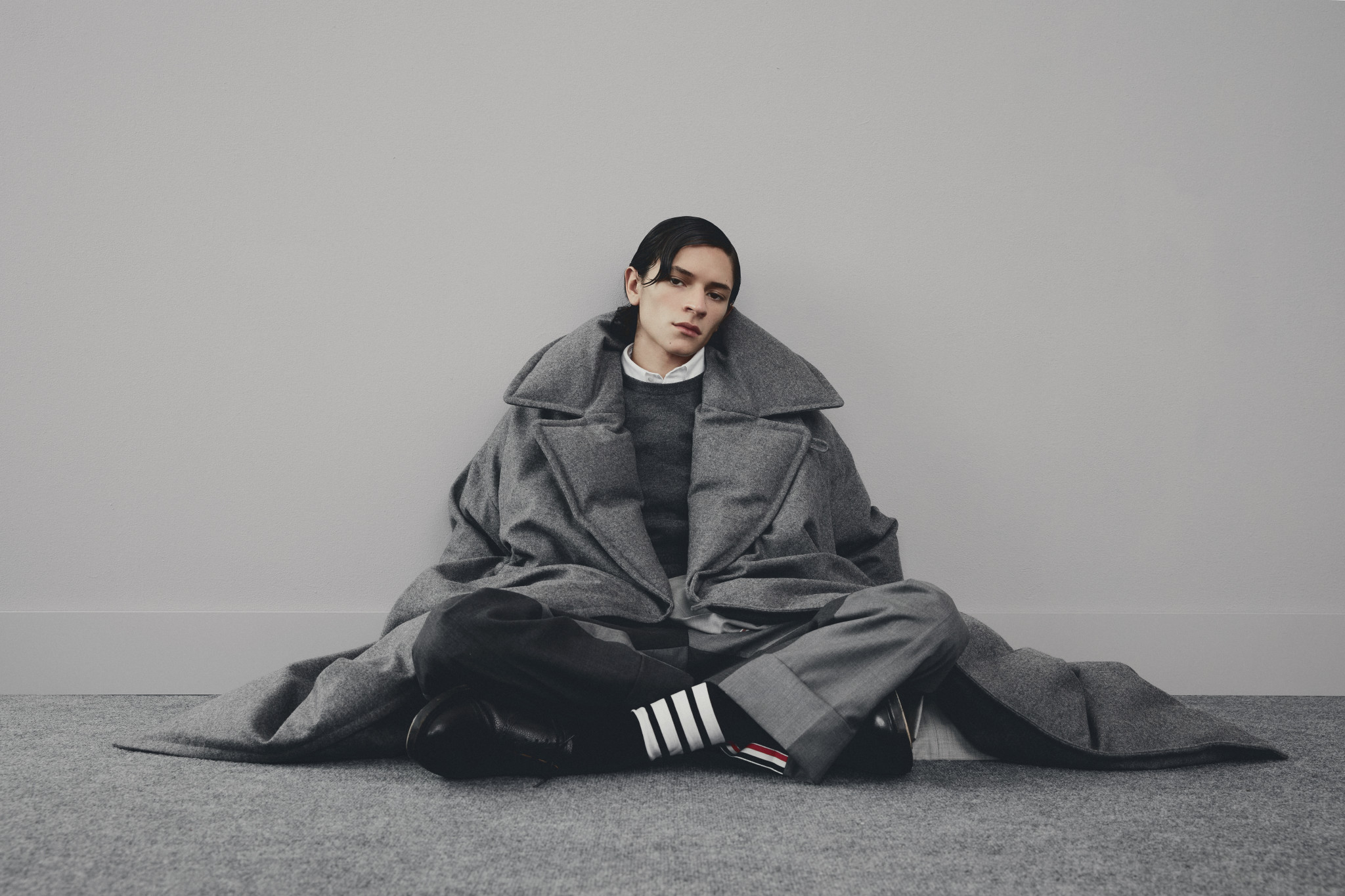
Model wears Thom Browne coat, Thom Browne vest, Thom Browne shirt, Thom Browne trousers and Thom Browne shoes. Featured In Top Image: Thom Browne cardigan, Thom Browne trousers, Thom Browne loafers, Thom Browne coat, Thom Browne vest, Thom Browne shirt, Thom Browne trousers, Thom Browne shoes, Thom Browne shirt, Thom Browne tie, Thom Browne skirt, Thom Browne socks, Thom Browne shoes and Thom Browne bag.
Steff Yotka
Thom Browne
Have you indulged in any retrospection this year because of your twentieth anniversary?
I am not really one to look back, other than with Andrew writing the book. Getting to do that with Andrew was great because I got to see my work through the most perfect expert’s eyes. But for me, I’m on to September, October, November.
At what moment did you feel pulled into the fashion world?
When Bergdorf’s and Colette first bought [the suit]. When David Bowie wore it back in 2004 or 2005. When Richard Buckley put it on the cover of Vogue Hommes International. Those were moments that I thought, “Oh, I guess it’s becoming more than I intended it to be.” I’m certainly in the fashion world today—and I’m in the business of fashion—but I feel like I still just do my thing. I don’t really care that much about everything else that’s going on, but I’m so proud of being in fashion. I feel like I’ve done something that is worthy of being recognized in fashion.
When did you feel like a success?
I feel like now we’re on a roll. People are appreciating it, buying it, seeing it, but I feel like there are still so many more people that need to see it, need to recognize that they can actually wear it and buy it. We are still very niche for a lot of people, and at the size [of the business] that we are it’s a great position to be in. We’re almost at $500 million and we’re still very niche, which is great.

Model wears Thom Browne shirt, Thom Browne tie, Thom Browne skirt, Thom Browne socks, Thom Browne shoes and Thom Browne bag.

Model wears Thom Browne shirt and Thom Browne tie.
That conversation between niche and mass is something that every creative person has to contend with. What side are you on?
I want to keep it true to what it is, but I think it still can be true to what it is in a bigger way. We do things very naturally, instinctually, organically, and we don’t force things. We could! But it’s by choice that we don’t, because we don’t want to ruin it. We don’t want to undo the first 20 years in the next couple years. So I think it’s really important to be very conscious of making sure that we do it in the best way, but there’s definitely so much opportunity that we have. We’re very fortunate.
You made a phone with Samsung, dressed a soccer team and a basketball team, outfitted First Ladies. When you’re approached with these ideas, how do you know it’s right?
It’s just instinct. When you have to think about it too much, maybe it just doesn’t work. Even with celebrities, those relationships have to be real for people to really appreciate them. If you feel like it’s forced, people can tell. You have to believe in it.
“That’s why I could make you anything, but I don’t.”
As the industry commodifies, the path to success becomes more obvious: go to design school, draw a dress, hire a marketing agency, they introduce you to an influencer, that influencer posts. And suddenly you’re a successful brand. But to me, to make clothes and wear clothes, you have to feel it in your soul. Otherwise, what are you doing?
Oh my God, yes. Can you tell this to all the design students?
Well, I’m not a designer. I’m a consumer, but to me there has to be no other way to work in this industry other than you have to do this thing.
You have to really want to do it, and you have to love it more than anything else in the world. And if you don’t, then you shouldn’t be doing it. There is no guarantee of it working. But also, success is so relative. It has nothing to do with how much money you make or how famous you could become. To me, success is doing something that’s really well done and that is so authentically yours. That’s what success is. And that’s why I could make you anything, but I don’t. I want to make you something that is true to what I do, because I would think that you’re coming to me for that.

Featured In This Image: Thom Browne vest and Thom Browne shirt.

Model wears Thom Browne vest, Thom Browne shirt and Thom Browne trousers.
Looking back over your career, do you have any regrets?
No.
None?
No. I think there’s one or two collections that have not been as strong as the others. However, for many of my shows, I think: It was what it was. When I was putting it in front of people, it was exactly what I wanted to do at the moment. But I think I’ve evolved and gotten better as a designer over the last 20 years. But everything happens for a reason. Almost going out of business happened for a reason—I was so focused on just the conceptual, more artistic side of fashion and not realizing, “Oh, I guess I should actually sell something to fund this machine.”
Are there certain shows or periods in your work you’re particularly proud of?
Maybe the Spring 2018 men’s collection, the “Why Not?” collection. It’s important to mention that I am not the first person to put men in skirts. But it was an idea that I thought would be really interesting at that time. I thought what made it really interesting was it was all very classic fabrics done in this new way.
When I say I’ve evolved as a designer, it’s that the world has matured too. I almost don’t design in men’s and women’s anymore. I design in clothing that can be worn by both men and women. And that [Spring 2018 menswear collection] was really the start of it for me. I did skirts on guys way before that, and of course tailoring for women way before that, but it was the first time I thought, “This kind of looks great.”
It’s very fun, but we’re also aware that we can’t be provincial, thinking the whole world is seeing it the same way. They’re still out in wherever in America thinking, “That Thom Browne guy needs to go away, making guys look the wrong way.”
Why do you think people are drawn to your clothes?
We represent, I think, an interesting idea of individuality. I feel like our true customer is pretty true to themselves, and they feel that in the collections. And the quality, of course. But I do feel like there’s a true connection to this feeling of, “I want to be not like everybody else.” That’s what our collections feel like.
And if you could go back and do it all over again, would you?
I could never do it again. No. I could never live the 20 years over again.

Model wears Thom Browne cardigan, Thom Browne shirt, Thom Browne trousers, Thom Browne socks and Thom Browne bag.

Featured In This Image: Thom Browne cardigan and Thom Browne shirt.
What are your hopes for the next 20 years?
I just do the same thing and a lot more of it. What’s harder now is really keeping it focused with more people and more things that we’re doing. Keeping everybody focused on what is fundamentally ours is the challenge. It’s a good challenge because it’s very clear on who we are and what we do, but it’s not always so easy to get everybody on board.
It’d be nice to look back and think like, wow, what they created was—it’s just like, when you look at all of the heritage brands, what they did at the beginning was important enough that they’re still here almost a hundred years later, and good for them.
And in 2043, paint a picture of what you’d like to be doing.
Oh my God. Am I still alive? 20 years? I’ll be close to 80. We just bought a house upstate, so I’ll be upstate. I will be retired for sure.
Lots of fashion designers have been close to and over 80 and still working.
Yeah. But I will be doing something else, probably. And hopefully looking back, and what’s happening at Thom Browne and hopefully smiling and appreciating how it’s gotten better and bigger. I feel at a certain point it’ll be nice to see Thom Browne through somebody else’s eyes. I think that’ll be interesting.
- Interview: Steff Yotka
- Photography: Jesper Lund
- Styling: Marissa Baklayan
- Set Design: Jordan Mixon
- Hair: Kiyonori Sudo
- Makeup: Dan Duran
- Models: King Abdo, Yan Li and Diego Andrade
- Photography Assistant: Christian Larsen and Aidan Tan
- Styling Assistant: Cassie Jekanoski
- Production: Peter Schwab and Christine Carreira
- Production Assistant: William Gavilondo
- Date: September 1, 2023

