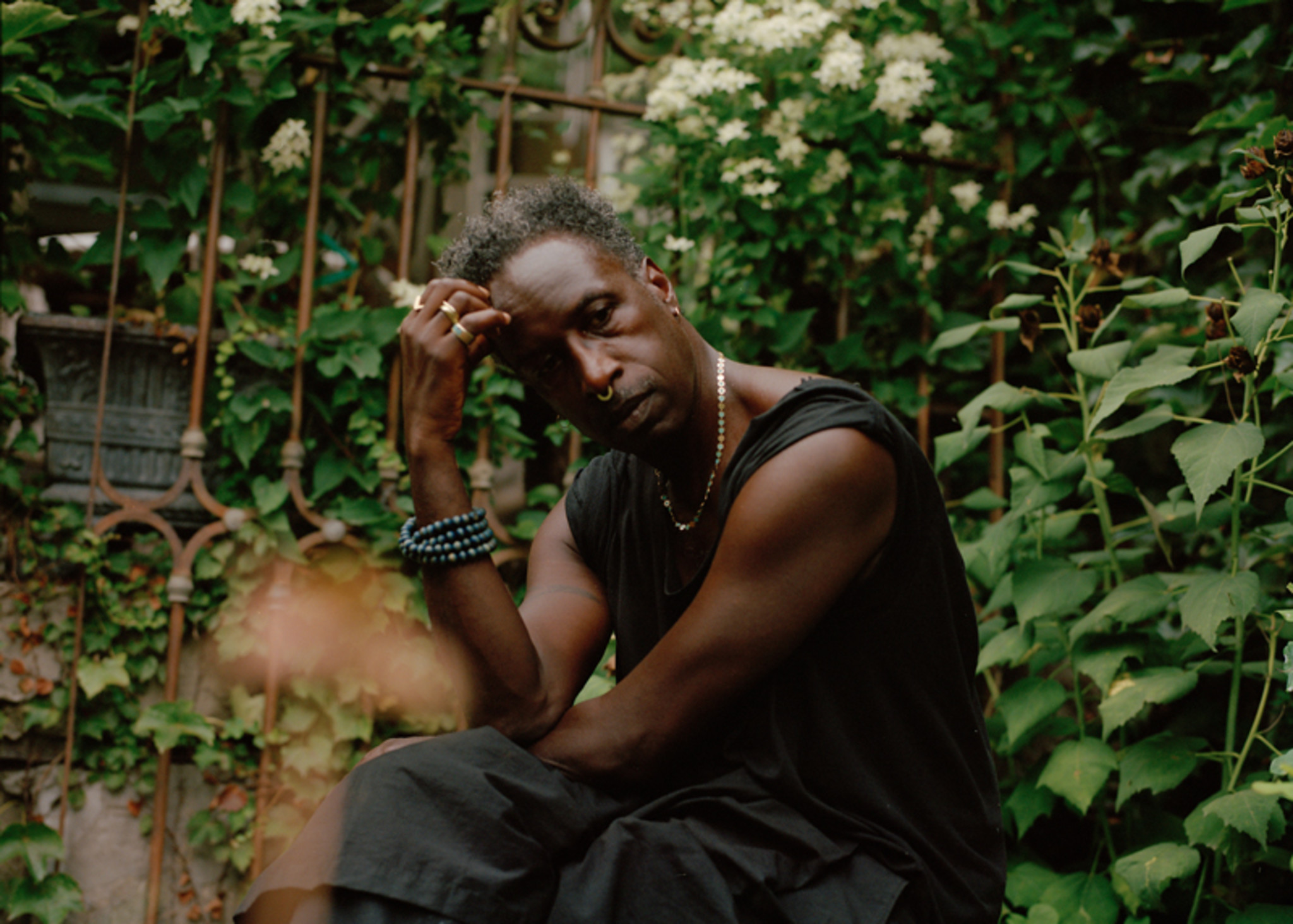
Spiritual Practice
Inside the Brooklyn studio of Nickola Pottinger, who creates haunting sculptures using family documents and heirlooms.
- By: Aaron Edwards
- Photographed by: Andy Jackson

Walking into Nickola Pottinger’s studio in Brooklyn, I’m greeted by sentries. Her sculptures, situated in a few rows on a layer of plastic, look like a chamber choir—stoic and waiting for a conductor to tell them to pop off a diminished seventh. Some are sphinxlike: guardians crafted from earth, paper pulp and polyurethane foam, perched like regal dogs. Others wouldn’t be out of place at a West Indian auntie’s furniture sale in Crown Heights. And look closer: that base is cast from a human foot, the back of that chair is adorned with heads in calm stasis.
Pottinger’s work—a drawing, collage and, most recently, a sculpting practice—is just as visceral as it is spiritual. When COVID lockdown restrictions were lifted, she started spending more time at her parents’ home in Brooklyn, tidying up inside and clearing out detritus from the backyard. The scraps of cardboard and old book reports from her childhood that she found became an inspiration. For years now, she’s used a hand mixer to grind down those family archives into the pulp for her sculptures, which have appeared at Art Basel, the New Museum, Mrs. Gallery and the American Folk Art Museum. Her work is an act of reconstitution, making something new from things that might get thrown away or lost to time.
There’s an if-you-know-you-know wink in her pieces, too. When I look at them, I see the animals and sloping hills of Jamaica, the island that my family and Pottinger’s both call home, and where she was born. Her sculptures conjure the island with mystical reverence. Many have wings. You have to wonder if they’d get up and cross the ocean toward Kingston while no one’s watching.
I spoke with Pottinger ahead of fos born, her solo museum exhibition debut, which opens at the Aldrich Contemporary Art Museum in Connecticut on June 8. She’s a new mother, and a lot of the latest work was developed during and after her pregnancy. We talked as she and her husband, the artist Zahar Vaks, took turns holding their daughter.

Aaron Edwards
Nickola Pottinger
I figured we could start by talking about process. There’s a very particular way you make things. Could you walk me through what that process looks like from conception to what we’re seeing here?
The works themselves are created from collected papers. Archives from my family homes. My parents, my sister included, will have papers that they’ll shred and they’ll say “Hey Nicky, I’ve got a bag of shredded paper for you.” And I’ll come pick it up. I started using paper pulp around 2020. My husband was at home, I was furloughed from work, he was still teaching remotely. And everyone was baking bread. I always wanted to do sculpture, but I was intimidated and didn’t know what material to use. It made sense to start with paper.
After a point in the pandemic, we were seeing our family much more and I had time to clean up the backyard and our building, which is one of the few Caribbean-owned ones on Eastern Parkway between Nostrand and Rogers. And there was a lot of debris and dead trees from the neighboring buildings that had all been renovated and gutted and were expensive. And that’s when I started collecting things from home: book reports, old art ceramic assignments that my sister and I did. From there, I made a recipe and used a cake mixer to pulp the paper. It’s sealing and cementing this feeling of collaboration and legacy. It’s this ritual. Making work with paper pulp has really sealed the deal for me and I feel like I’ve come full circle. When I brought those works to my studio after the pandemic and introduced them to my other works, I sat on the ground with my husband and said “Oh my god, I think there’s a connection.” They’re friends, they’re cousins.
One thing I’m curious about is how you decide which items to use when you’re starting a new sculpture. Does an idea for a sculpture come first or do the materials you collect drive what you’re going to make?
The hand and paper always does. But a big part of it, the first thing, is the molding. So this [she gestures at a piece] is for example a childhood doll that I cast in silicone. I’m also always casting my body. These are all my faces, my hands, my feet. It’s always usually a cast and then it’s built up in a collage way. I’m always using the principles I learned in collage, so there’s a lot of assembling and moving things before I commit to adhere pieces to one another.

Aunty and grandad, 2025. Paper Pulp, Pigments, Tape, Gold Leaf, Fabric. 22 x 17 x 16 inches. Courtesy of the artist and Mrs. © Nickola Pottinger. Photo: Olympia Shannon.

fos born, 2025. Paper Pulp, Polyurethane, Pigments, Moss, Teeth, Dirt, Oil Pastel, Moss. 45 x 50 x 21 inches. Courtesy of the artist and Mrs. © Nickola Pottinger. Photo: Olympia Shannon.

mad to raaatid, 2025. Paper Pulp, Metal, Hair, Aluminum, Dirt, Antelope Horn, Lava Rock, Frankincense, Resin, Teeth. 40 x 30 x 13 inches. Courtesy of the artist and Mrs. © Nickola Pottinger. Photo: Olympia Shannon.

Sunday school, 2025. Metal, Paper Pulp, Protea, Bow. 59 x 20 x 11 inches. Courtesy of the artist and Mrs. © Nickola Pottinger. Photo: Olympia Shannon.
You refer to some of your pieces as “duppies,” or ghosts. When I think about ghosts and Jamaica in particular, I think about how much reverence we have for death. We hold Nine Nights, it’s a really different relationship to what death actually means. How does it feel to be sitting among the ghosts you’ve created?
A lot of the work is made at night and I’ll create these totems on the works that protect them. I’ll also adorn them with protective elements like frankincense, black soap. I’ve had family members tell me about their encounters and things they’ve lived through and lived with. And I’ve had a few memories too. The work has always been ancestral. But there’s a jovial element to it too, like memories of going to Hellshire Beach and seeing loose goats walking around near the shanties. It’s always life experiences that are informing it.
Do you feel protective of the materials themselves that you’re working with? When some folks think of archival materials from family, there’s a preciousness. You don’t want to touch it, you don’t want to do anything with it. Is that different for you?
It feels like magic. I’m always trying to tap into this sense of magic and this spark. They’re spirits. They all embody a spirit. And I really lead by my spirit, too. I’ve been known for—when I was younger—going into the 99-cent store and walking through the aisles and trying to reconceptualize every little thing. Can I take this out of context and transform it into something else? It’s always been a good exercise.

Cry blood, 2025. Paper Pulp, Teeth, Pigments, Oil Pastel. 26 x 37 x 18 inches. Courtesy of the artist and Mrs. © Nickola Pottinger. Photo: Olympia Shannon.

Smaddy (Animal), 2025. Paper Pulp, Pigment, Oil Pastel, Dirt. 25 x 37 x 14 inches. Courtesy of the artist and Mrs. © Nickola Pottinger. Photo: Olympia Shannon.
What’s your relationship to the island these days?
I used to go to Jamaica every summer. As I’ve gotten older I’ve just started to see it in a different light. Just seeing how resort-ravaged it is. Every Black land is always robbed of resources. And you see people go and vacation and they’re going to fancy, nice places. Their beaches are beautiful. But people who live nearby can’t go because the hotels own them. I was always angry about this. So a lot of the work comes from childhood experiences. It’s me. But there’s also commentary about how colonialism still is very present. I feel like the government is so corrupt. Groceries are so expensive. But it’s where I spent a lot of my life. I may have grown up predominantly here in New York and in Brooklyn, but I’m glad that my parents always had me go down for summers for two months, just to stay connected. It’s a really big part of my identity and I’m really proud to be from Jamaica, to have family there. We live in Crown Heights too because of that. There’s just a familiarity that resonates with me as I walk down Nostrand Avenue, the people that I know, my neighbors. I feel safe because of it. But I feel like I always need to go [to Jamaica]. It feeds my soul. It helps my practice. I always come back better and recharged.
People who aren’t from Jamaica I think have these associations with it that are driven by what’s in the news: ecological disasters, resorts, their brushes with the food we make. How do you hold all of that with the work being so rooted in family and the connections you have to the place?
It’s something I’m always thinking about and I’m just selective of what I’m overtly sharing. The conversation is becoming more heavy and the work is just graduating, I think. A lot of it now is childhood and I think it’s going to graduate to teenage revelations and my personal views right now about things. The themes in the work are also very maternal; it’s about a kind of transformation as a woman, as a mother.
[She gestures to a chair sculpture with a cast of her pregnant belly above the chair’s back.]
This one was cast two days before my daughter was born and the whole pregnancy I was like, am I gonna cast my belly? Am I gonna be that person? I was also researching the material like crazy to make sure it was safe, and it was perfectly safe. I enlisted my husband to help me and it’s a very tedious task. You have six minutes of working time from the minute they mix. And the minute the solution started to dry, I started to have contractions. I think she and I are really in tune. I thought that made this more magical to me because it was a signal that she was on her way.


Aaron Edwards is a writer, story editor, and stage director based in the Hudson Valley. His work has appeared at BAM, Lincoln Center, and at the Tribeca Festival.
- By: Aaron Edwards
- Photographed by: Andy Jackson
- Photography Assistant: Sangwoo Suh
- Retouching: Pancake Post
- Date: June 2, 2025