Frank Bowling:
The 87-Year Old
Abstract Icon
The Artist
Still Wants to Make
the Best Paintings Ever
- Text: Kovie Biakolo
- Photography: Courtesy of Frank Bowling and Hauser & Wirth

At 87, Sir Frank Bowling has the same objective he’s always had: to be great. And whatever philosophy a person may hold as to how one becomes an artist, it’s hard not to think of Bowling as having been born to do what he does.
“I want to make the best paintings in the world, ever,” he said, corresponding from his home in London. For Bowling, the pursuit of distinction isn’t mere desire, it’s a discipline that has driven over six decades of work, establishing him as one of the most formidable living artists today.
Over the last few years, Bowling has experienced a new level of late-career recognition, with a retrospective at the Tate in 2019, culminating in being signed by Hauser & Wirth in 2020. The same year, Bowling was knighted by the Queen of England on her birthday. “I am competitive, and think of myself as a trailblazer who has been influenced by all of the places that I have travelled to on my journey as an artist and as a human being,” Bowling adds.
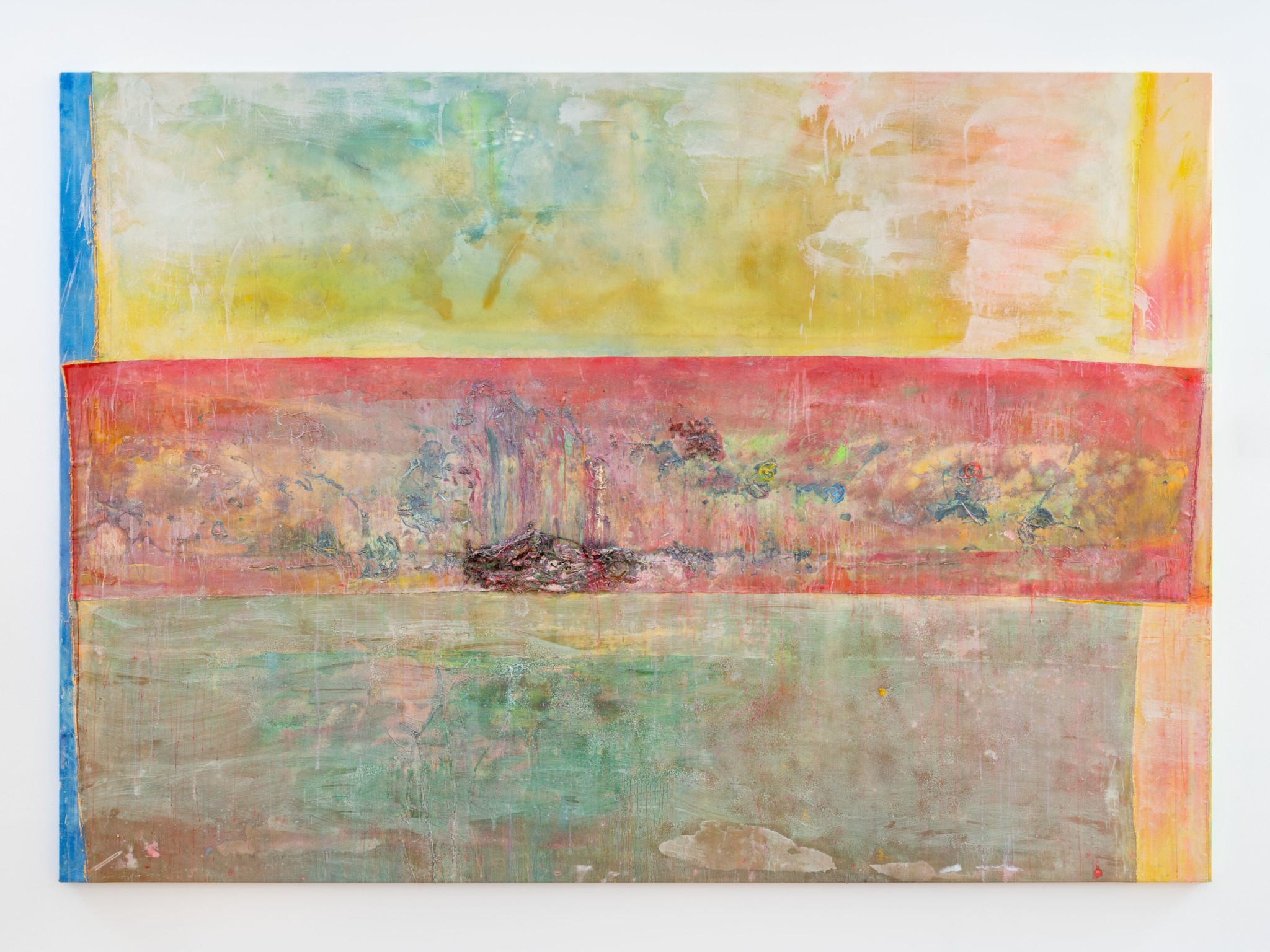
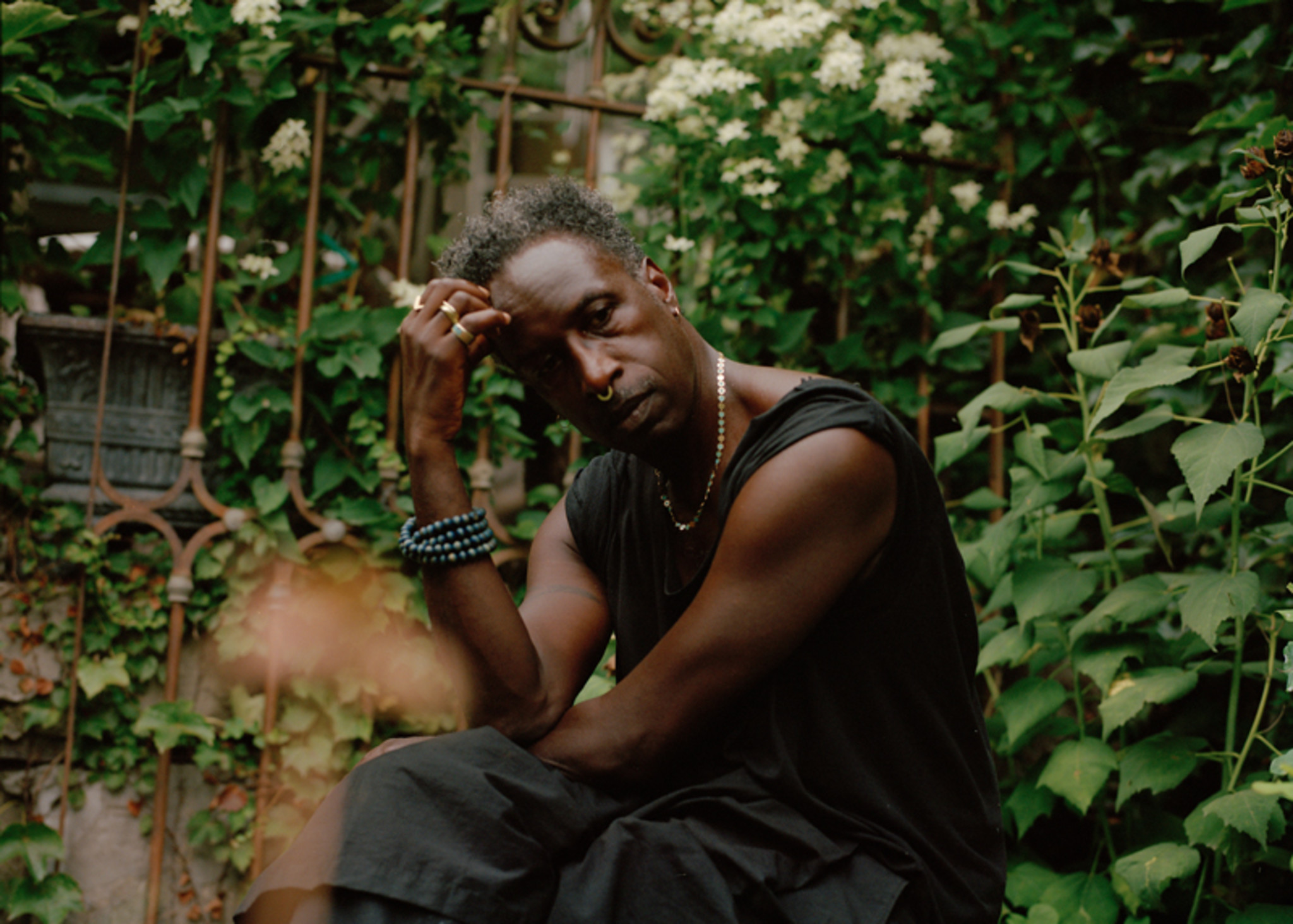
Frank Bowling, Swimmers, 2020. Acrylic, acrylic gel and found objects on collaged canvas, 229.3 x 326.4 x 8 cm / 90 1/4 x 128 1/2 x 3 1/8 in. Top Image: Frank Bowling painting ‘The Pearl Poet’ in London. Courtesy of the artist. Photo: Benjamin Bowling.
In May, Hauser & Wirth opened their inaugural show for the British-Guyanese artist, by way of simultaneous exhibitions in its New York and London locations. It feels symbolic, given that the two cities are largely responsible for Bowling’s artistic formation, with the artist having maintained studios in both places throughout his career, inspired by their art cultures since the 60s, when he first embraced abstractionist expression. The gallery’s exhibit celebrates over half a century of Bowling’s paintings, especially his contributions to Abstract Expressionism and its closely related form, color field painting. Among the works in the exhibition are some of Bowling’s most popular large-scale color field works, including 1971’s Texas Louise and 1984’s Enter the Dragon, the finest examples of the artist’s improvisatory repertoire, showcasing his signature experimentation with scale, luminosity, and materiality. About the exhibit, The Financial Times wrote: “It is a global moment for Bowling as well as for Black art.”
The light is about Guyana. It is a constant in my efforts.
The show included the renowned Polish Rebecca (1971), which famously sold at the New York Armory Show for $275,000 in 2013, giving the artist his first momentous commercial success. The history of the 9-by-11-foot painting is revealing: the story goes that Bowling re-discovered it in a friend’s attic just outside of London in 2012, after forgetting about its existence for over 40 years. Bowling has spent a lifetime finding himself through his work, and revealed in the anecdote, as in his paintings, is a dedication to investigation: of self, other, and of the world. Polish Rebecca, an acrylic work from his “Map Paintings” period (1967 to 1971), contains an outline of South America evinced by green highlights amid the deep purples prominent in the piece. It is a gesture to his Guyanese roots, a biographical fact and source of inspiration he is continually interrogating through his practice.

Frank Bowling, Texas Louise, 1971. Acrylic on canvas, 282 x 665 cm / 111 x 261 3/4 in. Photo: Charlie Littlewood. Courtesy of Hales Gallery.
Bowling’s work consistently contains such inquiries into his own past: “At one time, I thought my eye was influenced by London light. When I went home to Guyana in 1989, I was staggered. When I looked at the landscape there, I understood the light in my pictures in a very different way,” he said. “I saw a crystalline haze, maybe an east wind and water rising up into the sky. It occurred to me for the first time, in my fifties, that the light is about Guyana. It is a constant in my efforts.”
Born in 1934, in the North-central town of Bartica, Guyana, which was still a British colony then, the Bowling family moved to the northeastern port town of New Amsterdam when Frank was just six years old. He migrated to the United Kingdom alone in 1953 at age 19, and back then, Bowling had different ambitions. “I had every intention of becoming a writer. I wanted to write poetry. I felt that poetry was the best way to talk to myself, about myself,” he said.
It was around 1956, when he was still completing his national service at the Royal Air Force (RAF), that Bowling stumbled upon Whitechapel Gallery in London. He recalls that it was by chance—he was there to buy buttons and lace for his mother, who was a seamstress and owned her own shop in New Amsterdam.
“I happened to walk past when the show ‘This is Tomorrow’ was on,” he said. “I guess it was the start of Pop Art, and I’d never seen anything like it before in my life, I had no idea that this stuff could be art.”
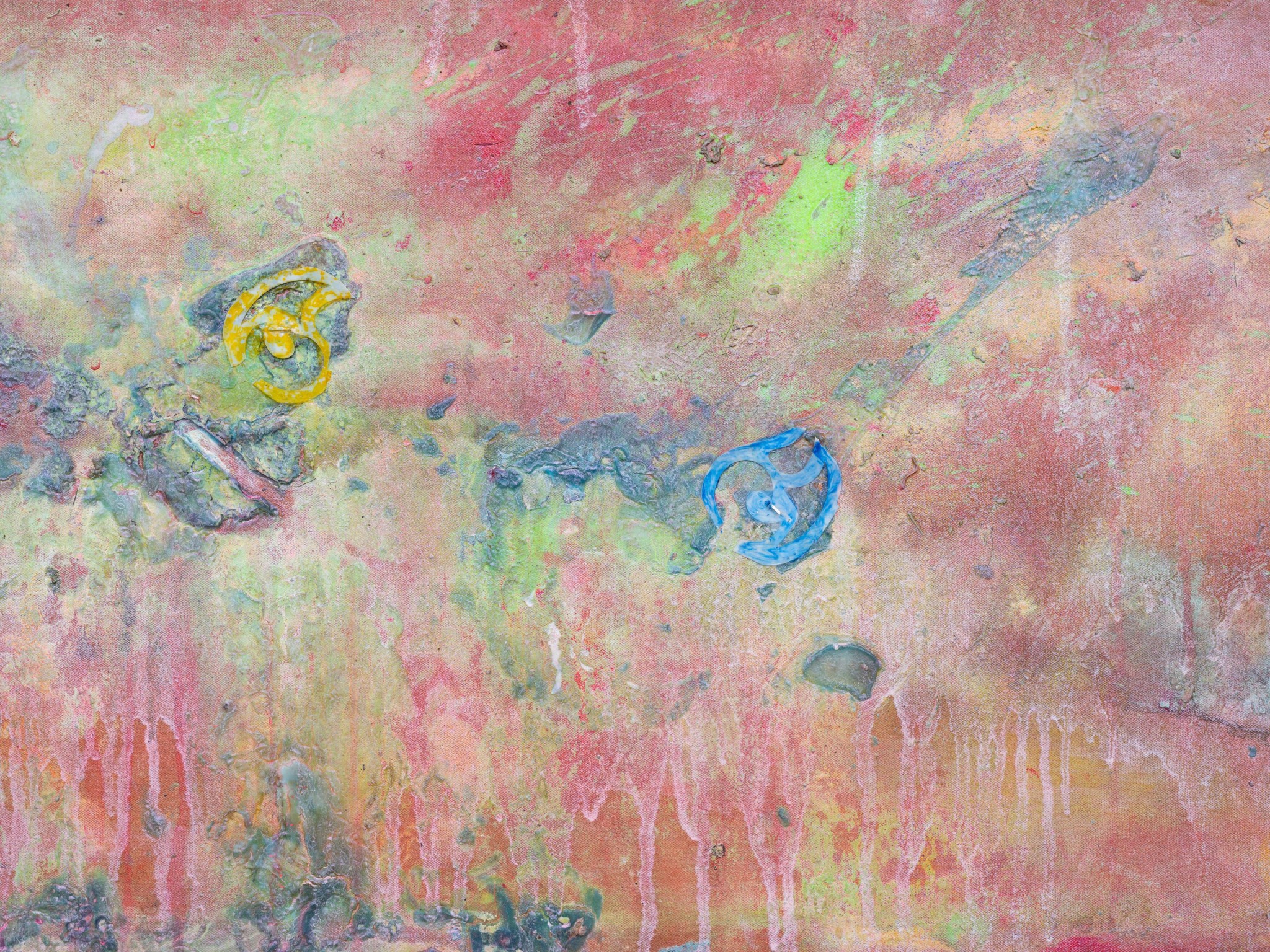
Frank Bowling, Swimmers, 2020. Acrylic, acrylic gel and found objects on collaged canvas, 229.3 x 326.4 x 8 cm / 90 1/4 x 128 1/2 x 3 1/8 in.
The now-iconic “This is Tomorrow” show was the brainchild of architect and art critic Theo Crosby, whose idea to showcase modern ways of living through a multidisciplinary collaborative practice among artists, architects, musicians, and designers was transformed into the groundbreaking 1956 exhibit. Bryan Robertson, considered among Britain’s greatest-ever art curators, facilitated the exhibit, which came to occupy memory in art culture as the precursor to the British Pop Art movement.
Alongside his encounter with the artist and architect, Keith Critchlow, it was this exhibit that lit a spark in Bowling, causing him to make the move from poetry to the visual arts. “I felt, on being introduced to painting particularly, that I was using more of myself. I was using my body to deliver the material onto the surface of the canvas,” Bowling said, candidly. “It seemed to be more all-encompassing than sitting at a desk with a blank piece of paper trying to deliver what you’re feeling and thinking.”
Bowling’s reputation as an avant-garde painter began to take shape early on in his studies at the Royal College, with his now-signature combination of abstraction alongside figurative elements and symbolism. In 1961, Bowling visited New York via a traveling scholarship through the school, and found a freedom in his work that he didn’t know he needed. “In London it seemed that everyone was expecting me to paint some kind of protest art out of postcolonial discussion. For a while, I fell for it,” he said. In this statement is a confession: His desire is to make his work, in spite of what is going on around him. Bowling has always longed to understand himself through his art, even when he might have faltered.

Frank Bowling, Piano to Guyana, 2004. Acrylic, acrylic gel and found objects on canvas with marouflage, 223 x 213 cm / 87 3/4 x 83 7/8 in, 230 x 219.6 x 10.5 cm / 90 1/2 x 86 1/2 x 4 1/8 in (framed). Photo: Thomas Barratt.
In 1966, Bowling officially moved to New York, and his commitment to figurative imagery was discarded, an adherence to modernism was heightened, and his occupation of abstractionism was confirmed, as seen in his “Map Paintings” period. “I suppose I’ve always been inventing, experimenting with ways of expanding on the traditional methods of applying paint—spilling, dripping, staining, pouring—you know, marking, whatever, measuring,” he said, as if all these trials and tests in creating ought to be obvious. “I really wanted to shift the thing around so that I was always ahead of what’s going on. I was always trying to make the work a little more than what was being done by all the others, and I still am.”
During the last year of social isolation, Bowling has continued to work and shift and play in his London studio, where he always feels at home thanks to family who accompany him there. He’d really like to spend more time there, although he says his doctors would prefer otherwise.
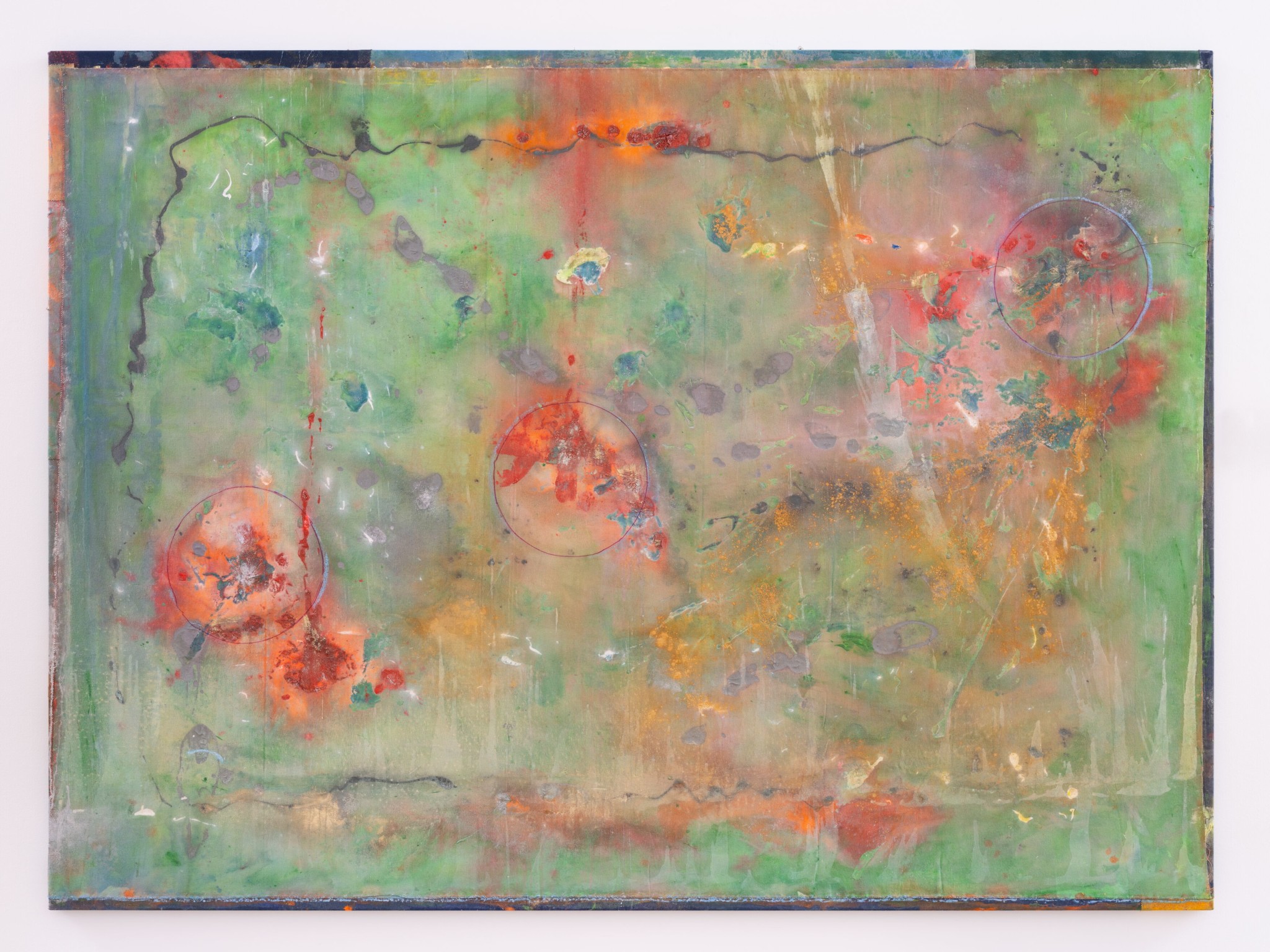
Frank Bowling, Wobbly V with Bunches, 2020. Acrylic and acrylic gel on canvas with marouflage, 188.3 x 255 x 5.5 cm / 74 1/8 x 100 3/8 x 2 1/8 in.
“When the pandemic first hit, they were telling everyone not to travel or go to work unless it was absolutely necessary. Well, for me it was absolutely necessary,” he said. “My doctor tells me that doing two or three hours in the studio at my age is a full day. I could do twice that, of course, because I am that way. I have a good time in my studio, that’s where it’s at, and it’s the only time of the day that I forget about the physical pain that comes with age.”
Few artists have experienced the steep, late-career rise that Bowling has, and given that he’s often been questioned about his varied life and prolific career, I can’t help but ask if there’s anything about him that he’s never told anyone before. His response:
“I had this idea, when I was thirteen or fourteen, that I could be, that I would be a great detective. That was the thing I wanted to be most of all during those early teenage years,” he said.
Bowling may not have become the detective of his teenage 14-year-old imagination, but in a
lifetime of creating, he has mastered the art of self-discovery.
Kovie Biakolo is a writer and multiculturalism scholar focused on culture and identity. She is also currently a Lipman Fellow at Columbia University.
- Text: Kovie Biakolo
- Photography: Courtesy of Frank Bowling and Hauser & Wirth
- Date: August 27th, 2021