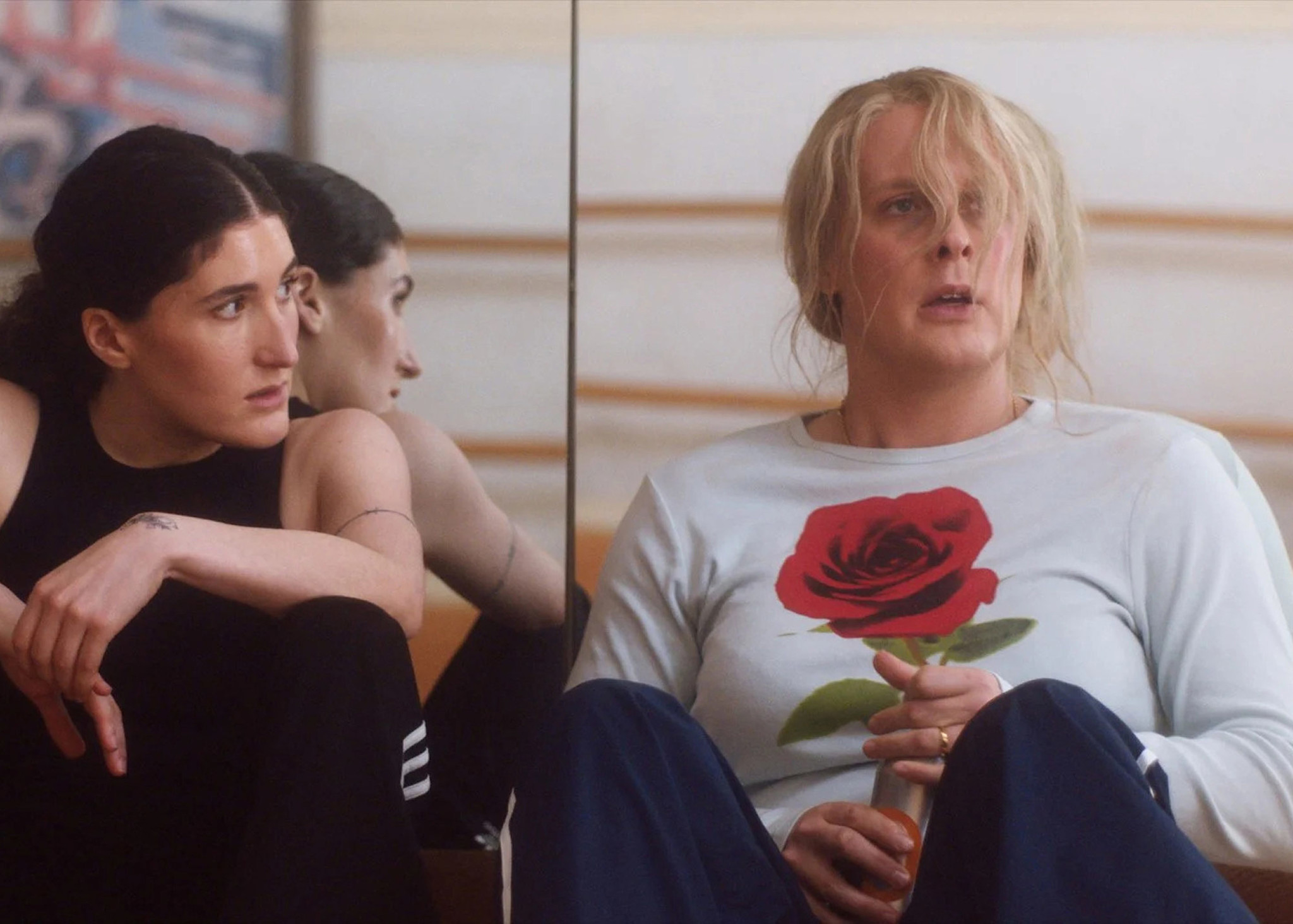
So, Mina Kimes
Walks Into A Bar...
The NFL Sportswriter And Analyst Plays By Her Own Rules
- Text: Emma Carmichael
- Photography: Caroline Tompkins

The first autofill that pops up when one types “Mina Kimes” in a YouTube search bar is “Mina Kimes laugh.” Without giving too much credit to whichever anonymous fan took the trouble to edit “Just five minutes of Mina Kimes laughing” and upload it onto the platform a few years ago, it is true that the ESPN senior writer and NFL analyst has a delightful laugh. When something really tickles her, she surrenders to a high-pitched, staccato exhalation, and briefly loses the ability to talk, which happens to be her full-time job.
“It’s like circular breathing,” Kimes explains to me one early evening in mid-May in Los Angeles, where she lives with her husband and dog, Lenny. “When I laugh, I crack myself up more and more.” It happens frequently enough that the ESPN talk show Highly Questionable once employed a “Mina Laugh Cam” during a broadcast, and Kimes says at least a few fans have made the sound their cell phone ringtone. “I think people just like weird laughs,” Kimes says, shrugging gamely. “Like Kawhi Leonard. People are really into Kawhi’s laugh.”
Because we are dealing with a woman sportswriter here, a corner of the internet celebrating her laughter might scan as troublingly horny. For women who write and talk about sports professionally, as Kimes knows all too well, attention is conditional. If it’s not leering, there’s a good chance it’ll be condescending; if it’s not condescending, it’s probably giving itself a pat on the back for listening at all.
Kimes, 35, is used to this kind of public scrutiny. She spends about five hours a week on television, dispensing complex football analysis and performing sports enthusiasm for hundreds of thousands of ESPN viewers a day. Just under a decade ago, she was an investigative business reporter for Fortune and Bloomberg, with no aspirations for sports journalism or television. In 2014, a personal essay she published about the Seattle Seahawks and her relationship with her father went viral; soon after, ESPN The Magazine hired her as a columnist and reporter, and her career changed course in dramatic fashion. She is now one of the top NFL TV analysts in the country—a gig that has made her famous, she says with characteristic self-disparagement, “in sports bars amongst men between 18 and 49.”
Kimes calls this range of dialogue “takesmanship.” There is the formulation and presentation of the on-air “take,” which can range in tone from “the NFL has a hiring inequity problem” to “the derp face Philip Rivers makes after a turnover dictates the outcome of a game.” But being a woman sports personality also requires navigating the everyday minefield of the internet, and the army of reply-guys who come with it. Kimes does so with unusual agility. She is good at this work in part because she loves sports, purely and without abandon, and often to the point of her delirious laughter on-air. This is not just a contractually obligated show. In late January of 2014, Kimes was, in her words, “fucking wilding” at a bar in Brooklyn, watching her beloved Seahawks play the San Francisco 49ers in the NFC Championship game. Things didn’t start out well: Seattle quarterback Russell Wilson was strip-sacked on the first play of the game, and Kimes took a couple shots to cope. With 30 seconds to play, Seattle led 23-17 when Niners QB Colin Kaepernick dropped back to pass from the Seahawks’ 18-yard line.
The play that followed—now known simply as “The Tip” or the “Immaculate Deflection”—is one of those sports moments for which everyone remembers exactly where they were when it happened. Kaepernick’s pass, intended for wide receiver Michael Crabtree in the right corner of the endzone, was deflected by Seattle cornerback Richard Sherman, who pirouetted into the air and almost blindly swatted the football towards a teammate for a game-ending interception. As the Seahawks stadium erupted, Kimes found herself on top of the bar in Brooklyn, more than a few drinks deep and screaming with joy. She had to be talked down by a bartender. “I like to think sports are fun,” Kimes says. “And I think about how to convey that a lot in my job.”

When Kimes and I talk, we are both freshly vaccinated and emerging into a world in which sports can be enjoyed publicly again. At the end of April, she co-hosted ESPN’s NFL Live at the 2021 draft in Cleveland, and attended her first post-quarantine baseball game a few weeks later. She appears on ESPN’s Highly Questionable and Around The Horn each week, and is gearing up for the NFL season, during which she’ll do color commentary for Los Angeles Rams pre-season games, serve as an analyst on NFL Live, and continue to record her weekly podcast, The Mina Kimes Show Featuring Lenny, Kimes’s 10-year-old rescue dog. “He’s a star,” Kimes says. “He really has the ‘it’ factor.”
Surprised as she seems about her own career path, Kimes is a natural: she is a careful listener and easy conversationalist, and has the kind of hair that looks like it was created in a lab to be seen on television. Off-camera, she defaults to playful and sardonic; she is naturally funny and almost allergic to taking herself seriously. Though she spends all day talking, she says TV work is “fake socializing” and she misses “just shooting the shit,” which we do for as long as is professionally responsible. (Kimes has the occasional charming slip-up on camera; she did use variations on the word “fuck” 29 separate times in our conversation.)
The rest of her telegenicism came easily. “You have to switch on a part of your brain where you’re sort of an extra version of yourself,” Kimes says. “Every emotion you have, you turn it up to 11. That’s something I had to learn how to do...It’s also helpful that there are people doing your hair and makeup and making you into the physically extra version of yourself,” she adds with a laugh.
Her father, who is American, met her Korean mother while stationed in Seoul with the Air Force, and Kimes’s military-brat upbringing gave her an almost placeless accent. (She is occasionally mistaken for Canadian; lately, her obsession with HBO’s Mare Of Easttown has caused her to slip into a Delco accent.) Kimes was born in Nebraska, but lived in five states before attending Yale, from which she graduated summa cum laude and with a degree in English in 2007—right into the recession. As a cub reporter for Fortune, she got thrown head-first into business reporting: She remembers standing outside the Lehman Brothers office on Seventh Avenue on the day of the 2008 crash, waiting to interview distraught investment bankers.
Kimes grew up watching sports with her father; his Seattle roots made her a lifelong Seahawks and Mariners fan. She played soccer through high school, but her fandom took a backseat in her adolescence. For the young women of our generation, being a sports fan meant either having to couch it in the performance of the “cool girl” who could hang with the guys, or being so secure in ourselves that we were OK with it just being a part of our identity—a tall order. “What is the life of a high-school-aged female sports fan?” Kimes says, thinking back on her younger self. “You’re not allowed to have male friends anymore, and then you’re also told things you care about are not really valued or cool, and that all of a sudden you have to care about all this other stuff that you never cared about.”
Perhaps that’s why many women come to sports fandom later in their lives, when they can do so on their own terms. This was true for Kimes, who unearthed her dormant fandom in her twenties. In 2011, she started watching Seahawks games with friends at a bar in Greenpoint, Brooklyn, and found a mélange of fellow obsessives on Twitter, ranging from the sportswriter Danny Kelly to a widowed superfan in her 60s. She started posting on forums—“which hopefully no one ever finds,” she says with a devilish grin— and reading game analysis and watching tape.

It was an especially fun time to be a Seahawks fan. College coaching great Pete Carroll was named head coach in 2010, and the team’s “Legion of Boom” defense helped quarterback Wilson lead Seattle to two straight Super Bowl appearances, in 2013 and 2014. (They won it all in the 2013 season; Kimes commemorated it with a “XLVIII” tattoo on her right inner bicep.) Kimes’s investigative background made her a precocious student of the game. “I devoured it all,” Kimes says, “and if I didn’t understand something, I asked questions until I did.”
American football can seem like a brutish, straightforward game to the casual viewer—a player catches the ball and takes it to the end zone while trying to not suffer a debilitating head injury, repeat—but it is arguably the most strategically complex of all team sports. With almost a decade of experience behind her, Kimes has become a seasoned expert on the league, respected for her insights on statistics and game strategy. Her knack for memorization and trivia—she regularly completes the New York Times Saturday crossword puzzle in under ten minutes, and helped her friend David Chang win Who Wants To Be A Millionaire last year as his phone-a-friend call—made her a natural fit for the cramming required of analyst work. (It’s an old skill: at Yale, she says, her study guides were renowned enough that “members of the crew team were desperate to cheat off or borrow them.”)
Kimes came into her sportswriting career as an “intense fan” of football, but it shifted into a more analytical interest as she started to appear on podcasts and ESPN radio programs. She says she felt like she started to see the game differently around 2012, when quarterbacks like Wilson, Kaepernick, and Robert Griffin III were leading option offenses.
“I always loved the idea of a quarterback who’s a threat to take off and run,” Kimes says. She lights up as she begins to break down one of her early revelations: “I was watching games and noticing the ways in which optionality changed the math for offenses, and how it made life really difficult for defenses. You could see linebackers being like, ‘Oh, fuck,’ when Kaepernick turned the corner and kept it. It slowed [the game] down for me, because it was a basic concept—just math and confusion, and misdirection. Once you understand what an option is, you understand something about the game.”
She’s also set herself apart by regularly pushing back against the kinds of tidy sports narratives her employer is known for packaging. During the 2018 NBA season, when Minnesota Timberwolves broadcaster Jim Petersen attempted to position a 50-point game by Derrick Rose as redemption after he was found not liable in a gang rape case, Kimes tweeted, “You don’t have to talk about this stuff if you aren’t equipped to do it. And it certainly shouldn’t figure into any comeback narrative.”
This instinct has made her uniquely primed for the transitional phase the NFL (and professional sports leagues generally) now finds itself in. By 2017, the league had effectively blackballed Kaepernick, whose kneeling protest against police brutality made him a free agent only a few years after he’d led the 49ers to the Super Bowl. Then last summer, after the murder of George Floyd spurred protests around the world, the NFL snapped to belated attention by adding the phrases “end racism” and “it takes all of us” to team endzone stenciling, among a handful of other timid “social justice initiatives.”
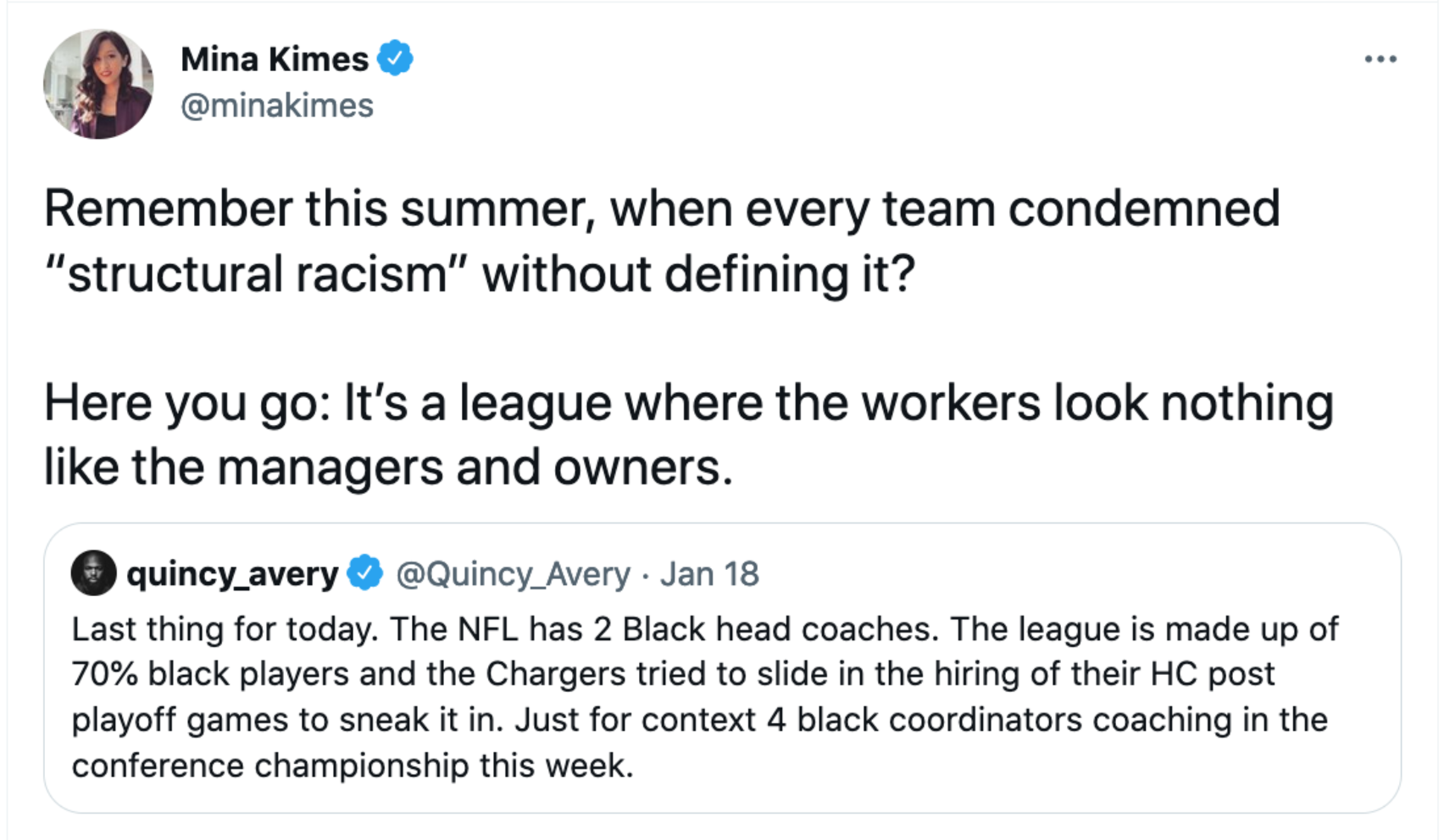
Kimes has always been critical of the league she covers—a tendency likely reinforced by her outsider background—and she spent the summer working alongside Black colleagues like Spears and Clark, covering a league that was struggling to catch up with the political and cultural moment. She has been especially vocal about the NFL’s hiring inequity: The league’s players are about 70 percent Black, but it employs just three Black head coaches. “Remember this summer, when every team condemned ‘structural racism’ without defining it?” Kimes tweeted in January. “Here you go: It’s a league where the workers look nothing like the managers and owners.”
On March 17, the day after six Asian women and two others were targeted and killed in the Atlanta spa shootings, Kimes had her usual spot on Around the Horn. “I was in a really bad place,” she remembers. “I didn’t want to work.” Spears called her in the morning to see if he could support her in any way. “Our relationship is about having fun,” Kimes says, “but it’s also about having those kinds of conversations.” At the close of the show, she spoke briefly and affectingly about the attack. “Your words matter,” Kimes said. “Your acknowledgment that this is happening matters. Your support for the Asian community—my community—it matters a great deal, especially at a time like this.”
The week we spoke, she had participated in panels for both the Council of Korean Americans and an espnW summit. She keeps a South Korean flag behind her in her at-home studio, and says that since the Atlanta shootings and the spate of hate crimes that followed, she has seen a notable uptick in racist abuse in her mentions. “Now it’s just 90 percent misogyny,” she says with the fatigued smile of a woman who’s grown accustomed to casually shrugging off abuse. “It used to be 99 percent. Now 10 percent [is] racism.”
Kimes has more than half a million followers on Twitter, and says she has blocked and muted thousands of abusive or otherwise unpleasant accounts over the years. “Nobody thought of me as a NFL analyst for a long time,” she says. “When I first got into talking about football, [women’s stuff] was all I was asked to do on television. I’d have to be like, actually, I really have a lot of opinions about the Ravens’ offense.” She’s learned to shut things out: “I need to be very deliberate about what I look at, what I allow to enter my brain.”
Early on, “it used to drive me crazy. I would do shows and I would be on with these former athletes who would get so much stuff wrong and nobody would care. I would get one tiny thing wrong and get destroyed.” Now, she says with a laugh, “people are so used to seeing me. That’s what equality is: fucking up equally.” She is still learning the intricacies of the game, though, and thinks she will probably never feel finished with that work. “I get really nervous about screwing up,” Kimes admits. “Some of that’s probably the whole burden of representation thing, but some of it is just my personality. I’d probably be nervous about screwing up if I was a nuclear scientist, and the stakes would be a lot higher.”
She plans to spend the summer and the pre-season studying, watching game tape with colleagues and asking them to break down blocking schemes. “That’s something I would have been too insecure to do earlier in my career, because I wouldn't want people to know that I didn’t understand things,” Kimes says. “But you can’t learn unless you ask. It’s amazing how much you get used to giving your opinions loudly and in front of hundreds of thousands of people.”
Emma Carmichael is a writer living in Los Angeles.
- Text: Emma Carmichael
- Date: June 30th, 2021
- Photography: Caroline Tompkins