Why Do All These Fashion Brands Suddenly Care About Furniture?
Emilia Petrarca reports from Milan’s Salone Del Mobile, a design fair where the toilets and spritzes were on display.
- Text: Emilia Petrarca
Since I started covering Milan Fashion Week in 2018, the party line among editors and publicists has always been: You think this is fun? Come to Salone.
Salone del Mobile, also known as Milan Design Week, is an annual trade fair that takes place every spring. Founded in 1961 with a focus on Italian furniture, it is now an umbrella term and anchor for an overwhelming number of smaller separate exhibitions, swanky parties, and satellite fairs hosted by brands, showrooms, stores, etc., throughout the week. Multiple writers and editors who attend regularly told me they’ve never even stepped foot inside the Salone pavilion, the fair’s central hub. “I don’t even know where it is,” said one. (Turns out it’s about 25 minutes outside of the city.)

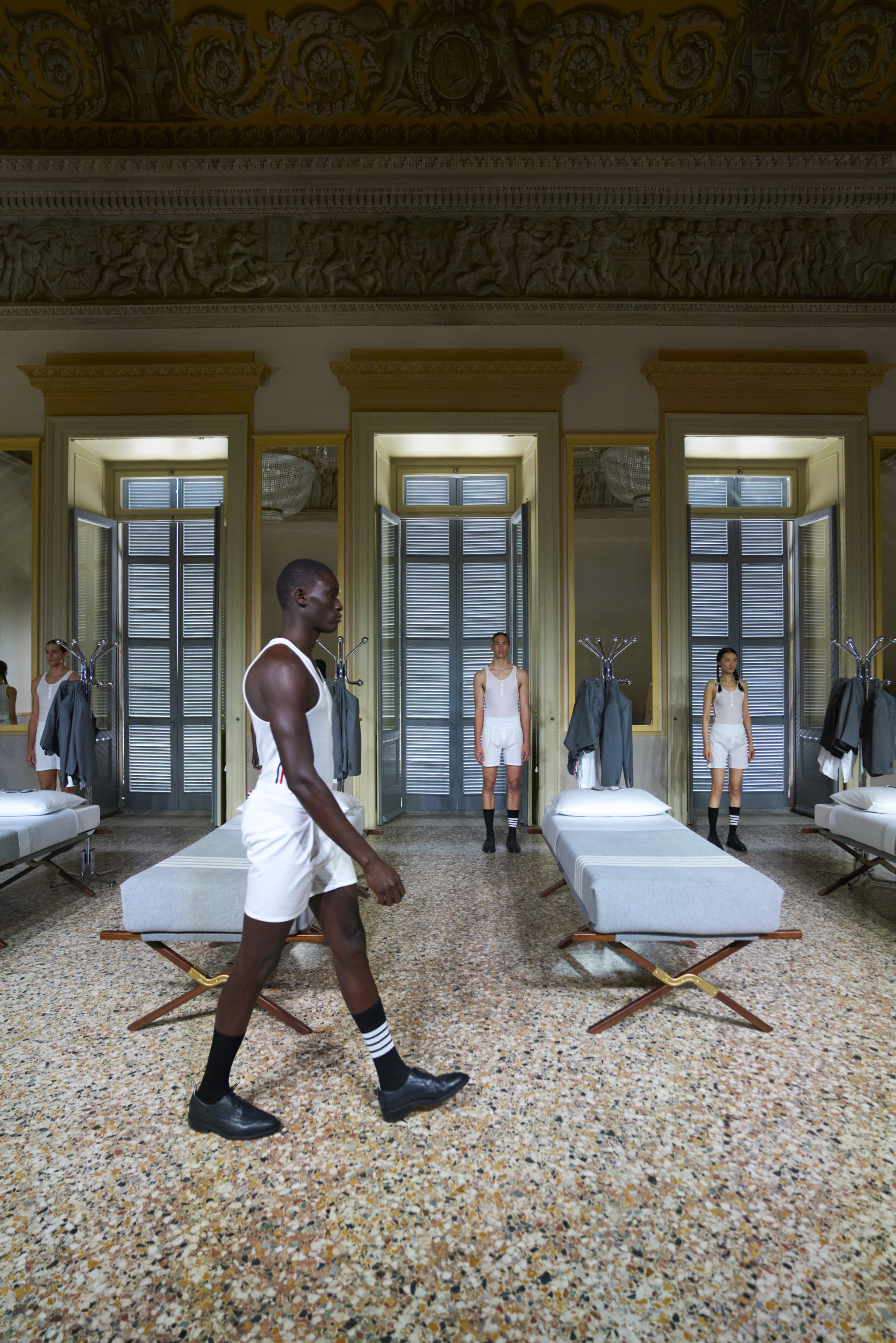
Loro Piana Interiors. Image courtesy of Loro Piana. Top Image: Thom Browne’s collaboration with Frette. Image courtesy of Thom Browne.
With hundreds of thousands of visitors attending each year, Salone has attracted the attention of luxury fashion brands and the fashion press. For Italian names like Bottega Veneta, Gucci, Prada, Versace, Fendi, Dolce & Gabbana, Loro Piana, and others, the week serves as an opportunity to engage a captive audience and showcase their home lines, however small. (My last meal on earth will be served on a porcelain Prada plate, so help me.) Now, others want in. This year, Hermès, LOEWE, Saint Laurent, Balenciaga, RIMOWA, Moncler, Stone Island, Off-White, Acne, Ralph Lauren, MCM, Diesel, and Thom Browne all hosted some form of design-focused event. Emily Weiss, the founder of Glossier, was also in town.
To put it in perspective, LOEWE creative director Jonathan Anderson told me he had to miss the Los Angeles premiere of Challengers to be at Salone for the brand’s exhibition and cocktail party. So I felt like I was in the right place. The question was: Would I see any furniture on my trip? Or just spend the week schmoozing over spritzes?

Balenciaga and Andew J. Greene's Art in Stores. Image courtesy of Balenciaga.

A Tacchini couch by Mario Bellini in Gucci’s Ancora burgundy. Image courtesy of Gucci.
As with fashion week, the party began in the Delta lounge at New York’s JFK Airport, where a number of familiar faces chugged glasses of wine before boarding the overnight flight to Milan. The unspoken industry code remained the same: What happens on the plane, stays on the plane. (I.e., if you see me drooling with my mouth open, no you didn’t.)
When I arrived in Milan on Sunday, my first stop was the Bottega Veneta preview, where the brand showed a limited-edition run of wooden and Intrecciato stools made in collaboration with Cassina and Fondation Le Corbusier—the same ones guests sat on during the most recent runway show.

Bottega Veneta’s collaboration with Cassina and Fondation Le Corbusier. Image courtesy of Bottega Veneta.
“Just so you know, people don’t really dress up for Salone,” said one regular in colorful cutout pants shortly after I walked in. I appreciated the well-intentioned tip, but suddenly felt self-conscious. I also didn’t know what they were talking about: Everyone was in a look. “Well, you just don’t want to look like you’re trying too hard,” they clarified. (Again, dig?) It became clear that the art world and the fashion world have very different thresholds for “trying too hard.” To fit in, I needed to be wearing something like Pleats Please and carrying a status tote from a niche gallery or exclusive event, not anything with a designer logo on it. Noted.Next, I walked a few blocks over to Gucci’s cocktail party at its flagship store to celebrate the release of a handful of collaborative design pieces, including a curvy, shiny, sexy leather Tacchini sofa by Mario Bellini in Sabato De Sarno’s new signature Ancora burgundy. I could hardly find the entrance, though, because the space was overflowing with people—more than I recall seeing at any fashion event there. As I squeezed through the crowd, one security guard put their head in their hands and literally said, “Mamma mia”—at which point, I decided to bail and come back another day.

Anthea Hamilton for LOEWE. Image courtesy of LOEWE.

Nicholas Byrne for LOEWE. Image courtesy of LOEWE.
Other than the dress code, one of the main differences between fashion week and Salone is the slightly more democratic, fluid nature of the latter. There are no front row seats to fight over. In fact, after press previews, many brands open their exhibitions up to the public. Last year, 11,000 people reportedly signed up to see Bottega Veneta’s Gaetano Pesce installation at its Milan flagship. This year, lines wrapped around the block at the Gucci store and at LOEWE’s exhibition of 24 collaborative lamps, which were artful and delightfully strange and, according to the red stickers present at the opening event, mostly sold out. You could even register to visit Loro Piana’s headquarters to see the brand’s homage to the Italian architect and furniture designer Cini Boeri. If you wanted to actually buy a leather chandelier or a cashmere-covered couch, though, that’s when things get decidedly undemocratic.
Bar Basso, a charming old cocktail bar famous for its oversized aperitivos, serves as the unofficial hub of Salone, drawing crowds that spill out into the street until the wee hours of the night. “You can not get invited to anything and still have the best week,” said one design world fixture at a 10:30 PM dinner on my first day, at the end of which my Negroni count was significantly higher than my furniture one. That said, I’m pretty sure the person having the best week was the interior designer I met shopping for a wealthy Palo Alto client who “buys everything.”

A FontanaArte lamp by Gae Aulenti and Piero Castiglioni in collaboration with Gucci.

My plastic "I <3 Milano" bag that I got for 5 euros at a souvenir shop a few years ago was a big hit at Bar Basso.

Spritz numero uno.

The pool at the T Magazine party.

On my last day, I saw some furniture at Alcova, a satellite fair outside of Milan.

10:30 p.m. dinner at Giacomo Bistrot. Didn't leave until 1 a.m. Images courtesy of Emilia Petrarca.
My second day began at Prada Frames, the brand’s third-annual symposium of heady talks and lectures led by various scholars and experts on the subject of “the complex relationship between the natural environment and design,” according to a release. Hosted at the Bagatti Valsecchi Museum, which was home to a rich and powerful Milanese family until 1974, the fully booked session I attended took place in a grand marble bathroom—likely one of the first in Milan to feature indoor plumbing, including a shower and large enough to fit about 20 people inside. After a long night at Bar Basso, I was admittedly not prepared to hear architect and researcher Marina Otero Verzier use the word “poop” in complete seriousness at a Prada event, and had to bite my tongue. Afterward, any time I saw a sign for a toilet I wondered if it was an exhibit or an actual bathroom.
That night, I went to T magazine’s annual bash at Villa Necchi Campiglio, one of the most stunning properties you can visit in the city—so stunning, Luca Guadagnino set I Am Love there—and therefore the site of the week’s most anticipated party. Apparently, it’s gotten too rowdy in the past (it is a museum, after all), forcing the magazine, which was celebrating its twentieth anniversary this year, to be more stringent about its guest list. That didn’t stop guests from taking selfies in the famous marble bathroom, however (“please, no” begged a guard), and one person from allegedly taking off their clothes and jumping in the pool at the end of the night. I didn’t stick around long enough to see them do it myself, but it perhaps says something about the caliber of Salone parties that no one was talking about the stunt the next day.
On my third day, I was happy to see a familiar face from New York Fashion Week: For the first time, Thom Browne joined the Salone ranks to launch his latest collaboration with the Italian linen brand Frette on sheets, towels, bath robes, and more. During his presentation at Palazzina Appiani, models napped for an extended period of time on luxuriously made gray beds with branded eye masks. “Same,” whispered one weary editor.

Natalia Grabowska at Prada Frames. Photo by Lorenzo Palizzolo/Getty Images for Prada.
Compared to Browne’s usual shows, it was a much smaller, simpler, and quite literally sleepier production, but the effort was appreciated by the crowd nonetheless. “Fantastic!” said one enthusiastic Italian hotelier on his way out. If fashion brands are going to continue to participate in Salone, which I have a feeling they are, they should aim to give visitors something more than a stainless steel shrimp cocktail on a revolving pedestal. (Looking at you, Balenciaga.) Of course, manufacturing a leather couch is a lot harder and more expensive than making a leather handbag, but the best exhibitions of the week were the ones that leveraged the fashion industry’s massive platform and love of a spectacle to bring new and unexpected perspectives to the fair.
By the end of the week, the question on everyone’s mind was not whether to buy a 12,500-euro Bottega Veneta stool but: Are you going to the Rick Owens rave in Venice? The start of the Biennale di Venezia prompted many Salone visitors to cut their trips short and head out early, but I felt like I’d gotten my fill. On my fourth and final day, my interactions resembled that of a damaged movie character, wandering and blurting out things like, “I love lamp. I love lamp? I love lamp!”
- Text: Emilia Petrarca
- Date: April 25, 2024