Kelly Reichardt Reimagines the Art of the Heist
The indie director on the making of her latest film ‘The Mastermind.’
- Written by: Eliza Brooke

Kelly Reichardt tends to dedicate herself to one movie at a time, but she’s always got something simmering on the stove. “When a project ends, I want to fill the void with something that I can wake up and work on, besides doing press for the film I just made,” she told me over Zoom in September. A week before the 2022 Cannes Film Festival premiere of Reichardt’s movie Showing Up, the acclaimed indie filmmaker found herself in Antibes, France, casting about for a new idea to occupy her mind. That’s when she came across a news story about a group of young men who stole two Gauguin paintings, a Rembrandt, and a Picasso from the Worcester Art Museum in Massachusetts on a May afternoon in 1972.

Courtesy of Anthony Gasparro.
Three years later, Reichardt is releasing The Mastermind, a 1970-set film about an unemployed Massachusetts carpenter, James Mooney (Josh O’Connor), who puts his art school education to work by orchestrating a robbery at the fictional Framingham Museum of Art. Reichardt first saw O’Connor in 2017’s God’s Own Country and appreciated the diversity of the actor’s onscreen performances, as well as his sense of humor and “classic, timeless mug.” When Reichardt was beginning work on The Mastermind, she said, “People were like, ‘Josh who?’” After a run of buzzy films including Luca Guadagnino’s sexy-sweaty Challengers, things changed: “By the time I was done editing, everyone was like, ‘How did you get Josh O’Connor?’
”Mooney figures that his art heist will take eight minutes from entrance to getaway — about as long as it took thieves to steal a collection of royal jewelry from the Louvre in October. But The Mastermind is not about the mechanics of a high-stakes operation of international interest, nor is it a slick, adrenaline-filled romp in the model of Ocean’s Eleven. The heist takes place in the movie’s first act, leaving Reichardt space to do what she does best: Craft a character study steeped in the practicalities and quiet challenges of daily life. “It’s more of an undoing film than a heist film,” she said.
Reichardt didn’t want to say much more about her intentions for The Mastermind. In general, she doesn’t like explaining her movies, which makes interviewing the director rather challenging. She declined to answer questions about Mooney’s motivations and seemed baffled by my interest in comparing him to characters in her previous films. “I just want it to go out and live as its own thing,” Reichardt said of the film. If it was up to her, there would be no trailer, no advertising at all. You’d go to the movie theater, buy a ticket to the new Kelly Reichardt picture, and let yourself be surprised by the story as it unfolds.

This anti-promotional ethos is compelling — especially when contrasted against other movies’ naked bids for viral press tour moments — and it speaks to Reichardt’s evident preference for executing her artistic vision over chasing commercial success. She wasn’t unkind while parrying my questions, knowing that I had a job to do, but she was decidedly not playing the press game. “Mooney is, by design, a bit of a blank slate for people to project onto,” she said. “A lot of the whys are for you to bring as a viewer.”
The why that haunts me, personally, has to do with Mooney’s decision to plan a heist in the first place. Reichardt films like Meek’s Cutoff (a Western set on the Oregon Trail) and Wendy and Lucy (an intimate portrait of a woman in search of a job and her lost dog) feature characters who are focused on survival in the most fundamental terms — people for whom a few ounces of water or an extra dollar are a very big deal. Mooney, whose father is an influential circuit county judge, is not in obvious financial straits. He’s not making stellar decisions, but he doesn’t seem like a rash or volatile guy. Is he simply looking to spice up his flat suburban existence as a husband and father of two? Has he lost faith in his prospects as a carpenter? Is he trying to prove himself as a provider for his family? And when things begin to unravel, does he still feel that the heist was, in some way, worth it?
Reichardt’s not saying; you’ll have to scrutinize O’Connor’s classic, contemplative, weary mug for answers.

Courtesy of Anthony Gasparro.
The magic of The Mastermind, and of many Kelly Reichardt movies, lies in the director’s ability to make absorbing cinema out of someone hauling a box of stolen paintings into a barn loft, fixing a broken wagon wheel, building a clay sculpture, or feeding horses in a paddock. “Whether it’s Michelle [Williams], Josh [O’Connor], Zoe [Kazan], Paul Dano, or whoever, it’s giving people something to do — physically, something to do — and giving them time and space to do it,” said Reichardt. She doesn’t rehearse, and she wants props to feel as real as possible: On 2013’s Night Moves, Reichardt recalls Jesse Eisenberg growing exhausted and irritated while moving sandbags that really were filled with sand. “I want [the actors] to feel the weight of things, feel the awkwardness of things, figure it out, use their bodies,” she said. “Then they’re not acting — they’re just humans doing stuff.”
Production designer Anthony Gasparro, who has worked with Reichardt since Certain Women in 2016, told me that he and the director are aligned in their pursuit of realism. “I generally do not like things to look over-designed. If anything, [they’re] barely designed. I shy away from things that are too obviously of a time period,” said Gasparro. To get a feeling for suburban life in the early 1970s, he worked with a UK-based researcher who has “an endless inventory of incredible imagery,” immersed himself in Stephen Shore’s photographs of motel rooms and dingy, everyday spaces, and leafed through personal scrapbooks, pocketing details like the color of a carpet or the old paper turkey hanging on the wall of someone’s home. Gasparro found that while clashing shades of orange, green, and purple would become more common later in the ’70s, muted autumnal colors were more period-appropriate for this film.

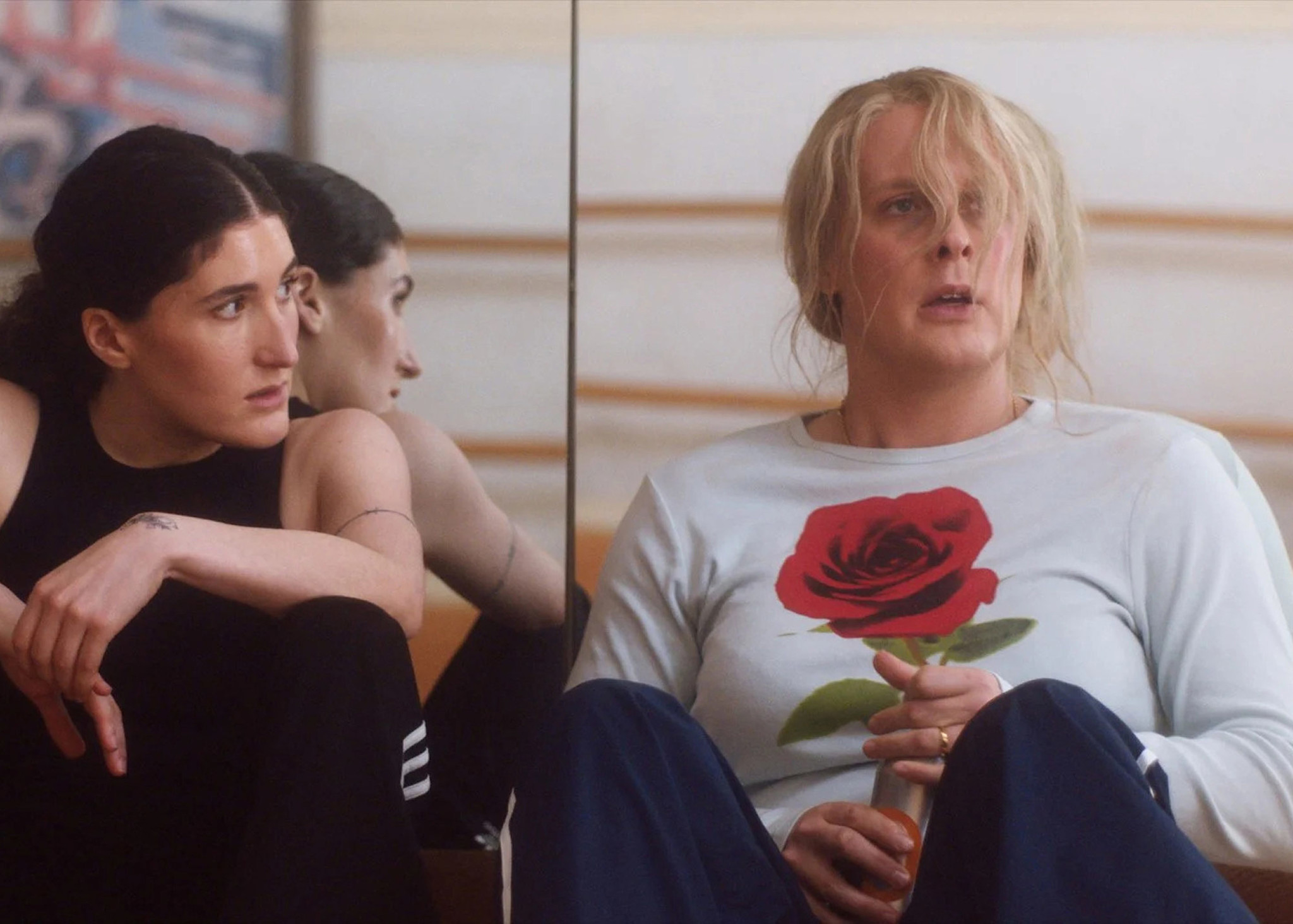
With the exception of the Framingham Museum of Art — the exterior of which is an I.M. Pei-designed library in Columbus, Indiana, a haven of Modernist architecture that provides the backdrop for Kogonada’s 2017 film Columbus — the landscape of The Mastermind is exquisitely dull. “I have a love for the mundane,” said Gasparro, whose team outfitted Mooney’s world with backyard clothes lines, rinky-dink ballet studios, and sleepy bus stations. Reichardt’s team scouted roughly 80 real-life houses around Cincinnati, Ohio, where most of the movie was shot, before finding the modest home that would become the Mooney residence. “Somebody came up to me after the premiere, and said it was the perfect ‘sad house,’” said Gasparro, sounding pleased.
Even Mooney’s criminal aspirations seem pretty small-time. Unlike the real-life robbers who swung for Picasso, Rembrandt, and Gauguin, he targets several paintings by Arthur Dove, who died in 1946 and is considered the first American abstract painter. “I didn’t want them to be well-known masterpieces. I didn’t want the stakes to be that high,” said Reichardt, who is herself a fan of Dove’s paintings. “His work was not in demand in 1970, at all. I liked the idea of Mooney going into a place and taking an Arthur Dove and running by a Turner painting.”
Perversely, the lower the stakes of Mooney’s heist, the more interesting the character becomes — the more you gnaw at the question of why he risks blowing up his life in this way. After my conversation with Reichardt, I decided to watch the film for a third time. It was during this viewing that I started to wonder if, perhaps, a key to Mooney’s motivations lies in the film’s jazz score, composed by Rob Mazurek and rooted in the Marfa-based musician’s recordings with the Chicago Underground.

The film opens on a shot of O’Connor in the Framingham Museum of Art, his brow furrowed; a low, dangerous piano note plays, followed by a rattling drum. Reichardt doesn’t often use music in her films, but Mazurek’s abstracted instrumentals materialize throughout, adding a shot of excitement, chaos, and intrigue to Mooney’s otherwise bland existence. Mazurek told me that he approached the music like it was a supporting character, and if that’s the case, it strikes me as another version of Mooney: the cool, controlled mastermind he desperately wishes he was. In that light, I have a lot more empathy for the guy and his ill-fated decisions. He’s a blank slate, though. Your projections may vary.
Eliza Brooke is a freelance journalist based in Washington, D.C. She is the author of The Scumbler, a weekly culture newsletter.
- Written by: Eliza Brooke
- Date: October 25, 2025
- Images/Photos Courtesy Of: Cinetic Media