Folk Tattoos for Modern Living
Llewellyn Mejia, aka Mr. Blue, has become one of the most sought-after tattoo artists out there, and for good reason: each of his creations are like little talismans—strange, sacred, and entirely contemporary.
- Written and Photographed by: Shona Sanzgiri

A mummified mountain goat’s head stares just past me as I take a seat in the Highland Park studio of tattoo artist and antiques dealer Llewellyn Mejia and flip through his Old Testament–length book of flash. I’m having a harder time than usual choosing from the dense grids of folk art that have come to define his work: suns with faces, coiled snakes, saints in various states of martyrdom, all rendered in the deceptively simple style that has made him one of the most imitated tattooers in Los Angeles, if not the country.

If there’s one thing that unifies his client list—judging by both those who step into his studio and his 113,000 followers on Instagram, where he goes by Mr. Blue—it’s an instinct for what’s next. Fashion micro-influencers, food writers, professional skateboarders, Pierce Abernathy. People with taste, but more importantly, good timing.
That same vernacular from his flash spills out into the studio itself: devotional trinkets and memento mori, carved wooden figures and weathered stone heads, a ceramic cat perched on a shelf, decorative green gourds, a life-size family constructed entirely from woven basketry, their hollow eyes watching from a corner. It’s a curatorial eye that balances the sacred with the very strange, with each object carrying the weight of patina, age, history—intentional but not precious, layered but not cluttered. I alternately feel like I’m in a graveyard, a shrine, or a wing of New Mexico’s International Museum of Folk Art.
Today, he’s working with a new client, a cinematographer. They’ve studied his flash on Instagram and have an idea for what they want, but there’s still hesitation. After exchanging pleasantries, they settle in, flipping through the flash book, faced with one too many good options.
“First tattoos?” I ask.
“Some of the first. I’ve always wanted more, but wasn’t sure what to get.”
Mejia gets to work, and the needle begins its low hum. They talk about films, exes, L.A., travel, falling into the familiar patter of old friends though they just met fifteen minutes ago. There’s a feeling of calm here that stands in sharp contrast with the typically aggro tattoo parlor aesthetic—the bright lights, the metal, the walls papered with flash. Mejia’s space is more like a curiosity shop. Incense burns somewhere. The music shifts from West African desert blues to Cuban bolero to ambient country. The environment is worldly and expansive, but rooted to this place. Mejia keeps it from feeling precious, swearing liberally, laughing often.


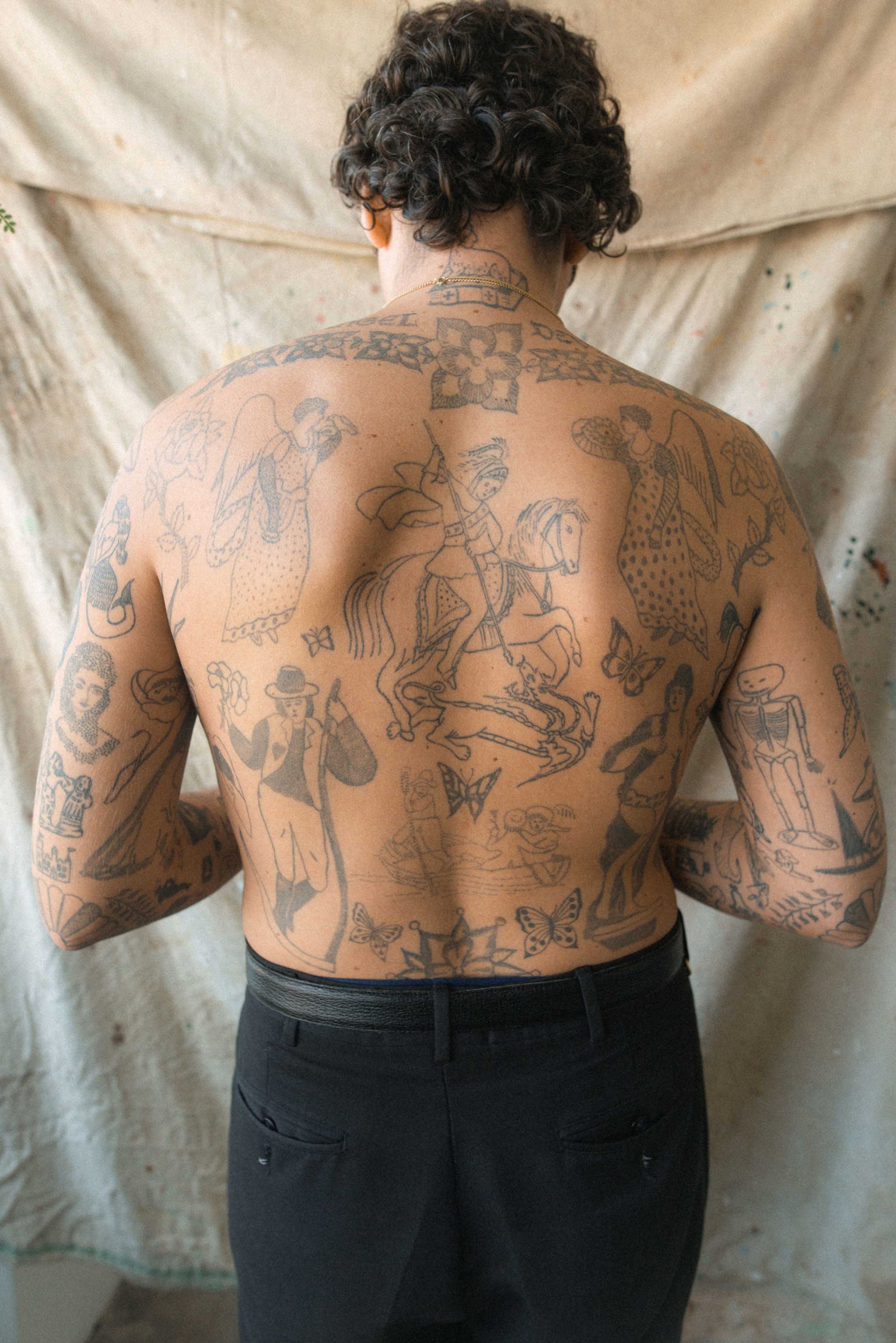
In an era where subcultures flatten into aesthetics and aesthetics flatten further into algorithms, Mejia has built something rare: a coherent symbolic world. Not just a pastiche of online references but an actual, physical place with its own internal logic. The tattoos he creates—the suns, snakes, and saints, but also cowboys, belly dancers, blades, gnomes preparing a feast, framed castles and graveyards—carry the weight of folk iconography, superstition, and graphic restraint. They function as private code while moving effortlessly across bodies and brands without losing their charge.
Mejia’s backstory is elusive, delivered in fragments and jokes. Born in Arizona, he spent his childhood moving frequently due to his father—a social worker whom Mejia speculates, with a straight face, may have been a reggae-loving CIA agent. Eventually the family settled in Minneapolis. Llewellyn—a Welsh name nodding to his father’s Romani traveler roots—was preparing to go pre-med and become a surgeon before pivoting to the Minneapolis College of Art and Design.
“I was getting arrested a lot,” he says, listing his crimes casually. “I was a klepto. Also an arsonist. Also a drug dealer. All of it. I thought art school would let me keep doing graffiti and stealing shit. My mom thought I’d end up dead or in jail. She’s proud of me now, though.”
At 19, he started tattooing friends with janky stick-and-poke setups, asking them to lie across his lap. The early tattoos were bad, but he kept getting requests and his talents developed in tandem with his work as a surface designer, eventually creating patterns and graphics for mass-market clients like Target, Williams-Sonoma, Chipotle, Urban Outfitters, and Pottery Barn, among others.
“So much of culture now gets flattened into aesthetics,” says Nico Lazaro, a menswear writer who has seven tattoos from Mejia. “Something starts as a subculture and becomes a Pinterest board. What’s interesting about his work is that it resists flattening, even as it spreads.”

The style, which Mejia has popularized and perhaps pioneered, is in high demand. Making an appointment is refreshingly accessible, just an Instagram DM, but you have to act fast. (“Shit, I thought this was spam!” he apologizes after ignoring my first few messages about scheduling this interview.)
Mejia reluctantly embraces the term “folk art” because it’s a shorthand that everyone seems to just get. The word “folk” can also describe the naivety and deceptive simplicity of the work—the flat perspective, the casual linework sometimes described as “ignorant style.” There’s also something of early 20th-century French and Russian prison tattoos in the mix, where style was secondary to broadcasting the crimes you’d committed. Not subtle or ornamental, but biographical.
“Everyone is biting my shit,” Mejia says with a grin that suggests he doesn’t find it that funny.
His partner, Lily Harris, a holistic nutrition practitioner, is more direct about his influence. “He basically made up the term ‘folk tattoo,’” she says. The two met while working together as designers at Target’s corporate offices in Minneapolis. “There was maybe one older artist who vaguely used the term, but Llew really put it in his bio and built his business that way. Now so many tattoo artists have ‘folk tattooer’ in their bio and don’t even know where it came from.”
“It all feels like part of the same world,” says Shane Gabier, a ceramicist who has more than a dozen tattoos from Mejia. “The way he dresses, the shop, the objects for sale, the building itself—the tattoos—it’s holistic.”
“There’s also something very spiritual about the work,” says Somsack Sikhounmuong, co-founder and designer of Alex Mill. “Even just walking into his space—it’s like a haunted house. The things he collects are imbued with so much history. And I think a lot of his tattoos carry that same weight.”
“It’s intimate without being intense,” Gabier adds, describing the experience of being tattooed by Mejia. “There’s humor. There’s patience. But there’s also a seriousness to the imagery that makes you think about what you’re choosing.”
The “haunted house” description might sound whimsical, but then there I was, surrounded by the gazes of dead animals and petrified faces while Mejia, dressed in a bear skin coat right out of The Revenant, described the time a ghost strangled his cat to death in San Francisco. Mejia tells this story matter-of-factly, and later Harris confirms he’s always been this way about the supernatural—believer, not skeptic. As he talks, I scan the room, rethinking what I’m seeing. Maybe they’re neither aesthetic nor subcultural, but talismanic, protective.
His work combines the visual charm of lotería cards—those simplified icons from Mexican bingo referencing Catholic liturgy, superstition, and mortality—with the sanctity of ex-votos, the small, sometimes hilarious devotional paintings made to thank saints for miracles. One offers visual pleasure; the other promises something deeper: intercession, protection, a relationship with forces beyond the self.
“He believes objects carry energy,” Harris says. And if you love them, you’re giving them new energy. They can’t hurt you.”
“All of this shit feels alive,” Mejia says, gesturing at the studio. “I’ve picked up these pieces from the most random places and while I know most of the provenance, sometimes I wish I didn’t.”

And so for the last fifteen years, he’s been traveling around the country in search of these provincial treasures—“whatever you want to call it. The older something gets, the more handmade it becomes.” The studio reflects that philosophy: old American pieces, Mexican popular art, Spanish colonial objects, European folk art, cathedral relics procured from a “psychopath in Wisconsin” (a long story involving bungee cords, claims of check fraud, and a hasty exit), all arranged with what he describes simply as taste. “People either have it or they don’t. I don’t overthink things. I just work and move on.”
Mejia’s fondness for people and patience with them is most obvious when he waits for what feels like an eternity for someone to pick a design or interrogate him about an object they likely have no intention of buying. At a recent Trinket sale, his antiques business, I overheard someone compare it to feeling like Augustus Gloop in Willy Wonka’s chocolate factory, greedily paralyzed by abundance. Mejia moves through the room, energized by the crowd.
“He’s actually the most optimistic person I’ve ever met,” Harris says. “There’s a deep level of joy you don’t necessarily see on Instagram.”
“He’s charming, but so is the work, which has a naivety,” Sikhounmuong says. “But beneath both, there’s depth. Even darkness.”

Courtesy of Llew Mejia.

Courtesy of Llew Mejia.
The question hovering over all of it is: what explains the popularity? Why is this particular vernacular—devotional, archaic, vaguely mystical—resonating so strongly right now with a specific slice of the culture: menswear obsessives, fashion insiders, actors, what seems like every third person in northeastern L.A.?
Lawrence Schlossman, co-host of the “Throwing Fits” podcast, who first met Mejia at a bar in Brooklyn nearly a decade ago, describes him as “a one-of-none type guy.” If it weren’t for Mejia, Schlossman says, he likely wouldn’t have tattoos at all. “It’s because of him. If he wasn’t specifically in my life—him as a person and him as an artist—I probably wouldn’t have any.”
“There’s a grounding quality to folk art across cultures,” Lazaro says. “Core principles people come back to. You find these signifiers that convey what’s important to you—your values—and you put that on your body. In a world that feels unstable and hyper-digital, people are looking for something that is durable, unironic.”
What might look like flash lifted from a medieval manuscript turns out to be something more contemporary: a shared language for people exhausted by the digital, hungry for the handmade and historical, seeking symbols that feel both ancient and newly urgent.
But creating art that resists disposability and digital exhaustion required navigating a more grinding kind of permanence: student debt.
“Everyone I saw tattooing was doing it as a fallback,” he says. “I had so much debt I was like, I have to get a big-boy job. I never really fit into corporate, but I felt like I had to try.”

Harris remembers that period clearly. “The debt put a huge fire under him. It made him more open to working with clients he didn’t necessarily see himself in—because you’ve got to pay the bills.”
At first glance, the corporate work comes as a shock—colorful, cheery, childlike. But a closer look reveals similarities. The same folk-inspired symbology—magic, botany, animals, metaphysics—merely resized, softened, and redistributed at corporate scale. Which raises an interesting question: what happens when symbols meant to convey personal values and spiritual weight end up as children’s swimwear or throw pillows?
“I don’t necessarily think there was tension, just more of a stagnancy,” Mejia says. “I still design surfaces—they just happen to be humans now when before it was plates, rugs, quilts, clothing. But working in the corporate atmosphere was difficult for me because I’m very independent and self-sufficient, and so in turn would get in trouble a lot for trying to undermine my bosses at work.”
Eventually, Mejia drew a line. “I decided to quit that career because I told myself I’d stop after working with tobacco, alcohol, and airline clients and had done that. And at that point I was really enjoying tattooing people and didn’t have the time to dedicate myself to two full careers at once.”
“Ironically I felt like I was getting closer to myself by realizing what I didn’t want to do,” he explains. “That shit paid the bills, but eventually I got to the place where I could say no and take risks.”

The folk art vocabulary he spent years developing moved seamlessly from plates to bodies because the symbols themselves were never the point—it’s what people do with them. At Target, they decorated homes. On skin, they mark identity, suggest protection, carry weight through time. The symbols endure not because they’re sacred or fixed, but because they’re flexible enough to mean whatever each person needs them to mean.
“The imagery feels old, but the impulse behind it feels very contemporary,” Lazaro says.
There’s a spiritual element to Mejia’s work, almost an understanding that while a tattoo can last for decades, art, especially on the body, is rooted in impermanence. He had advised his client—who would end up leaving with a sun and a coiled snake on their forearm—not to overthink the decision.
“It’s good not to take it too seriously,” Mejia said. “You add the meaning later.”
Shona Sanzgiri is a writer, editor, and photographer in L.A. He is the author of “A Time of Gifts,” a newsletter loosely about travel and living well.
- Written and Photographed by: Shona Sanzgiri
- Photo Assistant: Diego Heredia
- Date: February 25, 2026