Finding the Last Love Hotel
Writer Yoshiko Kurata Speaks to Legendary Love Hotel Designer Amii Shin, and Takes Us Inside the Last Standing Love Hotels of Japan
- Text: Yoshiko Kurata
- Photography: Irene Yamaguchi
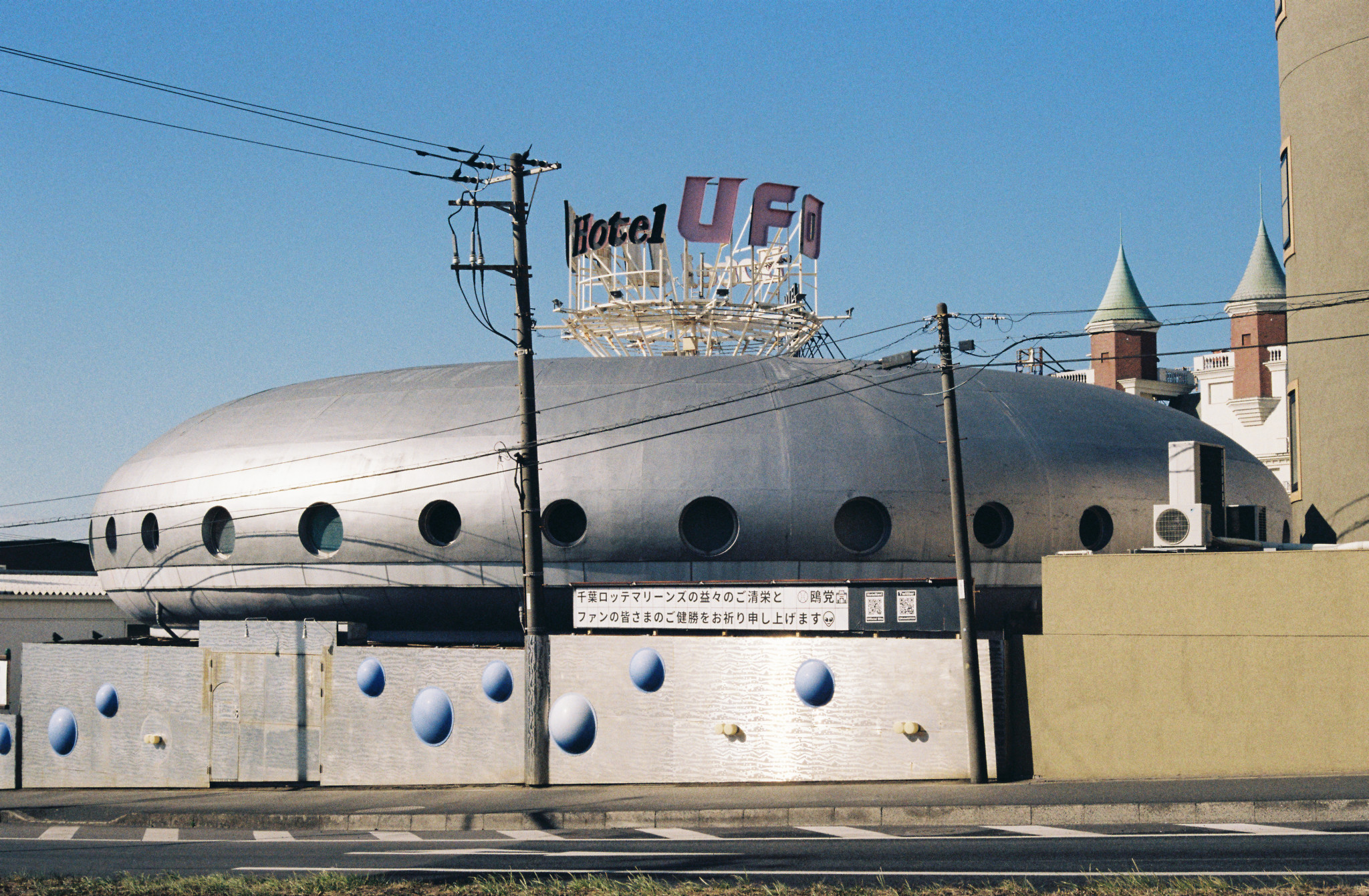
While driving through the suburbs a short distance from Tokyo, a large UFO appeared in front of me. It was parked on the ground, surrounded by a concrete wall. On top was a sign reading “Hotel UFO.” I knew what it was immediately: a love hotel.
As the name suggests, "love hotels" are different from ordinary hotels, and were created to nurture “love.” The origin of love hotels can be traced back to the so-called "encounter teahouses" from the seventeenth to nineteenth centuries that were used mainly by sex workers and their customers. Although they have changed their name since then, most of them can still be found in cities across Japan. The appearance of enshuku hotels in the early twentieth century ushered in a transition, and love hotels began to function as rental accommodations for couples and friends to enjoy, too.

In the West, it’s common for people to leave their parents' homes when they graduate high school. Here in Japan, even if one can finally start living alone as an adult, it is extremely hard to secure housing of an adequate size. To escape from such a cramped lifestyle, young people with free time on their hands lined up at "love hotels" during the booming economic decades between the ’50s and ’70s.


I spoke with legendary love hotel designer Amii Shin as he flipped through the architectural drawings of the 1,600 bizarre love hotels he has worked on. Among them were, of course, the revolving beds and 360-degree mirrored walls that are synonymous with the love hotels he created. The frenzied and eccentric designs of vintage love hotels are still talked about today, with the BBC and other foreign media going out of their way to visit Shin. “I was called the Walt Disney of the love hotel world," he said with a laugh, showing me hand-drawn sketches with specific details, from characters created when copyright was not strictly checked, to those incorporating current events that were a scandal at the time. One sketch included a jumbo, airplane-shaped love hotel with a 20-meter outdoor pool.

“The most important thing in a love hotel is the theme and the gimmick,” Shin told me. “At first glance, people might say adults don't enjoy this kind of thing, but when you use a carousel, a moving train, or a slide, you can't help but get carried away. When we opened a new love hotel at that time, we held a reception party for nearby female university students. We gave out adult goods as a thank-you gift, and at first they were shy, but by the time they came back they were ready to have fun," he said.

In Japan, pleasure culture became taboo after World War II. As a result, people became fascinated with the strange, underground world of eroticism. After laws legalizing abortion were passed, the women's liberation movement became active in Japan. This coincided with major economic and population growth from 1955 to 1973. From there, love hotels evolved into UFOs, castles, and other kitschy buildings with gleaming exteriors that proliferated boldly in the suburbs and backstreets of the city.

Today, the glistening love hotels featured in music videos and movie sets have become a fantasy of the past. While the hotels were once synonymous with the neon landscape of Tokyo, a revised entertainment business law was enacted in 1985, changing the way love hotels could be run. The law was called the “Amii Prohibition Law” at the time, and it banned all interior design features that were characteristic of love hotels, such as revolving beds, mirrors, and transparent glass in bathrooms. Population-control measures were also implemented, and love hotels were transformed into simple designs that were no different from business hotels.

Since the 2000s, the internet has taken over as a place to escape from reality, and people no longer seek the outlandish and unusual experiences that only love hotels can offer. In order to survive, love hotels have acquired a new face as "leisure hotels" that can be enjoyed by a wide variety of people, including families, couples, and friends. “If I had to build now,” says Shin of his dream, “I would build a 100-square-meter hidden love hotel like the Edo period style in Ginza for 2–3 million yen per night.”
With gentrification increasing and high-rise buildings and shopping malls being built in places where young and marginalized people congregate, there are fewer places to gather. Maybe it’s my nostalgia, but I’m still searching for the energy of the old love hotels, before they become a mirage.
- Text: Yoshiko Kurata
- Photography: Irene Yamaguchi
- Date: June 27, 2022