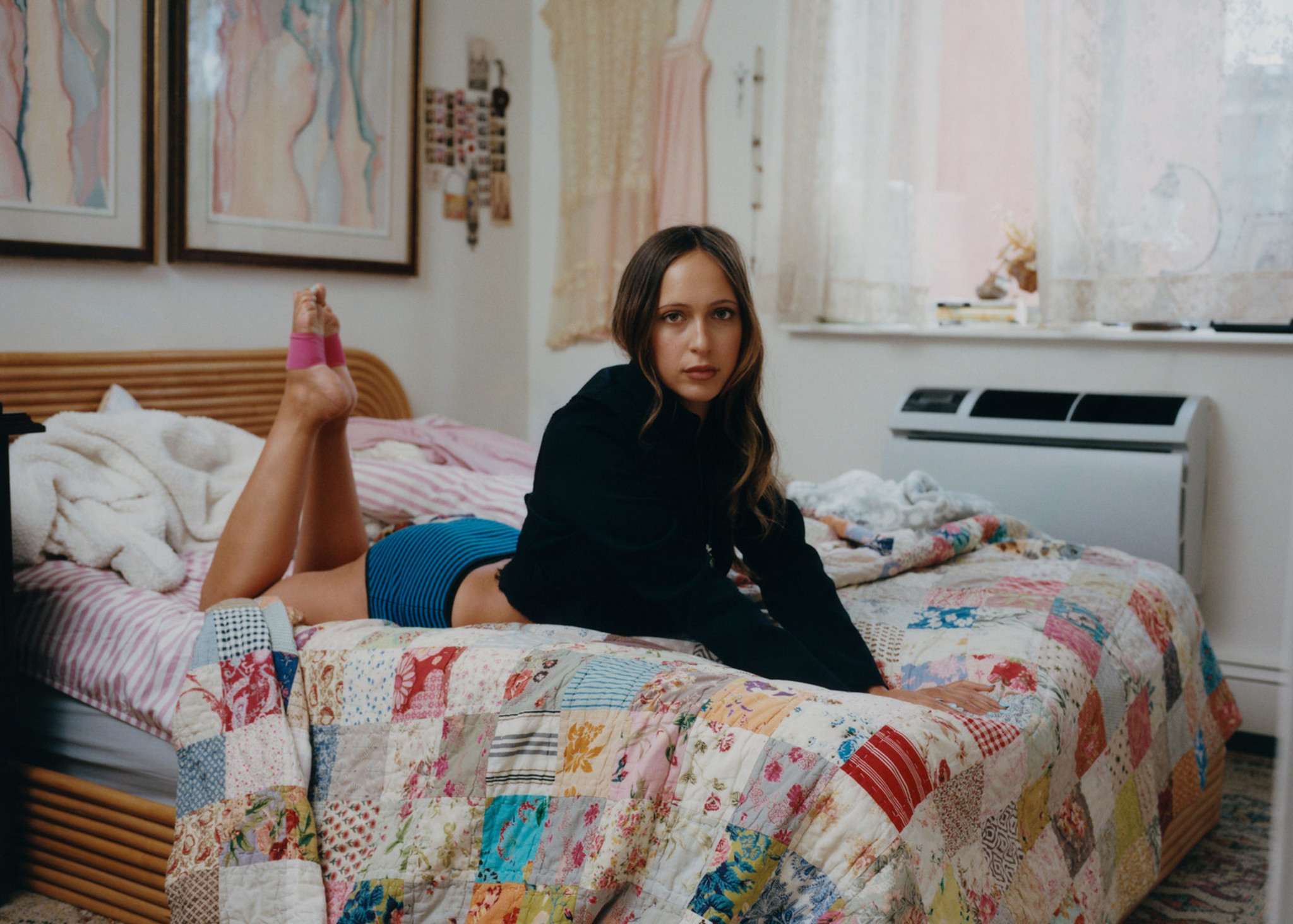
Living the
Anna Sui
Fantasy
Arabelle Sicardi Speaks
to the Most Energetic
and Imaginative
Designer of Our Time
- Text: Arabelle Sicardi
- Photography: Huy Luong
- Makeup: Ayako Yoshimura

As a child, when people asked what my parents did, I had the coolest answer: My daddy was a rockstar. Granted, his band only charted for one hair metal album of ‘80s power ballads and off into obscurity they drummed, but the answer is still true, and the photographic proof was formative to my childhood. The evidence of my parents' young adulthood gave me fertile ground when I began exploring fashion on my own terms decades down the line: My Asian mother designed menswear and sprinkled runway sample drop-waisted dresses and ‘80s windbreakers into my closet long before I thought they were cool. (They are, now.) My dad’s extensive hat collection and ratty vintage tailcoats became my signature accessories in childhood. My parents left the music and fashion industries on bitter terms, but the remains of their journeys always charmed me. More than once, I’ve daydreamed of a life where they never left their fields at all.
And so it is with an eye on the alternate universes of my life that I look at the biography of Anna Sui—Asian female fashion designer to rockstars, who began designing right around the time that my parents left the industry. An aunt in my particular multiverse, but certainly a legend to any and all.

Think of the coolest parts of New York City fashion and music history and Anna Sui was there. CBGB and Max’s Kansas City in the ‘70s. Joey Ramone styled like a buccaneer in her designs. Rehearsals for the New York Dolls with Steve Meisel. A David Bowie concert with the Dolls in attendance. Sui was there. Her group chats look like a who’s who of the fashion world—Marc Jacobs is her hypeman on Instagram, and she stays close to her peers by regularly collaborating with other designers. Vintage photos of Sui outside of legendary and oft-referenced NY clubs look like they could be the center of fashion campaigns now—the rockstar petticoats and playful layering that typifies “remixed” New York has long been part of her DNA, her oeuvre, her world. “Her influence isn’t simply everywhere;” fashion journalist Robin Givhan wrote in a memorable, glowing review for the Washington Post, “her aesthetic has become part of the fashion vocabulary from which almost everyone draws.”
When I think back on the influences that have shaped my life, I see a forest of connections that Anna Sui made first, and made beautifully. She referenced Aubrey Beardsley’s illustrations in fall 1992. Her SS20 collection was a joyful homage to the Gibson Girls. In ‘97, Sui cast Dave Navarro as a runway model, styling him in a purple camisole and leather pants, with black haloes of eyeliner. Fantasy not only dreamed, but actualized, established, with a worldwide debut. Not everyone gets Madonna to wear their clothes before they officially launch. But Sui did, and the world has been shaped by the magnetism and escapism of her work ever since.
Arabelle Sicardi
Anna Sui
Your friend Tim Blanks calls you a cultural archaeologist, in that you have so many references and delve into so much world-building. I really admire the fact that you’ve pushed back against interviewers when they ask you if you “come into yourself” when you are designing because your work is iterative. I was wondering what world-building looks like to you. What does your mind palace look like when you're creating?
There's always something that sparks an idea for a collection, anything from hearing a new song, reading a book, or seeing a movie. For the show last February, I was sitting watching television with my dad, and there was an old Busby Berkeley movie on. He was a choreographer in the ‘30s. I loved seeing all the girls in their rehearsal outfits. I started looking at pictures of old film stars and looking at Antonio Lopez from the ‘70s. As I'm doing that, I'm researching fabrics, deciding on color palettes. I'm working on prints, working on sweater designs, on embroidery. Everything builds into a wall of inspiration. It's very systematic, with color stories in panels for every delivery, and there’s a separate theme per panel. My collaborators, like Pat [McGrath], come to the board, and will decide where to then take it. The wall gives guidance to everybody.
You have such a deep roster of creative collaborators. How do you decide who you're going to collaborate with next?
It's very organic. I recently worked with Batsheva [Hay], and I had always heard about her because we had a lot of mutual friends. She came to visit me because she had some questions about textiles or contractors. By the end of that conversation, I said that we should do a collaboration together. Other times people approached me and they have a specific idea they want me to collaborate on. I love designing everything and I'm very limited as far as what I can design because we have a little studio here and then we pretty much make all the clothes within the neighborhood. I love being able to branch out.

Mick Jagger was one of your first customers. You started at the TOP!
Yeah, that was exciting, that first men’s collection that I did. He happened to be hosting Saturday Night Live and his stylist called—he ended up wearing my clothes on the show.
Revisiting those designs—did approaching menswear again for SSENSE have to do with the rise of new rock star celebrities that Gen Z loves, like Harry Styles?
It was honestly a whim, because my last fall collection was inspired by a TV show called Ready Steady Go!, which was all about the British Invasion and the bands that had their debuts then. It was so fun watching that footage and I was inspired by the mod look. My vision for the show and the video was to have a band onstage, and you had to have guys in the band, too.
Often rock stars straight up steal their girlfriend’s clothes.
My favorite period was glam rock. I love that Keith [Richards] always wore Anita Pallenberg’s clothes, and Mick [Jagger] wore Bianca’s beaded jacket. So I designed menswear with that in mind, and maybe that was the reason people weren’t buying it initially. It was a little too feminine or they didn’t get it because it wasn’t classic menswear. But I still did it, with matching jackets and the same pants for girls and guys.

When you reflect on your archives, and are asked to give your blessing to retrospectives, how have you reworked the material in a way that feels fresh?
When we did The World of Anna Sui exhibition [in 2017]. I had never even looked at the archives. They just went in a box and I never saw the box again. When we had to figure out what outfits we were going to put on display, suddenly we were pulling out all the boxes. I remember my longtime assistant, Thomas Miller, went to London to set up the exhibition. He called me crying, and he said, “Anna, you can't believe how beautiful this looks. It just brings back so many memories,” and it was the same feeling I got when I walked in the room. We never realized how much work we did. You're always working on the next show. You don’t even think about it again, it just kind of disappears. There were so many I hadn’t even thought about, and I can’t find those fabrics anymore. It’s emotional.
Do you have a favorite fairy tale? Something about your work tells me you do.
You know, there's been that whole internet blow-up of the 1998 fall collection. People came back to me and asked me what that was all about. My memory is that when I was in seventh grade, I did a book report on The Lion, the Witch, and the Wardrobe. I loved that book. I loved the fantasy of walking through this closet and going to another world. My teacher gave me an A minus because she said, “Anna, you're too old to read fairy tales.” That stuck in my gut for a long time, and I decided to make it into a collection. I also happened to see an incredible exhibition at the V&A in London about Victorian fairy tale artists like Arthur Rackham, Kay Nielsen, and Walter Crane. Those were the images I put on the board.
I was trying to capture that kind of beauty—something with a transporting quality, but with something sinister going on in the background. There was a spookiness to it.

It's a formative part of your aesthetic. There’s escapism, romance, abundance, but darkness is a texture too. It’s a velvet thing. It’s also the best part of fairy tales, the risk and the reward are all wrapped together. Being a designer is risky, too, but you’ve sustained across collaborations and opportunities in a way others haven’t. What lessons have you learned that you can share?
When I started I did a lot of freelance. I was working in Italy, where I had to fly back and forth every two weeks. It was exhausting but got me ready for globalization. I didn’t speak the language, I didn’t know the market, I didn’t know how to find fabrics, but I ended up doing three different collections there, for seven years. You should take every opportunity that makes sense, as long as you physically can. You never know what door is going to open.
When I had the opportunity in Japan, it was so exciting. There were a lot of different presentations on how it could work, and the one that made the most sense was having a retail partner and distribution deal. I got 11 licenses, one of them being cosmetics, which is still one of my biggest licenses today. You have to weigh out your options and not be dissuaded by obstacles. And say again: Why not?
Challenges are just part of how you create more curiosity. Are you ever afraid of failure?
Of course. Especially today, there’s so many questions about growing up Asian, being a woman, having a business with no big backer behind it. With all these things—I found a way. I never used these things as an excuse to not try something. When I first started, I went to the bank to talk to a banker about a loan. And he said to me, “When is your dad coming in to sign for this?” I asked what he had to do with it, and walked out. I figured out another way, by freelancing rather than getting a loan. My theory is to never take no for an answer, to always get somebody else on the phone, always ask a question a different way. It may not be the easy way. But there is always another one.
Speaking of your dad—it’s uncommon for the children of Asian American parents to support their children pursuing a creative art profession. How involved is your family?
They’ve been to every show since the beginning, until my dad was too unwell to come. My mom continued to come after my father passed away. It’s been special. Initially my mom asked why I wanted to be a dressmaker. But they got it when they saw the first show. And my dad knew every press person, maybe even better than me. He chatted with them, and he loved the whole process.

What a blessing, and it helps build better relationships when your family is truly invested in you.
I’m so lucky that my nieces have all been working with me, too. They grew up coming to the fashion shows. Isabelle is my assistant and in charge of social media, Jeannie Cassandra has done all the videos and photography for me, Chase has been in a lot of the ads. It’s been fun having them onboard.
How do you know when a design is done? When is it time to let go?
That’s an easy one. The day of the show!
Arabelle Sicardi is a beauty and fashion writer whose work has been featured in New York Magazine, Harper’s BAZAAR, ALLURE, and more. They have a Max Factor Micrometer tattoo and collect Dali perfumes. They’re also the author of The House of Beauty, a nonfiction book on the beauty industry and political power, forthcoming from Norton.
- Text: Arabelle Sicardi
- Photography: Huy Luong
- Makeup: Ayako Yoshimura
- Date: June 30, 2022