Finding the New Fleece
With Arnar Már Jónsson
The Design Duo Talks Functional Poetry,
Craftsmanship, and Problem Solving
- Text: Eliot Haworth
- Images/Photos Courtesy Of: Arnar Már Jónsson

In the opening to his 1971 book Design for the Real World, Victor Papanek defines his subject matter, writing, “Design is composing an epic poem, executing a mural, painting a masterpiece, writing a concerto. Design is also cleaning and reorganizing a desk drawer, pulling an impacted tooth, baking an apple pie, choosing sides for a backlot baseball game, and educating a child.” It is within this radically expanded understanding of design—as a dense matrix of interactions between people and things—that Arnar Már Jónsson makes clothes.
The label is run jointly by its namesake Arnar Jónsson, who is from Iceland and lives in Reykjavík, and Luke Stevens, who is British and lives in London. The two met while studying at London’s Royal College of Art. Their garments are functional yet poetic, treading a line between technical and luxurious. Think hardy, reversible outerwear that is delicate to the touch and hand-dyed with plants native to Iceland. Fabric—gossamer military-grade ventile, dense piled virgin wool—is meticulously sourced, some pieces take hundreds of hours to construct. Often the result of obsessive research spanning years, combined with an intuitive and joyful feeling for what makes something work, their collections have quickly grown a loyal following, including stylist Max Pearmain (former editor of Arena Homme+) who is now a key collaborator.
When talking to the duo, it is clear that they are driven by an intense curiosity and the desire to explore cut, fabrication, and production processes. They are interested in aesthetics, the symbolic meaning of garments, and the tribalism of subculture. Economic systems, social systems, historical precedents, and speculative futures. Things that aren’t clothes at all. They could just as well be designing a piece of furniture, a garden, or the way they want the working week to be structured. Above all, they explain, everything comes back to two guiding questions: How should we live? What’s needed today?

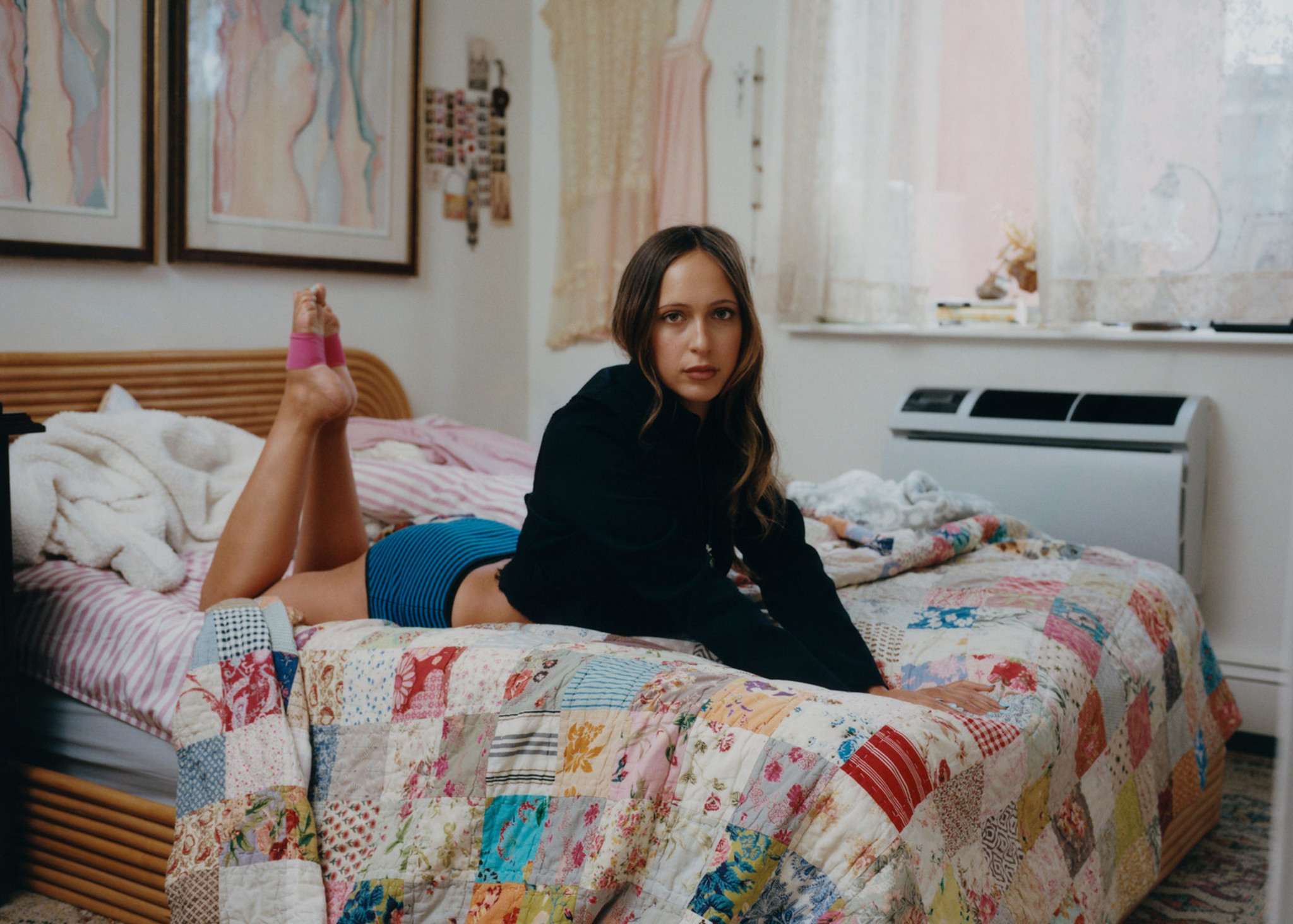
Left and Right Images: Photography by Eddie Whelan.Top Image: Photography by Eddie Whelan.
Eliot Haworth
Arnar Már Jónsson & Luke Stevens
Where are you both right now?
Arnar Már Jónsson: I’m in Reykjavík city center, in my studio.
Luke Stevens: I’m in London, in my bedroom.
How does that geographical separation shape your work?
AMJ: It’s become quite key to our process. I often use the relative quiet in Iceland to work on the early stage things when they need to be conceptual. If we were both in the same studio stressing about production I don’t think we would be able to do that so effectively.
LS: And meanwhile I might be with our manufacturers, better understanding processes or developing techniques. In terms of design, the roles we take on are often very fluid and can change each season.
AMJ: What we do hinges on deep research and problem solving at a conceptual and technical level and the question of what needs to be made today. We don’t make something if there’s not a reason for it. That’s what design is. It’s about solving a problem with a solution.

Left Image: Arnar Már Jónsson, Photography by Baud Postma. Right Image: Luke Stevens, Photography by Baud Postma.
Can you give me an example of that problem-solving approach?
AMJ: For AW21 we’ve done fleece in a specific type of virgin wool. We love fleece, but it’s also annoying. You sweat too much in it and it’s also often too thin, or too thick. We couldn’t justify using it until we’d solved these issues, so we found this really amazing fabric that has a resemblance to fleece but it’s virgin wool. The way it’s piled means it breathes. It keeps the cold out and the heat in. It can be an outer garment or an undergarment, and it has natural water resistant qualities. We’ve spent years looking for a fabric like that and we finally found it. For me, that was a really good design solution.
Aside from the functional side of your designs, there’s also a symbolic quality to what you do. For example, your dyes are made from plants that you hand picked in Iceland…
AMJ: We used that to dye jackets. We wanted to make jackets that were highly functional and technical but with a very natural, organic production process. We could have just used natural dye extract and a regular waterproofing process but we don’t want to make things that are only functional or technical. It took about 380 hours for the dye production. Plus, hand-waxing is another 100 hours. Hand-picking, hand-dyeing, hand-waxing. The time it takes to make these things. It connects us in a very real and physical way to what we do.
LS: That’s intrinsic to our approach. To be very hands-on.
Does your broad definition of design come from studying at a school like the RCA that has a very strong industrial design program, and a very strong architecture school as well?
LS: Definitely. All of the design theory that we draw on, it’s all to do with product or industrial design. Architecture and the relationship between things. It’s something fundamental that’s often overlooked in fashion design.
AMJ: I don’t know if I can even say that I’m a fashion designer. That’s not to dismiss fashion at all, don’t get me wrong. It’s sometimes more about the idea and the aesthetic than it is about the solution. In that sense, it’s good that we can say that we are fashion designers, but in general we think a lot more like industrial or product designers. We exist in an in-between place.

Left and Right Images: Photography by Eddie Whelan.
I want to come back to that phrase “in-between.” A lot of what you do seems to occupy a sense of in-betweenness. Whether that’s literally being geographically in-between London and Iceland, or looking at spaces that are not quite urban and not quite rural as an influence, or making clothes with a process that sits between product design and fashion design. What draws you to that space?
AMJ: I think it’s just responding to the complexity of being a human. How can you make things that have multiple functions? How can you design things for the outdoors that also work in the city? We like versatility. I’m also a bit contrarian so I naturally resist being categorised as too much one thing or another.
Where do you want to take things?
AMJ: We’d like to take it further than clothing design and establish other ways of working. At one point, we could design a house, a chair, a car.

Left and Right Images: Photography by Eddie Whelan.
I can see a clear link between that and your recent project with Selfridges where you were asked to do a pop-up store and you used it as an opportunity to design modular furniture. It was very pragmatic, because you were making furniture that you could re-use in your showroom, but also provocative because you were highlighting and hijacking the infrastructure of a huge department store and its sales cycle.
AMJ: The whole definition of a pop-up is that it’s bound to die after its three-week sales window. How do we feel about that? How do we approach it? How do we try to create some meaning and longevity from this system rather than using it purely as an opportunity for marketing and sales? Sometimes these questions are better explored through other mediums than solely through clothing.
LS: It’s quite difficult to put all these ideas into a jacket! It was really great to treat the clothes and the furniture they were hanging on as a continuum. For us they were both equally valid parts of the output of the label and the questions we were trying to answer.
AMJ: That’s what keeps us excited about going forward. If I felt that I’d only be designing jackets and trousers for the rest of my life, I would start to have a panic attack.
Eliot Haworth is a writer and editor from London. He is deputy editor of Fantastic Man and has a background in zoology. As a journalist he has worked with The Observer, The Telegraph, The Business of Fashion and MacGuffin and as a cultural commentator for Monocle Radio, ShowStudio, The Financial Times, The New York Times, The Guardian and Die Welt.
- Text: Eliot Haworth
- Images/Photos Courtesy Of: Arnar Már Jónsson
- Date: November 17th, 2021