Lilypad Magazine
Can Keep a Secret
Graffiti Writers And
Train-hoppers Take
The Spotlight In
The Year’s Most Exciting
Young Publication
- Interview: Sam Reiss
- Photography: Jill Schweber

What do the margins look like when we can see everything? It’s a question Lilypad Magazine’s trying to answer. Founded in 2020 by Doyun Baeg, a Calgarian in Montreal, and Bergen Hendrickson, in New York, the team, both 28, is two issues deep—publishing sporadically, though a third issue is scheduled for summer— into documenting a certain downtown scene: graffiti, skateboarding, its adjacencies and outgrowths.
Published in large format and full color, Lilypad is as much about how things are covered and the way stories are told as the subjects themselves. They give platforms with intention: Peter Sutherland, the artist, runs down his bike messenger career, and photographs Mark Gonzales midair over garbage bags on his single speed; Wombat, the graffiti artist, explains what she does; skateboarders and downtown people abound. Tactile, and equal parts futuristic and analog—graphics straddle the line between old-school Letraset depth and Sega CD–type flurries—pages carry energy waves, breaking down train-hopping diaries to bike messenger lore casually, relaying what’s happening in one scene to cities all over. It’s a communitarian document: Writers and train-hoppers whose names are best kept offline get some privacy. “Donut Letters”—a recurring section of reader submissions where anything goes—show up with full context, scanned and printed with handwriting intact. Features range from text-heavy interviews to long, all-graphic displays. It feels more like a potluck, or maybe a mess of tattoos, than a top-down directive. The aesthetic is cohesive and lively, and the theme is that there’s no theme, just that it’s all in one place.
The way major magazines have run—clinical dispatches on subjects obscure and otherwise, streamlined for broad consumption—seems outmoded now, or bulky at least, in an era when so much is accessible. Lilypad’s pages have weight, to be sure, but its stories and images are fluid and light. It’s about access, but also display.

Bergen Hendrickson and Doyun Baeg with friend.
Sam Reiss
Doyun Baeg & Bergen Hendrickson
What are your roles in the magazine?
Doyun: Me and Bergen do everything. Both of us will hit up contributors, interview people, edit the magazine. We don’t have much role differentiation.
How’d the magazine start?
Bergen: We’ve been friends for a really long time. He had the idea for this magazine before COVID, in Mexico City, and talked about it. COVID hit and I was in grad school, upstate. We were stuck at home, bored, making a zine for fun: Perico. From there, Doyun had the beginnings of some articles, which I helped him edit.
Lilypad seems to be in a couple lanes: Glossy-but-downtown magazines from the ‘90s, skate mags. Were these active inspirations you were going after?
B: A lot of people aren’t used to seeing a really small print publication in the form of a magazine that looks like it has a large run. That format is inspired by those skate magazines—I’m old enough that when I first got into it, you’d learn from getting magazines every month: what’s cool to wear, what tricks are called, the whole world. I’d go to the library to look through old issues—it wasn’t like you could go on Thrasher.com and watch videos. There’s all kinds of art with equivalents, magazines that give access to more inaccessible subcultures. In real time, they’re how kids get hip to things and feel like they can take part.
B: When people ask what the magazine is, my first answer is it’s not really a skate mag, but with skateboarding in it. My better answer is it’s a magazine about our friends and people we know. Across issues you’ll see connections between those people. Issue 1 is an homage to our friends—there are so many talented people, even in just that one issue. They reappear in different roles: graphic design in one issue and a featured artist in the next one, a poster in [Issue] 1 and an interview in [Issue] 2. It’s a document of a real group of people: giving people who we don’t know access to people who do know.
D: I make this joke that one of the big inspirations is David Attenborough’s Planet Earth,— finding cutty shit that’s going extinct.
What’s going extinct?
B: Not fatalistically, but people doing things in a way you often wouldn’t notice. The cultural equivalents of a weird rat in a cave. Not to give ourselves too much credit. But I think we’re engaging with people who are endangered.
D: The Wombat interview is a good example. We capture her in the prime of her graffiti career…
B: Or features on individuals who’ve put time into alternative, vagabond modes of travel. Like the Rick Ians story from Issue 1; it’s a freeform travelogue of someone experienced in train-hopping telling gnarly stories. In that world there are things you need to be careful about publishing. So letting those individuals give that glimpse on their terms—their own images and narratives—is important, because it’s not like we’re following them around with a camera.
D: Some of the secrets you don’t publish. But you keep the core.
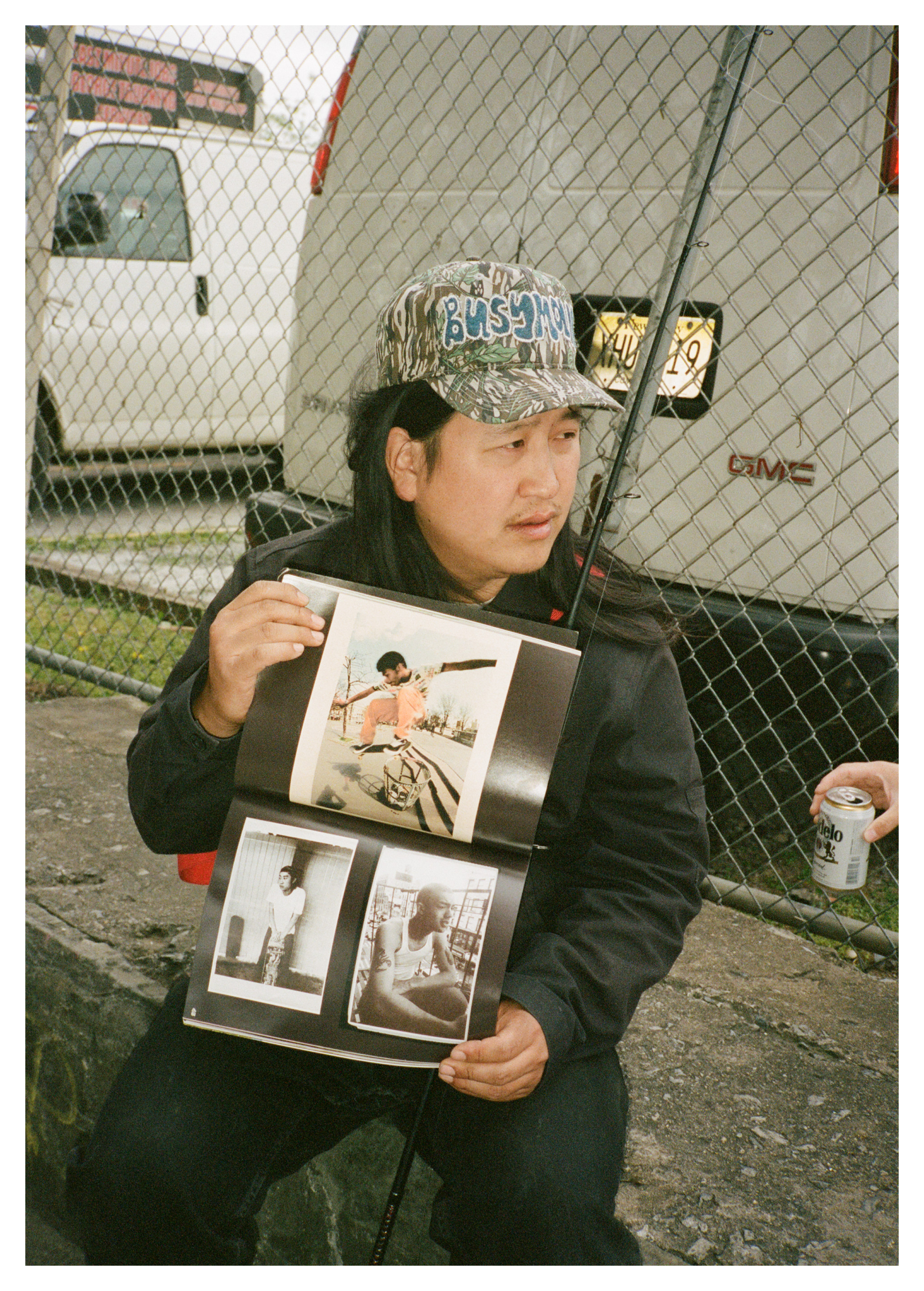


“I think we’re engaging with people who are endangered.”
Does not having traditional magazine experience help? Was it a conscious decision to give subjects more of a platform by letting them contribute beyond their answers?
B: To be honest, we just don’t know how we’re supposed to do it. I went to grad school for curatorial studies, focusing on publications, artist books. I think this magazine is a curatorial outlet. It has the skin and bones that makes a magazine a magazine. We do it stupid forensically. When we laid out the first issue, we looked at other magazines, but beyond that, everything else is us doing whatever we want.
D: When people don’t know how to make music, and they make punk music, it sounds cool. Or if someone doesn’t have a background in painting, then the painting looks different. It’s not our intention, but that’s what’s fun, we’re figuring it out. Starting it, I’d wonder how to do X or Y, and I’d go look at one in the bookstore, like oh, this is how you’re supposed to do it.
B: When we’re figuring out formatting we look at the most boring, big time magazines.
D: The stuff near the checkout.
B: One place had us stocked next to Artforum. I thought it was funny, because they couldn’t be more different. But if you’re just looking at the covers, it’s not that crazy to have them next to each other. We’re undercover as a normal magazine.
What does the future look like for a community-based magazine?
B: Somebody pay us $1,000,000 to buy the magazine. I’m just kidding. Kind of. Honestly, the magazine is rooted in our friendship. We have goals. When people hear it’s just us, they say, “What the fuck are you guys doing?” It’s crazy to make a full-sized magazine with just two people. We both have multiple jobs.
D: The main thing is, what would my 15-year-old self like to read? If that changes, and Lilypad looks like everything else, that’s the time to dead it. If it becomes too commercial, it would suck.
B: It’s about a real world of people that actually all know each other. There’s this world of people we’re discovering. We described them as fringe, but fringe doesn’t necessarily mean peripheral. They have a very strong gravitational pull. They bring into our lives their own interesting people, and it builds out this strong, cohesive world. Hopefully we’ll keep meeting them.


Sam Reiss writes a newsletter for GQ about vintage clothing and a column for Inverse.com about powerlifting and nutrition, and about furniture, design, and other topics for GQ Style, ESPN and other publications. His "Snake America" newsletters are being collected in a book for Shining Life Press.
- Interview: Sam Reiss
- Photography: Jill Schweber
- Date: July 25, 2022