Need a Grill? In Tokyo, Tetsuya Akiyama Is the Man to See
The man behind Grillz Jewelz has made jewelry masterpieces for everyone from Pharrell to A$AP Rocky to Megan Thee Stallion.
- By: Hyunji Nam
- Photographed by: Sue Kwon

Nestled in a side alley of Tokyo’s Akihabara neighborhood, a green sign reads Grillz Jewelz. The shop sees a steady stream of clients year-round. Since 2011, Tetsuya Akiyama has been crafting grills, becoming a go-to figure for global rappers passing through Tokyo—part celebrity artisan, part quiet icon.
“There was a time, not too long ago, when only people into hip-hop cared about grills,” Akiyama says. “These days, I can feel just how much they’ve spread—how mainstream they’ve become.”
What started as a dream from one hip-hop-obsessed kid in Japan—to one day make jewelry to adorn the mouths of famous rappers—has grown beyond his wildest imagings. Today, artists young and old have sought him out. Pharrell. RZA. Lil Uzi Vert. Steve Lacy. A$AP Rocky. Megan Thee Stallion. Still, Akiyama values his everyday customers just as much. “Whenever I hear kind words from media or clients, I feel proud of what I do,” he says. “Each bit of feedback means a lot to me—it reminds me I made the right choice.”
Legendary photographer Sue Kwon visited Akiyama’s shop as part of a personal project to document Tokyo’s hip-hop culture. Known for capturing the raw intimacy of the rap scene in the ’90s and 2000s—De La Soul, N.E.R.D., Method Man, Mobb Deep, N.W.A—Kwon saw in Akiyama’s work a new branch of hip-hop culture growing independently from Japan. She photographed him as she had so many legends before. “Grillz Jewelz’s eloquently crafted pieces are more than just jewelry—they are a fusion of his love and respect for hip-hop culture and the essence of those who wear them,” Kwon told SSENSE. “I appreciate that, at a crossroads of tradition and innovation, Akiyama enriches the legacy of hip-hop with each piece he creates.”
But Akiyama doesn’t speak in big declarations. His mindset is that of a craftsman. “My goal right now is to deliver pieces faster to the customers who are waiting,” he says. “Each one takes time, because I put everything into it—but I want to work more efficiently so no one’s left waiting too long.”
How did your interest in grills first begin? And how have hip-hop and its surrounding subcultures shaped your perspective?
It must have been around 2002. I remember seeing an ad in The Source for a shop that specialized exclusively in grills. That ad became a pivotal moment for me—it made me seriously consider opening my own grill shop one day. It was the first time I realized there were stores dedicated solely to selling gold teeth.
Back then, people didn’t really call them “grills” yet—they were more commonly referred to as “gold teeth.” Seeing Wu-Tang Clan and Slick Rick with gold in their mouths made me think, that’s insanely cool.
But this was before the internet became what it is now, so there wasn’t any obvious way to find out what gold teeth actually were, let alone where to get them. My main sources of information back then were foreign magazines stacked at local record stores, and music videos—those were the key. I absorbed everything through them—not just the music, but the fashion, the jewelry, the attitude.

Akiyama at his store, Grillz Jewelz, in Akihabara. Photographed by Sue Kwon. Top Image: Tetsuya Akiyama in front of his store, Grillz Jewelz, in Akihabara. Photographed by Sue Kwon.
I heard you worked at a jewelry workshop early on. Did that experience help you create more inventive grills?
Before I opened my own shop, I spent about three years working at a jewelry workshop. I was there six days a week, from morning until night, doing mostly repetitive tasks—hundreds of them, over and over again, every single day. It was a far cry from the glamorous world of jewelry-making I had imagined.At the time, it felt like work that had little to do with creative thinking. But looking back, I realize it was a period when I developed a trained eye—and built the foundation—for what I do now. I never attended a formal jewelry school, so I’m deeply grateful to that workshop for giving me a chance to work despite having zero experience. It was where I learned everything from the ground up.
Do you remember your first hip-hop artist client?
The first artist I ever worked with was the Japanese rapper YOU THE ROCK★. His first order was for a set of grills that looked like the ones Jaws wore in 007—a style where the teeth appear like a wall of superalloy. These days, Kanye West wears a similar style, but to me, the true originator of that look will always be YOU THE ROCK★.

(Left) Akiyama with Rihanna and A$AP Rocky. Image courtesy of Grillz Jewelz. (Middle) Akiyama with RZA of Wu-Tang Clan. Image courtesy of Grillz Jewelz. (Right) Akiyama with Lil Uzi Vert. Image courtesy of Grillz Jewelz.
Artists like A$AP Rocky and Steve Lacy have come to you for grills. Compared to other grill makers, what would you say are your strengths in terms of design?
It’s honestly a bit difficult for me to look at my own work objectively and point out its defining features. But if I had to say, my grills were born out of a deep fascination with Black American culture, and in that sense, I don’t think they can ever claim to be part of the real Black cultural lineage. They started as a form of imitation, after all. But perhaps when something like that is made by an Asian—specifically, a Japanese person—it ends up carrying a slightly different sensibility, a different kind of flavor. I’d say I always try to approach my work with a deep sense of care and intention. That level of craftsmanship is something I’m constantly conscious of.
You’ve created a number of pieces for A$AP Rocky. Could you tell me about the one that took the most time or effort to make?
I think the most memorable and painstaking piece I’ve made for him was the very first set of flower grills. I embedded actual pressed flowers inside the grills and mixed clear diamonds with yellow and pink diamonds to complete the design. To me, Rocky has always embodied this duality of street and elegance. So I thought—what if I intentionally placed flowers inside something as hard-edged as grills? It felt like the perfect way to express his unique sense of elegance.
When Rocky released “Goldie” in 2012, everything about it—the music, the fashion, the grills—was mind-blowing. It left a huge impact on me. At the time, I had been running my shop for about seven years, but business was still slow. I barely had any customers. I was working part-time jobs at night just to get by. Still, I held on to this reckless dream of one day making grills for A$AP Rocky. That first flower grill I created for him in 2021 remains the most unforgettable and meaningful piece I’ve ever made.
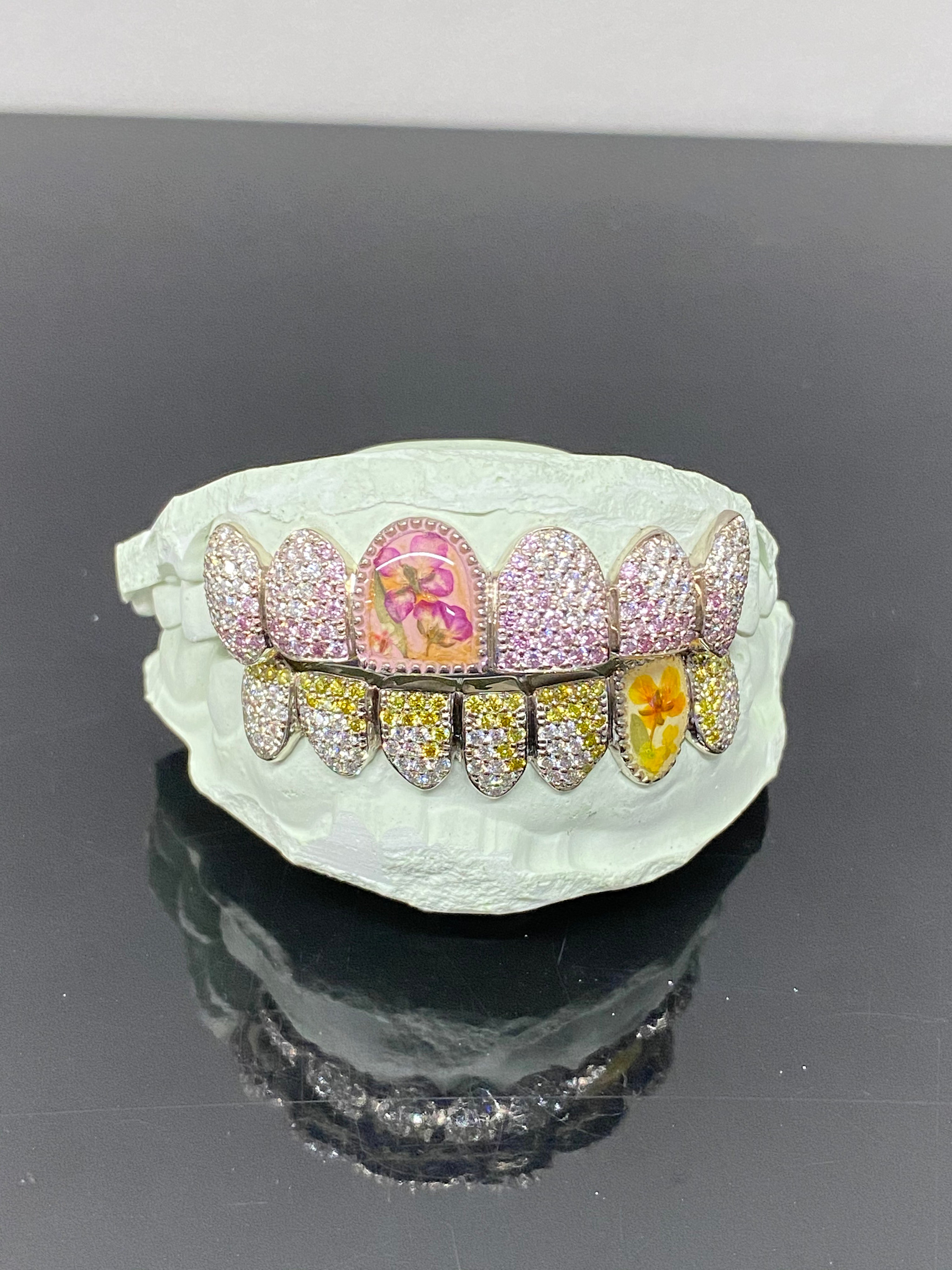
The pressed flower grills Akiyama made for A$AP Rocky. Image courtesy of Grillz Jewelz.

Akiyama working on grills at his store. Image courtesy of Hawk Kim.
Walk me through the process?
The process is actually quite similar to traditional jewelry-making. It starts with crafting the wax mold, which becomes the base form. That’s then cast in metal, followed by polishing and decoration to complete the piece. The total production time depends on the complexity of the design, but in terms of pure labor, it usually takes anywhere from 7 to 20 hours. For more intricate designs, it can take even longer.
As for pricing, it varies depending on how many teeth are being covered and the materials used. The most basic grills start at around ¥6,000 (roughly $40 USD), but they can go all the way up to several million yen, reaching into the tens of thousands of dollars for fully custom, high-end pieces.
When world-famous rappers visit Tokyo to get their grills made, they might ask you where they should hang out afterward. What would you recommend?
I’d recommend Kubota, the eel (unagi) restaurant right behind my shop. So far, every guest who’s been there has told me it was absolutely delicious.
The rise of Japanese rappers is fascinating. It feels like they’re developing a distinct genre and reaching a more global audience. What’s your take on Japanese hip-hop?
From the THUMPIN’ CAMP(さんピンCAMP) era to now, I feel that Japan has steadily built its own hip-hop culture, generation by generation. [THUMPIN’ CAMP was a landmark hip-hop event held in 1996, featuring a wide lineup of Japanese rappers.] The scene has grown significantly compared to what it once was.
These days, seeing Japanese artists collaborating with musicians from overseas is genuinely moving. I truly hope that Japan’s unique take on hip-hop continues to thrive and expand on a global scale.

The rapper Yuki Chiba (left) and Megan Thee Stallion (right), who collaborated on the song “Mamushi,” are also clients of Akiyama. Image courtesy of Grillz Jewelz.

You recently made a surprise cameo as a taxi driver in the music video for “LV MURAKAMI,” a collaboration between Japanese rapper JP THE WAVY and artist Takashi Murakami. Can you tell us about that experience?
I got a message from JP THE WAVY saying, “For this MV we’re doing with Murakami-san and Louis Vuitton, there’s only one person who can play the role of a blinged-out taxi driver—and that’s you. Please say yes.” It sounded like fun, and honestly, I owed WAVY a lot, so I agreed right away. We shot the scene with me driving an actual taxi covered in Murakami’s signature flower motifs, with WAVY riding in the back. It was such a fun experience, and it still remains a really good memory for me.
What have you been listening to a lot lately?
In the shop, we usually have a hip-hop radio channel playing. I used to stream Hot 97 all the time, but since it’s no longer available, we’ve switched to other streaming radio stations. Personally, I still listen to a lot of the hip-hop I grew up on—mainly from the ’90s to early 2000s. I’ve always gravitated toward East Coast sounds, so artists like Nas and Mobb Deep have been on heavy rotation for years. I do try to keep up with new releases, both from the US and Japan, but somehow I always end up returning to the classics. There’s just something timeless about that era.
What does hip-hop mean to you?
To me, the essence of hip-hop lies in turning one’s minority position into something powerful—amplifying it through your own lens. It’s about building a world of your own, using your personal style and philosophy as tools, even when you’re starting from a place of disadvantage. That drive, that attitude—that’s what I believe hip-hop is really about.
- By: Hyunji Nam
- Photographed by: Sue Kwon
- Production: Hawk Kim / WCS.inc
- Date: April 25, 2025