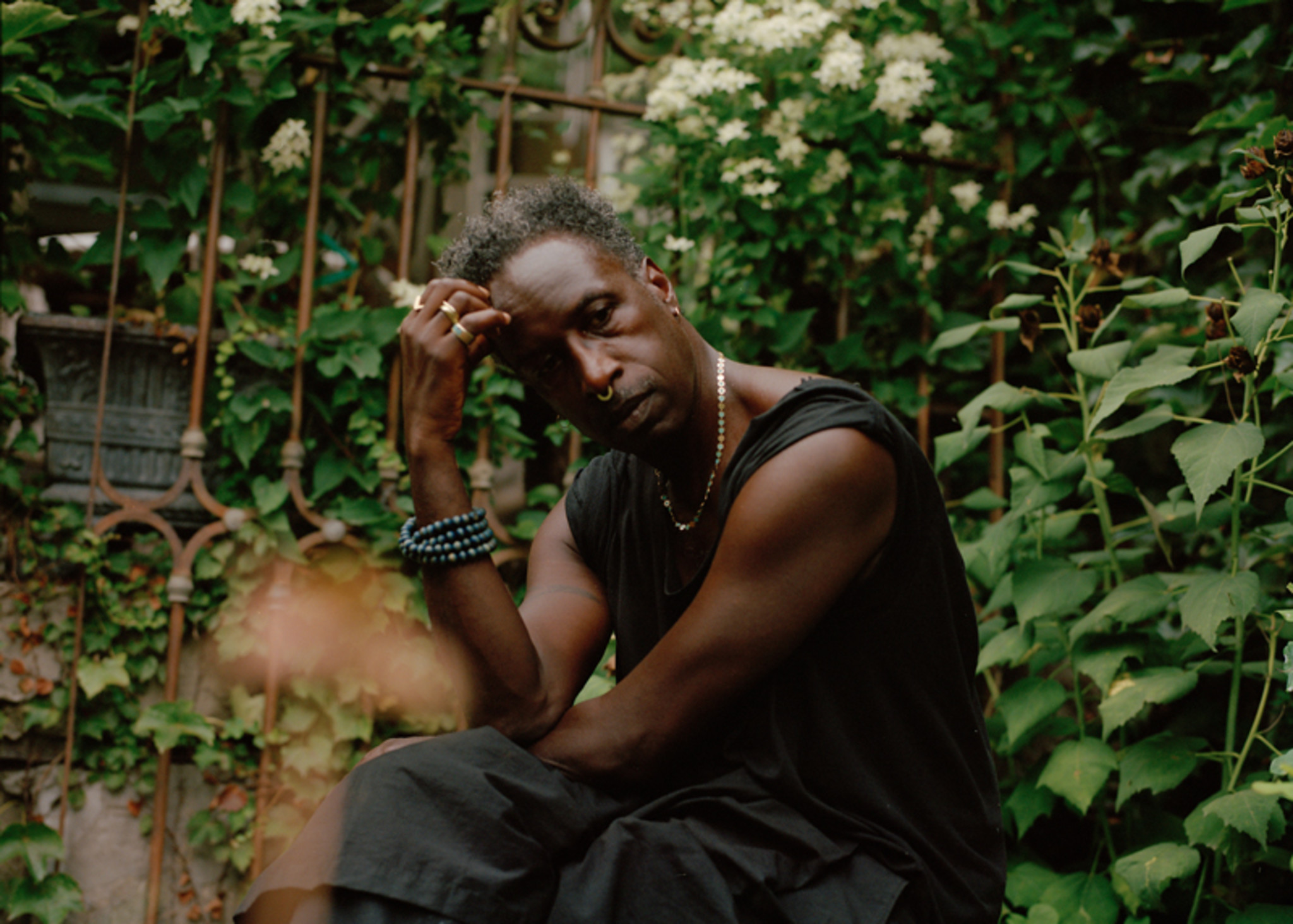
“I Would Struggle
Without Glamour”:
A Conversation With
Ethan James Green
The photographer discusses nudity,
collaboration, the Pirelli Calendar,
and his new exhibition, Bombshell.
- By: FT
- Photographed by: OK McCausland

Born in Michigan, Ethan James Green arrived in New York as a model in 2008 and quickly started turning the camera around. With the late David Armstrong as his mentor, Green, now 34 years old, developed a practice of intimate, often black-and-white portrait photography that flatters the subject simply by revealing them. “Ethan offers beauty as an undeniable truth, using the camera to frame evidence not easily seen in person,” Martine Gutierrez, a regular collaborator, tells me. No mere models, Green’s subjects collaborate with him, often on multiple projects. Many of them are themselves artists, and many inhabit a shared, lively queer New York milieu. That milieu was the source material for his first book, Young New York (2019), and also provided the collaborators for his second book, Bombshell, released this year.
Green’s work is based in, and evokes, a sense of community and communal trust. “I feel quite lucky to have worked with Ethan,” says photographer and regular collaborator Sam Penn. “He’s photographed me, I’ve photographed him, he’s published my work, I’ve curated his work. He is a great photographer, obviously, but is also so good at collaborating with other artists, understanding their work and figuring out the best way to showcase it.” To better showcase the work of other artists, Green founded the New York Life Gallery in lower Manhattan in 2022.
Green’s photography has garnered extensive acclaim in the worlds of art and fashion, culminating in an assignment that is among the most prestigious meeting points of the two realms: the Pirelli Calendar, a.k.a. “The Cal.” First published in 1964, the calendar was discontinued for a decade beginning in 1974. When it returned in the mid-’80s, it had morphed from an advertising gimmick into something more—an exclusive, iconic opportunity for prominent photographers to showcase their work, with the emphasis now more on the models’ bodies than on any slips of clothing they might be wearing. That focus on nudity and sexuality was tempered in recent years, but is now making a return, though carefully and collaboratively, as Green explained to me over the phone. With lines of trailers and a crew of some 60 people, the production was a far cry from the close-knit collaborations of his New York community, and yet not so different in approach.
I spoke to him while he was back home in Michigan, briefly resting between the Pirelli shoot and the opening of Bombshell, his first-ever solo gallery show at Kapp Kapp and a companion piece to the book.

Chloé at Ethan James Green Bombshell exhibition. Top Image: Alex Consani and Ethan James Green at Bombshell exhibition.
FT
Ethan James Green
You shot the 2025 calendar in the Florida Keys. What was that like?
It was amazing. It was really great. It was a mash up of two worlds—the magazine editorial celebrity world mixed with something that’s a bit more personal. It’s fun to have that crossover and work with a lot of collaborators that I work with in the editorial advertising arena on something more personal. That doesn’t usually happen.
Is there a specific camera that you’re attached to? What were you using to shoot the calendar?
I am the least technical person ever. We rent cameras for jobs, so we just use the most recent version of the camera that we’ve been using. I’m looking it up right now [laughs]. But we were coming from Bangkok to Miami, and the last night in Bangkok I was walking with some people and we were going to a flea market and we found a split frame camera, an old one. I thought, oh, I’ll just use it for the calendar, just for fun. It was interesting, ’cause now that I’ve had some space from it, I’ve realized that the equation and formula to the Pirelli Calendar is so close to my book Bombshell, and the split-frame camera acted kind of like the Polaroid camera acted for the Bombshell project. When I would hit a wall, I’d switch to this camera [and when] you look in it, it looks completely different. So you start approaching the pictures in a completely different way, and then something magical would happen.
How did the Pirelli Calendar come about?
I got a text from Piergiorgio [Del Moro], who’s been the casting director on it for, I think, at least five years. And he just was like, “Would you be interested in this? Your name is like being thrown around right now.” And then they started reaching out to my agent. During the same time I decided to do a tarot reading, which I rarely do. And the woman who was reading my cards told me there’s gonna be a big package coming from Italy, and that’s a very good thing. And the next day I got to my studio and I had been sent all the calendars from Pirelli, and the fiftieth-anniversary book. And they flew to New York and came to my studio and gallery and we talked about what we loved and what our favorite things were. Then they called me a few weeks later to confirm, and that was back in February, and it’s been nonstop Pirelli ever since.
And in between you called Martine, and she was on her motorcycle.
Yeah. Just another day with Martine [laughs].

Alex Consani at Ethan James Green Bombshell exhibition.

Hari Nef and Ludwig Hurtado at Ethan James Green Bombshell exhibition.

Left: Ethan James Green, Connie, 2021. Middle: Ethan James Green, Devan, 2021. Right: Ethan James Green, Hari, 2021.

Dara at Ethan James Green Bombshell exhibition.

Faris Saad al-Shathir and David Velasco at Ethan James Green Bombshell exhibition.
Would you consider this fashion photography? Pirelli isn’t a fashion house, so how would you classify this kind of project?
The goal was to be even more timeless than I normally try to with fashion, and because nudity is something that we get to play with. It’s different, ’cause you’re not shooting with clothes needing to be the focus. It’s a lot of people that I would photograph in fashion, but I think it’s interesting to pull them out of that and do something that felt more personal, an approach that’s very compatible with fashion [but] even more about the person. And, it was interesting working with [stylist] Tonne Goodman on it, because I’ve done so much fashion work with her, and seeing her shift and make it so the clothes are never the focus and just completely something that does enhance the picture.
As a photographer, do these categories affect how you approach the image, or do you just take the pictures you take and sort it from there?
I’ve always been instinctual. And I’m very inspired by fashion photography, so there’s always going to be an element in there, but I feel like the approach is always quite organic with me. You’ve got to adjust to who you’re shooting, where you’re shooting, what the light is. I don’t think too much about it. It just happens.
You’re more of a “let’s go in and see what happens” photographer, rather than “there are certain shots I know I want to get.”
When I’m starting, there are certain shots I know I’m going to get, but then every single time, I learn the lesson that you may have an idea of what you think it needs to be, but nine times out of ten, you’re going to end up someplace better if you’re open-minded.
You shared with The Guardian recently that this Pirelli Calendar goes back to the kind of sexiness that they’ve stayed away from the last few years. Is that something that came from you? From them? Was there a lot of conversation about it?
That was something that I wanted to do right off the bat, ’cause for me, if I’m going to do Pirelli, I want to do Pirelli. I think people really want to see sexy pictures again. But I think that there’s a respectful way to do it. With the Guardian article, the journalist left out a huge part of our concept, really, which is the collaboration with the subject. We’re having long conversations and sittings and asking the subject constantly what they feel. I think the thing that is important to know about our sexy approach is how involved we’ve asked the subject to be.
The Pirelli Calendar isn’t changing people’s careers anymore. It doesn’t have that power, so everyone who is in the pictures, the reason they agreed to it is because they want to participate and make that type of image with us. The big thing is involvement with the subject, from choosing what they wear to how they want to stand to looking at the pictures as they come in and feeling open to suggest trying something else. We got a lot of great pictures at the end because some of the subjects offered to try something. They’re like, “What if we do this?” And, Connie, myself, the rest of the team are like, “That sounds amazing. Let’s do it.” And, a few times that ended up being the picture. And it was all the subject’s idea.

Courtesy of Kapp Kapp.

Courtesy of Kapp Kapp.

Patti Wilson at Ethan James Green Bombshell exhibition.

Left: Ethan James Green, Dara, 2017. Middle: Ethan James Green, Peter and Stevie, 2018. Right: Ethan James Green, Marcs, 2015.

Left: Cruz Valdez at Ethan James Green Bombshell exhibition. Right: Mark Holgate (right) and party attendee at Ethan James Green Bombshell exhibition.
Tell me about Bombshell. How did it come together?
It’s actually going to be my first solo gallery show as a photographer. I run a gallery, and all the other shows are not my work, usually, so it’s exciting to have my work exist in the gallery space like that. But that project is actually super similar to the Pirelli project. It’s a lot of pictures of mainly friends, a lot of people I’ve photographed over the years. It started with just a hair test with my friend Lucas Wilson, who’s a hair artist, and my friend Marcs, who I’ve photographed probably more than anybody else. We just started with a hair play day, and we just kept repeating “bombshell,” as we were shooting, ’cause Marcs showed up with like some flowers from the flower market, a little bit of lingerie, and Lucas gave her these like, you know, bombshell, big, beautiful hair moments. And after we finished taking that first day of pictures, it just felt very similar to my first body of work in New York. I had that same rush. I wanted to do it again, and we had this formula.
And so it just kind of revealed itself, ’cause I had been investing a lot of my time in my fashion work, ’cause the personal work—nothing had felt this good and right in New York for years, and then Bombshell happened, and it just felt so right. I was able to just reach out to a lot of the same friends that I shot for my first book. We worked with three different hair artists: Lucas Wilson, Jimmy Paul, and Sonny Molina. We shot it over about two years. Maybe one and a half years. My friend Devan Díaz wrote the intro to it. I love her writing so much, and I feel like she put our friends and the experience that we all shared together in this little time capsule. It’s another project that’s very collaboration-based. That’s something that I think is just consistent through all my work.
What does working with friends or regular collaborators allow you to do that you couldn’t do with a random model that you hired for a shoot?
I think there’s a trust there. When you’re working with the right collaborators, you can move organically together. If someone has a suggestion, usually it’s a great one because you’ve built this relationship and you’re on the same creative page. You bring in collaborators because they bring something to the project that you couldn’t bring yourself. A lot of the people that I photographed for the project are close friends and have worked with me not only in front of the camera but behind the camera. A lot of the people who participated as subjects in the project are usually collaborating behind the scenes with me. So there’s this understanding and [an] understanding of my work in a way that you don’t always find subjects have with photographers. We could really explore together in a bigger, better way.
Is glamour important? Is it important to you? Is it important to society? Is it something you are invested in?
Yeah [laughs], I’d say I’m invested in it. But I didn’t realize how much I am until you asked me that. I think I would struggle without glamour. I love to be around it. And I think it’s really fun to celebrate it, and so many of my friends just walk into a room and bring it into the room by just being there. I think glamour’s really exciting. It’s something that people have been so afraid of for a while. But I think it’s what the city needs.
The interview has been condensed and edited.

Party attendees at Ethan James Green Bombshell exhibition.
FT is a philosopher and critic based in New York. His current work can be found on Patreon.
- By: FT
- Photographed by: OK McCausland
- Date: September 12, 2024