Badu Rising
Erykah Badu has been on fashion’s mood board for almost three decades. Now she’s ready to be on its payroll.
- Interview: Elena Bergeron
- Photography: Nick Sethi
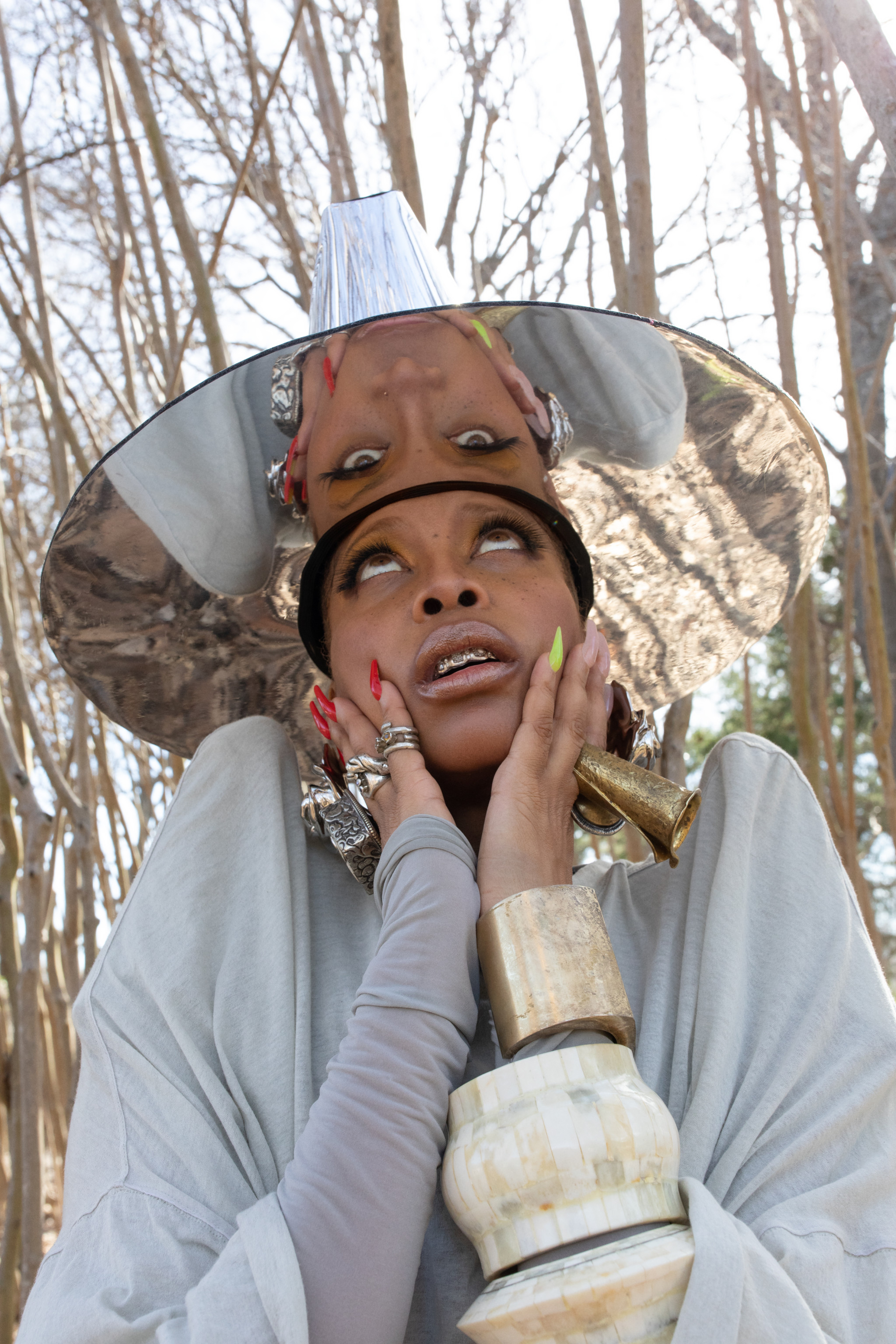
Erykah Badu pauses to consider what it’s like to move through the world dressed like Erykah Badu.
In the 26 years since her album debut, she’s drawn eyes upward, following her towering headwear, and downward, to consider the rivers of fabric coursing to where she stands, speckles of amulets and ankhs and talismans dotting the journey.
“Going to the airport, you know, it’s a little impractical,” she finally says. “Cause when I’m dressed I’m usually dressed for the day and sometimes I forget I got to go through all these changes, the metal detectors and what have you, you know, it’s a lot. It's not practical then. So I’ve learned to kind of put all my jewelry in a little bag and put it on at the end of security. Yeah.”The Brand of Badu is a powerful thing, which now seems obvious. That was perhaps an audacious idea when she dropped Baduizm in 1997, days shy of her twenty-sixth birthday. As an emergent artist then, her music, like her look, was a reset. This holds true today, too. Erykah Badu masterfully layers the familiar with fresh ideas, changing the whole into something whose beauty can sustain a searching eye or ear. You can listen to “On & On” or “Orange Moon” or “Honey” and hear centuries of Black music depositing their silt, glinting in ways that feel just right.
“I don’t feel comfortable unless I’ve created this thing, this shape and silhouette.”

Erykah wears Thom Browne coat, Simone Rocha pouch and her own hat. Top Image: Erykah wears Rick Owens crewneck, Y/Project earrings and her own rings, bangles and hat.
“No matter what it is, it’s all about the shape and the silhouette and I don’t feel comfortable unless I’ve created this thing, this shape and silhouette,” Badu says. “It’s just the way I see things. I mean, my house is that way, the way I cook is that way. The way I fashion my tweets is that way, the way I do my hair or write my songs. It all has the same element of—or the essence of—whatever that is that makes me. And…um, yeah.”
It’s a couple of questions into our conversation before I notice the yeah. When we speak by phone, she’s hurtling somewhere along a Texas highway on her way to perform at the Houston Rodeo, her horse-riding Uncle Mike in tow. The reception is spotty enough to crackle the questions but the responses make their way back direct. And the yeahs, I realize, are not an unconscious verbal tic. They’re punctuation. The way a painter might step back from a canvas and surmise that not another stroke is needed. Consider it finished. Satisfactorily. Yeah.
The power of her ideas, their recognizability as specifically hers, has been a throughline to her various ventures. The “Badubotron” radio show gave way to the Badubotron tour in 2021. Badu World Market, an e-commerce site, sprang up in 2020 and immediately sold out of Badu Pussy incense: The clever nod to the mythology of her influence over men was “created with the ashes of Badu’s underwear.” In March, That Badu, a strain of weed that she created, dropped with more cannabis-based products to come based on woman-centered needs she’s learned to address through her work as a doula.

Erykah wears Pleats Please Issey Miyake dress, Thom Browne coat and her own jewelry.
Lately, the 52-year-old’s unique perspective has drawn calls from some of the biggest heavyweights in fashion. Anna Wintour personally asked her to walk in Vogue’s 130-year anniversary fashion show in 2022. That year she also attended the Met Gala with Francesco Risso, creative director for Marni, and the two have been sharing memes and ideas ever since. This year, Marni is set to release their collaboration of nearly 40 pieces.
But her emergence in the high-fashion world isn’t a new moment. Tom Ford made her the face of his White Patchouli fragrance way back in 2008, and she styled a 2016 Pyer Moss show in exchange for keeping the shearling overalls designer Kerby Jean-Raymond loaned her for an appearance. R&B-head Riccardo Tisci cast her as the face of Givency’s Spring 2014 campaign before doing the same at Burberry for Fall 2021. Thom Browne called her “a true definition of the creativity in America,” as he worked with Badu on her look for the 2021 Met Gala, and she sat front row at his runway show this February.

Erykah wears her own rings.
Badu says she’s been invited to fashion week since she first stepped into stardom, but only recently decided to actually show up. It’s been a tactical change of heart: “I know my creativity stands out. I know people are inspired by me. I know I’m on everybody’s mood board. Now I’m ready for you to put me on your payroll.”
The self-described B-girl and sometime DJ comes to fashion precisely at a moment when hip-hop’s influence is being directly attributed and celebrated. And scrutinized. On the heels of Dapper Dan getting his just due from Gucci, and as adidas considers how to kick its dependency on Ye, the producer and songwriter Pharrell Williams was named to fill the void left by Virgil Abloh atop Louis Vuitton’s menswear.
While some applauded the appointment as continuing Abloh’s legacy of cool curation and Duchampian norm-busting, more than a few critics lamented his hire as a sign “that a pure designer, that is someone who had committed themselves to both the technical aspects of fashion as well as its creative expression, couldn’t deliver what the company wanted,” as Robin Givhan wrote in The Washington Post.

Erykah wears Marni jacket, Marni skirt, Marni lounge pants, Nike sneakers, Sophie Buhai ring and her own hat and bells.
“Blackness is
the common denominator
to all of the arts.”

Erykah wears Marni lounge pants, Nike sneakers and her own bells.
“The theory of things is something really good to learn, if that’s what you’re interested in,” Badu suggests, referring to classical training in the arts. “But I don’t think it’s necessary. I can’t read any music at all, but I can play instruments and write songs. So I'm thinking that the theory of music was based on someone like me somewhere who was doing what was coming to them naturally. I went to Kenya and visited with the Maasai tribe, and there’s nothing out there but dirt, brown dirt. And you see all these beautiful colors coming from the distance—creative jewels and really talented beadwork and all these things. We create up out of mud.
“We weren’t interesting to them at one point. But we are now very interesting to them because everything, the common denominator is Black people and Blackness is the common denominator to all of the arts. You know, the creators and the ones who create out of a need, the resilience, the resilience of artists in the Black community.”
Still, any artist, even for one so consistent in their practice as Badu, runs the risk of having their work misinterpreted. The skewed reception to ideas—whether for lackluster execution or the biases of the audience—is a real challenge. The Brand of Badu has become lore. With her spirituality at the forefront and a maximalist’s sartorial armor coupled with the trail of doe-eyed men she’s left in her wake, Badu is often perceived as an ethereal priestess, rather than a flesh-and-blood woman.

Erykah wears Pleats Please Issey Miyake dress, Pleats Please Issey Miyake trousers, Issey Miyake jacket, Rick Owens sandals and her own headpiece and sunglasses.
So when she stepped onstage and put on a mini twerk fest during Megan Thee Stallion’s set at a festival in Switzerland last year, the “Savage” rapper said Badu had “shocked thee shit outta me.” The social media commentariat was inflamed when Puma Curry, Badu’s 18-year old daughter, posted a photo of mother and daughter shot from behind while wearing matching leggings.
“I don’t know why this particular one caught their eye,” Badu says. “I’m the girl who did ‘Window Seat.’ What’s the big deal?”
The airy dismissal reminds that when that video came out in 2010, with her disrobing in Dallas’s Dealey Plaza, where JFK was shot, Badu’s point nearly got drowned out for the response to her nudity. She’d planned a piece of performance art that referenced Irving Janis, who in 1972 coined the term “groupthink.” The undressing, Yoko Ono–style, was meant to be a visual interpretation of the idea: Those who throw off the armor of popular opinion stand to be targeted for it.
“I didn’t know it would be overshadowed by my figure,” she says. “There’s no way I knew that my booty did that when I walked.”

Erykah wears Rick Owens crewneck, Y/Project earrings and her own bangles and rings.
Interviews during the subsequent rollout for the album, New Amerykah Part Two (Return of the Ankh), were almost solely devoted to explaining the nudity. She jested at questions about her reputation for casting spells on men in her purview while making points about not performing for the male gaze. Less ink and HTML code were given to how Badu was pushing away perfectionism in her songwriting and using GarageBand and her very first computer to produce albums about fear (2008’s Part One) and love (Part Two).
It was a pivotal diptych in her career, one that had already seen her score Grammys and platinum albums while also giving birth to her first child. But Badu experimented with time and pitch on that album, further departing from the expectations of the “Queen of Neo-Soul,” a title she felt froze her work in the past.
Since then, she’s continued to create—music and babies—and keeps up a touring schedule that has her on the road eight months out of every year. Balancing those things has further lit up her phone line with calls from Teyana Taylor and Summer Walker, artists whom she’s helped deliver children.
“I never talk about music or create art with those girls or many of my women friends. We talk about life and what’s going on right in front of us because there are not many people that an artist in our position can talk to candidly and honestly. You know, it’s very hard to find people who are equally yoked with you so that you can have easy conversation about anything in your life when it’s different, you know? Yeah.”

Erykah wears Thom Browne coat, Simone Rocha pouch, Thom Browne shoes and her own hat.
At this point in her road trip, we’re talking about how she and Lauryn Hill in the late 1990s helped reset notions of what it meant to top the charts while creating a family. I ask if, in her conversations with those new mothers, she’s seen any changes in how the music industry does or does not accommodate mothers.
“It’s childbirth. It’s not an illness,” Badu says, nudging the idea that women artists had been creating and procreating long before she was nursing her firstborn, Seven, onstage and on the road. “I didn't even know when Chaka Khan had a baby. Didn’t know that. Didn’t know when Deniece Williams had a baby or when Minnie Ripperton had a baby. But shit, you know, sure and behold here they are, adults and creators. I didn’t know when Diana Ross had babies. We couldn’t see that.”
I suggest that’s because labels and managers and touring companies didn’t want the public to know; that the idea of marketing a mother once was a more fearsome idea than marketing a sex symbol.
“That’s changed a lot, because we’re visible a little bit more. And as the term ‘modern woman’ begins to expand, so does the visual of it. Men didn’t want a lot of things,” Badu says.
It gives way to an exchange about the women who are expanding that notion now. “I think India Arie did that in 1998 or 9, you know, when she came out. She did not fit the profile, kind of like I didn’t fit the profile. But she even took it further—to Africa with her melanin and her hair texture and those things that are not supposed to be aesthetically pleasing, you know, because as a woman, I think the record label finds you hard to market when you are not fashioned for the consumption of male entertainment. But now there are a lot of women writers and historians and executives in these fields and in these places. So it changes along with them. But let me see. I don’t know nobody else. Can you name someone?”
I suggest Lizzo.
“Jill Scott came along before that. Lizzo takes the platform to another level with it, which is a sign of the times, you know. We appreciate Lizzo. We appreciate her freedom and her bravery, because it’s scary, you know, when a lot of people have a certain energy towards you, you feel it, and, you know, it dims your light and brings you down. I think it’s so heroic for artists to go against the grain and be themselves and want to be counted and demand a seat. I think that that’s a beautiful thing. That’s what I like my daughters to see. Yeah, Lizzo would be one of them. What about Rhapsody?”
Yeah, I say.
“Yeah. Not only her voice, but her demeanor and her—she's not selling an image. She’s selling her music and that’s different.”
I offer: “In terms of what she sings about, Ari Lennox feels like she’s pushing things in a unique direction, too.”
“Oh Ari? Ari’s one of my favorite singers,” Badu enthuses. “‘Whipped Cream’ is my favorite song. Any time of day I can put that on with that four-on-the-floor and cry and clean up or whatever I need to do, you know?”
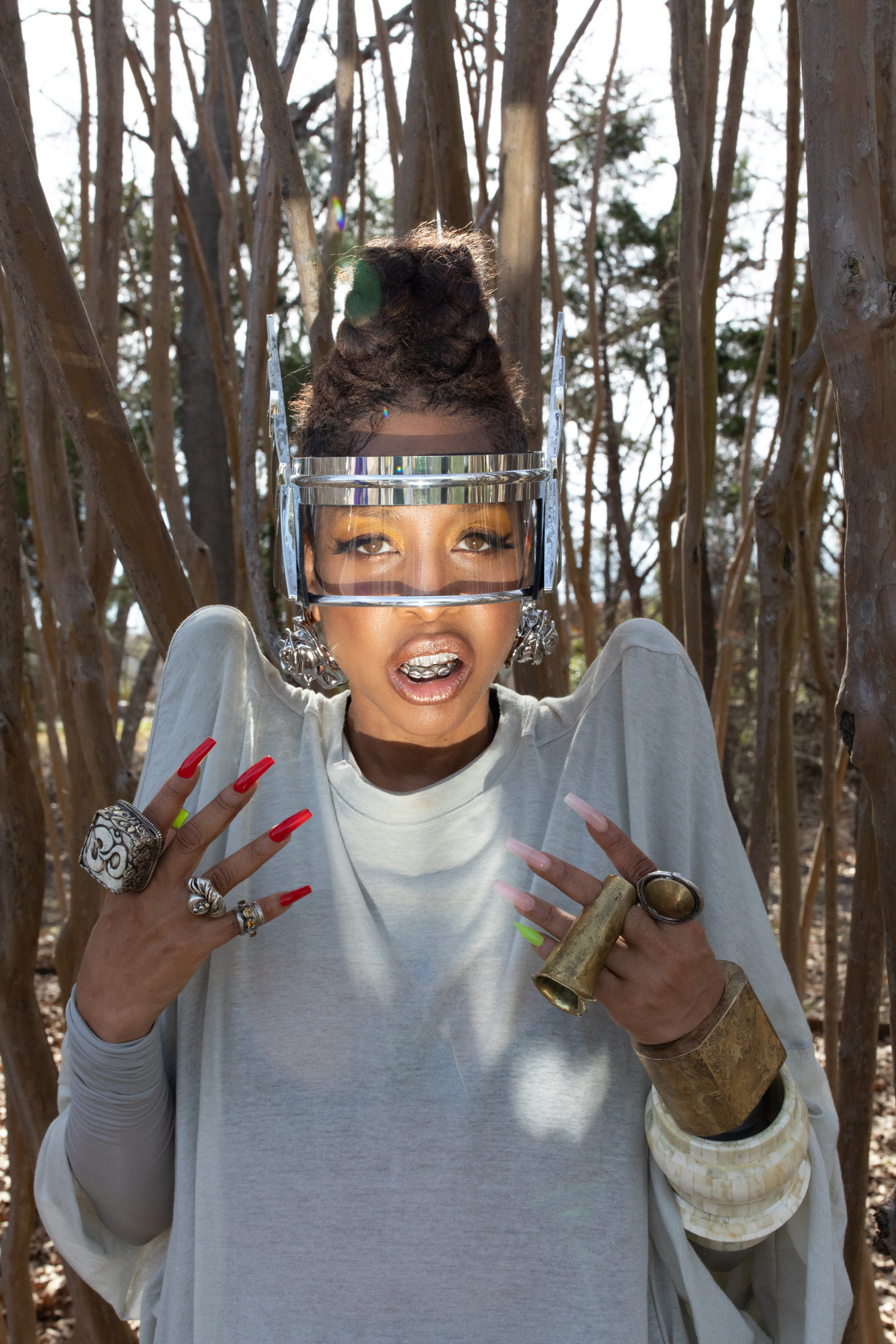
Erykah wears Rick Owens crewneck, Y/Project earrings and her own rings, bangles and sunglasses.
By this point, I don’t know how many miles Badu has left to go or how fast she needs to travel to get there—if she’s late or early. There’s a publicist clocking the time while we get into the nuts and bolts of her role executive producing and appearing in The D.O.C., a documentary about the ‘90s rapper and ghostwriter who is also father to their daughter Puma, and then we wend around to more esoteric ideas about artificial intelligence.
Weaving through the mundane and the esoteric, she dots a point on the pervasiveness of technology, the subject of her 2015 release, But You Caint Use My Phone. The gadgets and machines—the headphones and cell phones and speeding cars that facilitate our conversation—can’t be avoided, not even by Badu.
“I’m definitely in the world with you.”
Elena Bergeron is a Brooklyn-based writer and editor whose work has appeared in Fast Company, GQ, Complex, and ESPN The Magazine, among other titles. Most days, she can be found helming NFL coverage for The New York Times.
- Interview: Elena Bergeron
- Photography: Nick Sethi
- Styling: Becky Akinyode
- Creative Direction: Erykah Badu
- Makeup: Michelle Dick
- Hair: Yasmin Amira
- Photography Assistant: Paige Labuda
- Styling Assistant: Chas Chevonne
- Production Assistant: David Velez
- Photography Direction: Michael Quinn
- Production: The Morrison Group
- Casting: Greg Krelenstein
- Date: April 6, 2023

