There Are No NPCs in Julio Torres’s Universe
The writer, director, and comic is building a moving-image multiverse where even the inanimate objects are recognizably human.
- By: Jorge Cotte
- Photographed by: Tyrell Hampton
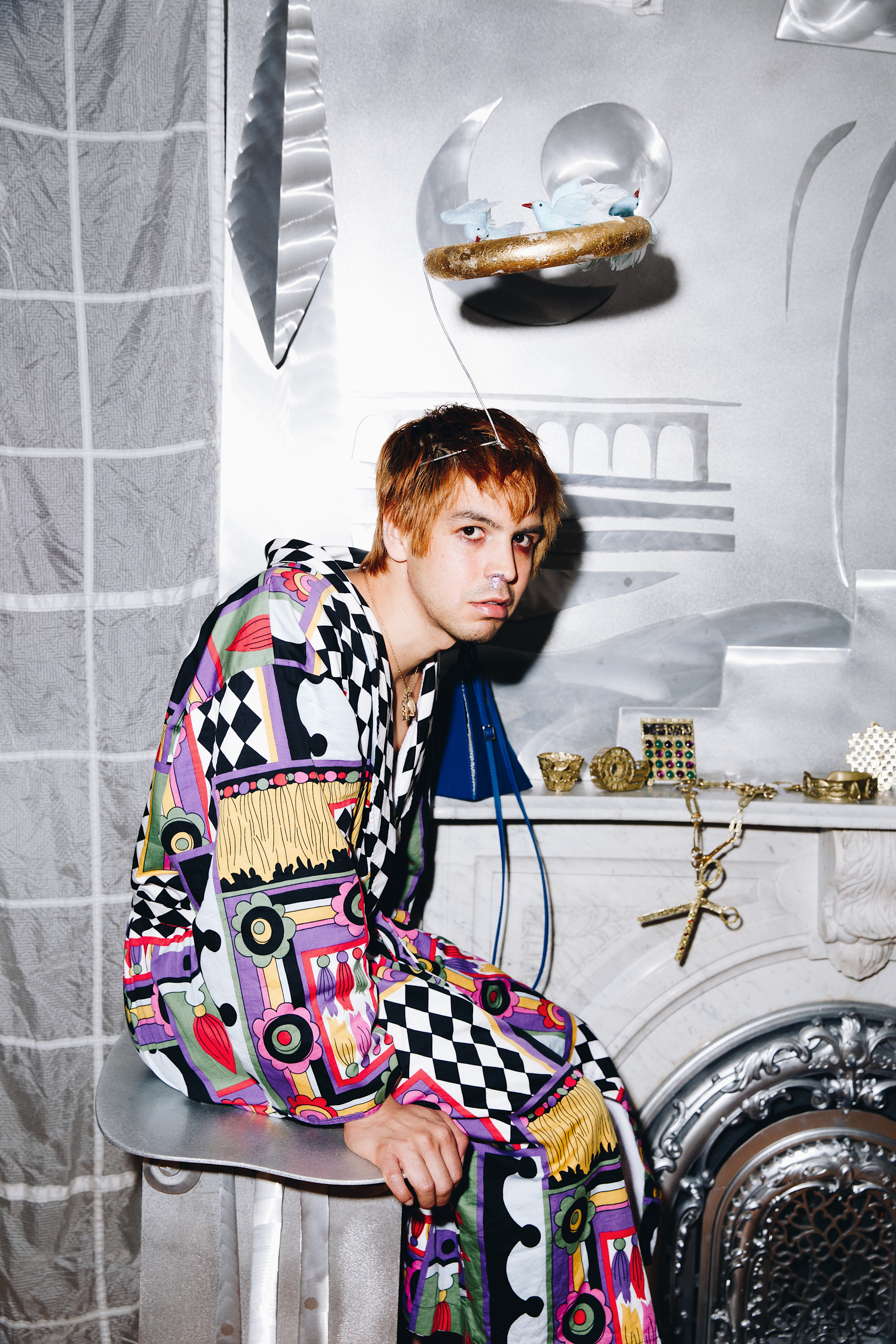
In one vignette of Julio Torres’s audacious Max series Fantasmas, the main character steps into a jump rope group exercise class in the kind of gym that wishes it were a nightclub. Torres plays a character, also called Julio, who needs to exercise for an upcoming superhero role that he doesn’t really want. But he sees the absurdity that the sweaty, optimistic gym-goers around him miss: What—really—is the point of jumping rope? Why do you need the rope? Wouldn’t you burn the same calories if you jumped in place? This line of questioning sends the exercise class’s instructor into a tailspin, who moans: “Because if you keep pulling at this thread, everything collapses, and suddenly, there’s no God.”
The context leading into the gym scene captures much of what makes Torres’s voice special: a character cordoned off by societal pressures and the entertainment industry’s bizarre preoccupations; identity politics as fence rather than launchpad; the gym location—heightened but also instantly recognizable in its absurd trendiness—and, at the core, a willingness to question the default, conventional wisdom of the world. Despite the threat of unraveling things that feel sturdy (or perhaps because of it), Torres is always pulling at threads. He’s able to see that the emperor has no clothes—or rather, that there is no emperor, only clothes in the shape of one. Though Torres’s questions may reveal an absence of authority, that absence makes room for him to see the humanity in everything.
Much of Torres’s work is about extending interiority into the margins—a sink, a succulent, a plexiglass square with a corner missing, a hog who works as the Flintstones’s garbage disposal, or the woman in a gay porn movie who exists only to be cheated on. For Torres, aesthetics and the projection of interiority go hand in hand. We are constantly making judgements about things around us, rooted in how they make us feel, and yet we ascribe those feelings to those objects. Torres takes that further, seeing in those projected feelings not the physical characteristics of a sink, but an interiority that is human and deeply recognizable.
Even if you don’t recognize the 38-year-old writer, director, and stand-up comedian Julio Torres, you likely know his work. His voice first flourished as a writer on Saturday Night Live, and many of the sketches he worked on glimmer with his unique point of view. His most well-known is “Papyrus,” about a man who cannot get over the fact that James Cameron’s Avatar, the highest grossing movie of all time, used a stock font for its title. Another standout is “Wells for Boys,” which takes on both traditional gender roles and the commodification of gender performance.

In 2019, Torres released an HBO comedy special, My Favorite Shapes, and Los Espookys, a genuinely bilingual show that he cocreated with Fred Armisen and Ana Fabrega. In Shapes, the viewer encounters Torres’s aesthetic specificity and preoccupations: clear and translucent plastics, reflective surfaces and metallics, and organic shapes create a meticulously designed world. Five years later, Torres made his feature film debut with Problemista, a movie that reimagines elements of his autobiographical journey with immigration and precarious employment in New York City. It was his first time directing, but Torres doesn’t see that step as a leap as much as a natural progression. On SNL, Torres got on-set experience with his frequent collaborator Dave McCary, and with Los Espookys, Torres expanded his involvement as a writer, performer, and producer. But more importantly, he slowly gathered a community of collaborators.
Collaboration is important to Torres, who talks about his “creative family” and who ends Fantasmas with a scene that brings so many of the performers and stories of the rest of the season together in a beautiful act of collaboration and finding community. The scene can be read as a metatextual reframing of all the struggle and strife that came before it, where everything can be refashioned by performance and creativity into something that brings people together.
When we spoke, Torres had recovered from a year of near-constant publicity and was “planting seeds” for his next movies. But Torres has not left stand-up comedy behind either. Since fall of last year, he has toured with a new comedy show titled Color Theories—and as he has developed the storytelling aspect of his artistic practice, the role of stand-up comes into relief as the theory behind his work—comparing stand-up to the artistic statements that are put into practice in his dramatized work.
A new artistic statement may hint at what’s next for Torres, though it’s safe to say that he will continue pulling at threads and refashioning worlds only he could make; that he’ll continue unveiling the mundane to show what’s absurd and fantastical about what we accept in contemporary life.
Over Zoom, Torres discusses his influences, recent work, and how he approaches character and collaboration.

It feels like you emerged as an artist fully formed, so I want to know about your aesthetic or stylistic influences. From reading other interviews, I know that your mom is a designer, and she was an influence, but what are some of the artworks or films that you would consider big influences in your style?
I think that I’ve always gravitated towards people who make worlds unto their own and who create a visual language that they can—even if not literally, but artistically—call their own. I just heard Pedro Almodóvar say that he’s made 24 movies and some of them he really likes, some of them he likes less, but they’re all his. I think that is beautiful and what I would love my journey to be. Him, Michel Gondry. More recently, Bong Joon Ho or Boots Riley. I was also a big Sofia Coppola fan in my teenage years. In terms of film careers, those are the roads I’m interested in.
In terms of visual influences, obviously New York City plays such a big role in what I’ve done so far. And I feel like any director with a point of view will show New York in a different way. I have my New York, Radha Blank has her New York, Spike Lee has his New York. But I feel like mine is fused with this sort of surrealist wonder that’s a little bit from painting, a little bit from the telenovelas that my mom was watching when I was a kid. And I take versions of magical realism from that.
Also, my childhood was very heavily influenced by fairy tales and ’90s animated movies that really informed Problemista. It’s a mishmash of aesthetics that gives me the liberty to explore the world as I see it now.
It’s interesting that you brought a magical realism because I’ve seen it brought up with your work and I always wondered if you actually see that in your work, or is that something projected onto you. If you’re brown and you’re making anything that’s—
That word is in my mouth because somebody else put it in my mouth. When I’m working, I don’t really think to myself, “I’m going to make magic realism.” I’m just portraying the way I feel it, rather than how it is.
Yes, there is an element of abstraction. There is a surreal, lifted take on it. But, you know, magical realism comes with this sort of tropical sheen to it that I don’t necessarily know that my work has. I feel a bigger kinship with Kafka than Márquez, because I’m very into existential dread or what it means to be a person in a city today.
And the absurdity.
Yeah, yeah, yeah. And the loneliness of it.


New York features in both Problemista and Fantasmas. Problemista feels more grounded. Even though there are fantastical elements and parts where you interface with Craigslist as an embodied person, there’s also a literal immigration law office or a line of Citibikes on a New York street. Fantasmas struck me as more dreamlike. Were you trying to differentiate the two?
In the versions of myself that I play in these two works, the Problemista one is obviously more naive and childlike, which is ironic because, like you say, that work is more grounded.
Whereas in Fantasmas the bleakness of the world has jaded my character much more so than in Problemista. So, the visual take there was escapist. In Problemista, you see the real world with love, and in Fantasmas, you extrapolate from the real world, and you see concepts more than you do life as it is.
And it is a lot more absurd, right? There’s elves and hamsters and mermaids and demons. But even with these absurd characters, I do see their longings as very human. But it’s nice to know that I am willing and able to be completely absurd visually or way more grounded.
It’s interesting you call it bleak because the lighting itself is gorgeous. It feels like a halo around these situations.
It’s very ghostly, obviously. And that’s very deliberate. It’s a little dissociated. Whereas everything is very sharp in Problemista.
Were you trying to be more abstract and conceptual?
No, not really. Fantasmas came out of my desire to tell smaller stories—smaller-in-length stories. And then I was like, OK, well, how are they arranged? What is the common denominator thematically? And then at the very end, how do I visually represent them?
I was very keen on having it be a sort of fantasia. But the characters came first, the worlds around them and their situations came second, and then the way it looks came third.
Do you think about artificiality and performance as something that you’re playing with? Because obviously you are not hiding that you’re on sets and stages in Fantasmas. But I’m also thinking of the character of Vanessa (played by visual and performance artist Martine Gutierrez) and how she’s revealed to be a performance artist playing the role of an agent, but she also is literally doing the work of an agent. So, it’s both performance and not. Do you see everything as a kind of performance?
Yeah, I do. I see our jobs as a kind of performance. We’ve all heard the customer service voice, the way the tone of voice goes up at the end of every sentence. “Can I get you anything else?” No, this person doesn’t talk like that in their private life, but they’re playing the part of waiter.
Jobs become our masks in a hypercapitalist society. Fantasmas is also very preoccupied with jobs and roles and how that affects your life and interpersonal relationships, and people feeling trapped or unseen in those roles. Vanessa is performing, but so is a customer service rep, right?
Someone who just glosses your work might miss the strong undercurrent of critique in it. And that’s coming out even more in your recent work. In Fantasmas, a Christmas elf is suing Santa, but it’s a labor dispute.
It’s a labor dispute that he loses because he’s unlikable! And because Santa is untouchable.
How much are you deliberately trying to do that critique versus just developing the story and only later seeing the trends in your own work?
It’s always a lot more organic. I’m not a thesis statement-first person. I’m character first, story second.

My Favorite Shapes extends interiority and empathy into what that other people might see as just an object. But I also see that same impulse in the customer service encounters. You’re identifying the system as inhuman, but there’s still a human there and you’re trying to reach them, right?
Yeah. And I would say, with Problemista, because that is a movie about problems and the human toll of these problems, I was very keen on always showing the waiter, showing the gallerist, showing the customer service rep. Let’s see their faces and give little details about what their lives are away from this, because maybe it’s not their movie, but we should get the sense that, if the camera were to stay there, we would get a whole other Problemista.
And that’s right in line with telling The Lion King from the point of view of one of the zebras. (Julio pitches this story to an uninterested exec in Fantasmas.)
There are no NPCs in my universe.
Where do you think that comes from?
I don’t know. People really stay with me. I’m a very curious person. My father is very curious, and my mother—they both remember people very well and wonder about people’s lives. And then, honestly, playing with toys is literally that. Your toys live a life of their own and they all have their own little stories. And I feel like I just sort of keep doing that.
Also, Problemista touches on that period of my life when I took on so many different roles, like literally jobs. I’m weirdly grateful that I got the experience to roam around New York and take little Craigslist jobs. Even though, obviously, I wouldn’t wish that on anyone, but you know, being an interpreter for public schools, being an assistant to this person, assistant to this other person, a chocolate free-samples person. Being like OK, what’s it like to walk into a supermarket and talk to the supervisor and put out your little table? What people come to this supermarket in Sheepshead Bay versus the rich person that lives in Soho versus the public school in Staten Island where I translate? Just seeing all these pockets and windows into different worlds. I think that was very formative.
It must be a dream to get to work on one of your projects if you’re a production designer or wardrobe designer. How do you find the people that you want to collaborate with?
I’ve really lucked out with the production designers that I’ve worked with and would in a heartbeat work with any of them again. I look for excitement. I look for a level of silly. I look for just willingness to play. When I interviewed Tommaso [Ortino], who did the production design for Fantasmas, he suggested that in the Crayola boardroom that the table be white and that they all have a crayon in the shape of a ball, and they pass the ball to each other, making a line in the paper. And that way they could go back and map who talked when. Time, money, budget—we ended up not doing that. However, it made me think, “Oh, this guy is it, this is the person I want to be working with.”
When you come up with a character, are you seeing how they dress, how they style themselves, or is that something you discover later?
Sometimes I do, sometimes I don’t. I always know their essence, but never exactly what they’re wearing. Which is where a wardrobe designer comes about. I knew the Tilda character was disheveled, erratic, a mess, a tornado of a person. But that could have looked many different ways. Factoring in the physicality is how it became what it became. And also tracking her becoming a dragon-sort-of-being inspired the Pleats Please, all the alligator skin stuff that she wears, or the medieval tapestry-looking silhouettes that she’s wearing. Those are not things that I was thinking of when I was writing her, but sometimes they come through working with the actor and the wardrobe designer.
Who do you share work with? Who are the people that you turn to with an early draft that you want to get feedback on?
I’m at the moment where I’m learning who those people are. I find that it’s always a good sign when I get really excited about an idea and I casually tell a friend and get a reaction from it. I know that if my friend Ana [Fabrega], who cocreated Los Espookys with me, laughs or smiles at an idea that I’m onto something. But also, every idea is different. Every idea needs different help.

Jorge Cotte is a writer living in Chicago.
- By: Jorge Cotte
- Photographed by: Tyrell Hampton
- Talent: Julio Torres
- Creative Direction: Samantha Adler
- Grooming: Cyler Daigle
- Production: The Avenue Production
- Casting: Papergirl
- Photography Assistant: Sawyer Michaels
- Production Assistant: Marco Miccolis
- Retouching: picturehouse + thesmalldarkroom
- Date: April 7, 2025