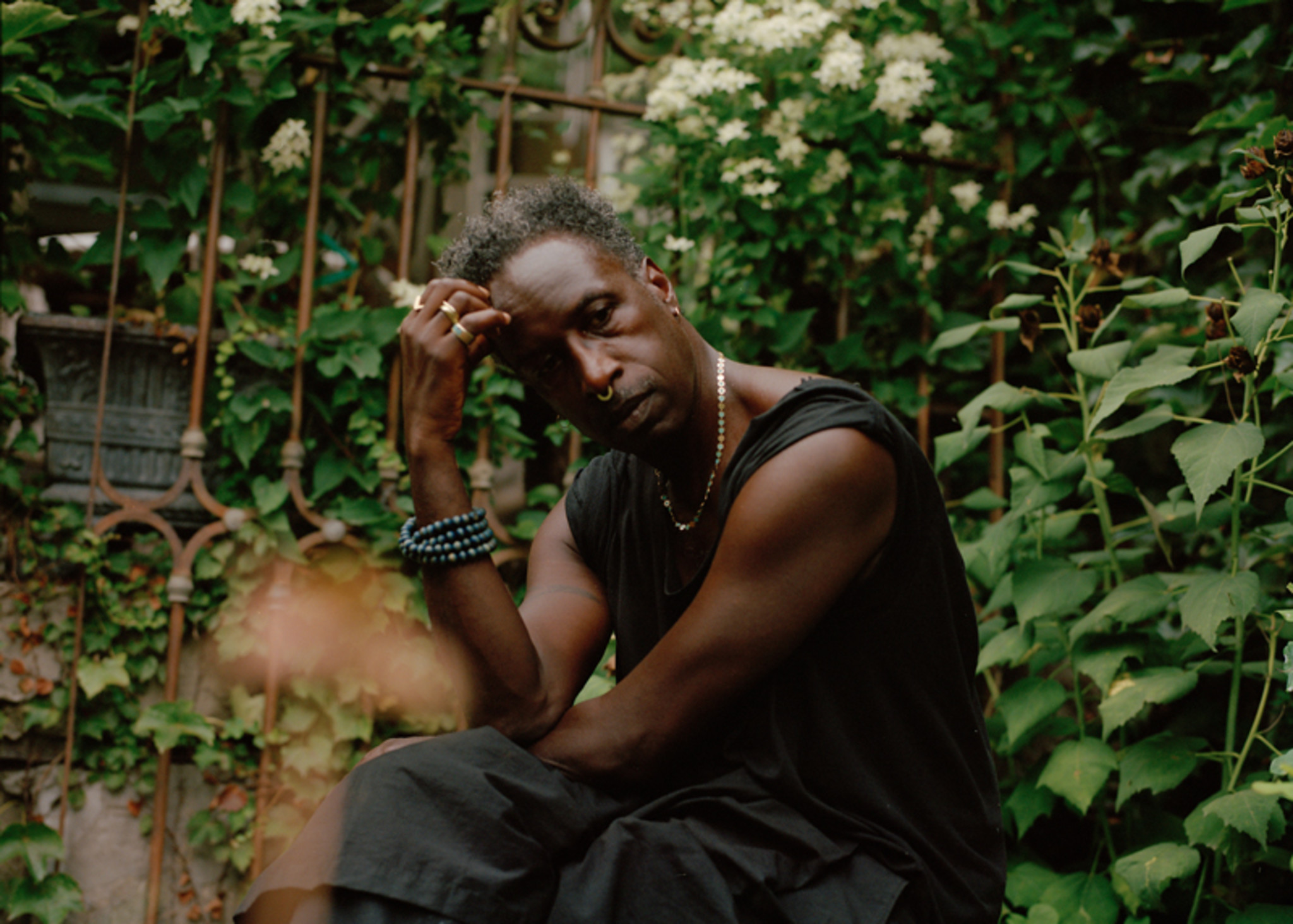
Stan Squirewell Builds a House
The 48-year-old artist expands his work into three dimensions with ‘The Weight of Grace.’
- By: Zito Madu
- Images/Photos Courtesy Of: Stan Squirewell and Claire Oliver Gallery

At the center of Stan Squirewell’s new exhibition, The Weight of Grace, is a house. On view at Harlem’s Claire Oliver Gallery until the end of October, the exhibition consists of 14 mixed-media works, soft sculptures, and installations, with the central conflict or theme being that of family history, which makes it apt that a real house is what dominates the show. A house can be rendered and somewhat felt through photography, painting, and other 2D genres of art, but a house can only be understood in terms of space. The physical space it occupies, the people who inhabit and move through its rooms and floors, and its life as a spiritual space that one leaves as a child before working to return to it through art.
Squirewell’s house is a ten-foot-long house made from reclaimed and salvaged wood labeled The House of Inheritance. Inside the house, Squirewell sets a framed photograph of his fifth-generation grandfather, a Civil War veteran. The photo is the oldest photograph Squirewell owns of any ancestor. At 48 years old, Squirewell has worked in different modes of art. He is a painter, photographer, and performance artist, and his work tends to incorporate and reflect all of those different disciplines.
A house is the perfect structure for Squirewell’s practice of layering his different disciplines along with the past and the present. What he usually has to achieve through the juxtaposition of found portraits collaged with modern fabric patterns, paint, and glitter, exists naturally in the structure of a home. Many of us grow up in intergenerational homes, where grandparents whose only photos are one or two black-and-white portraits from the mid-1900s, are one room away from a young child who has never known a world without the internet. Our clothes, style, even our personalities, tend to be passed down from our parents or our older siblings and cousins. Sometimes our version becomes a collage of the style and personalities of the others, as we mix and match, take and leave, the things they give us in order to find and make ourselves.
When I called Squirewell for our interview, he was in his car at the airport in Louisville, Kentucky, with spotty internet service. I mentioned to him that I became familiar with Louisville through an ex of mine, who was from there and taught me how to pronounce the name properly and was adamant that the city was the only place that made real whiskey and bourbon. He said an ex was also the reason that he first went out there, and now he lives and works there. Before changing the subject, we laughed about growing up poor and never imagining where life will take you. Love, like art, can take you to unexpected worlds.
When Squirewell was young, his home and his neighborhood were his whole world. He is the oldest of five, and lived in a household where even the children from the neighborhood would come and stay periodically. “My mom was like the little woman in the shoe,” he said, referencing an old nursery rhyme: “There was an old woman who lived in a shoe / She had so many children, she didn't know what to do / She gave them some broth without any bread / Then whipped them all soundly and put them to bed.”

Stan Squirewell, Frederick, 2026. Above: Stan Squirewell, The House of Inheritance (detail), 2026.
In his childhood home, he got most of his clothes, or the clothes that he desperately felt that needed, from his older brother. He wanted the distressed and patchwork jeans that were the staple of the popular brands of that time like Used Jeans and Major Damage. His mother refused to buy them for him, since the idea of buying clothes that were ripped apart and sewn back on together seemed silly to her. When he finally got them, they came from his older godbrother. “When he was done with his clothes, my godmother would just come in with a couple sacks of clothes,” he said. “I remember how fascinated I was just going through what he had that was now mine. ”This practice of reusing, mixing and matching, remixing, collaging, hemming, sewing, patching, and changing what was passed down to him, which he learned on his own and from watching his aunts and great aunts who would also be present in the house, also became his first artistic practice. Which then led to his love for cooking as a teenager, another art of mixing, like the hip-hop DJs that he also loved and took inspiration from. A curious child, Squirewell eventually turned that practice towards himself as he worked to learn more about himself and his family history. “It consumed me, actually,” he said. “There were periods in this learning process where I learned some things about my history that I didn’t necessarily like.” Those discoveries left him with knowledge as well as anger. He was forced to be silent in response to the internal anger from finding out his family history and to the violence of the world around him. He grew up in Washington D.C. in the ‘80s, when it was the murder capital, and the city was riddled with bullet holes and the consequences of the crack epidemic. One summer his mother sent him to Rockingham, North Carolina to keep him safe, but the violence even followed him there. After a near-death experience at a bus stop with his stepfather when he was around eight or nine years old, his mother took him to a therapist. “There was a week or two of me not being able to say anything from the shock of what I saw. She was like, Oh, my son needs some help. And what [the therapist] did set the course of my life,” he said. “He gave me some paper, pencils, markers, and some paint, and he sent me home with him. He said, ‘I know you can’t say anything. So if you can, draw what you’re feeling and bring it back…Anytime you have a lot to say, but don’t know how to say it, you make some art.’ I’ve been making art ever since.”

Stan Squirewell, The House of Inheritance (detail), 2026.

Stan Squirewell, The House of Inheritance (detail), 2026.
To make that art, Squirewell had to find the artistic lineage that he belonged with. The good luck that he had as someone from DC was that so many of the greats were at his fingertips. He lived down the street from Howard University and by osmosis, he was predisposed to the works of artists like Lois Mailou Jones, Jacob Lawrence and his migration series, and the AfriCOBRA collective. He was especially impressed by the art of Wadsworth Jarrell and his hypercolorful cubism, which Squirewell didn’t realize was part of the African American artistic lineage until then.
Squirewell’s early work, like We Wear the Mask 1, 2012 was a direct challenge to the history and narratives of race and how marginalized communities are perceived in the United States. Back then he primarily focused on painting. In that piece, he paints a deeply dark individual, whose body shines in its blackness, wearing a kente cloth styled Ku Klux Klan hood while holding up two middle fingers. The philosophy behind his work has remained consistent, though the technique has shifted and has continued to shift.
In recent years, Squirewell’s work has centered around mixed media collages. Rather than just creating paintings of his subjects, he goes to the past to elevate and bring through real people. He remixes portraits of individuals and families, often Black Americans, sourced sometimes from the Smithsonian Museum and from his own vast collection which he has built over the years. He combines these images from the past with vibrant contemporary fabrics and adornments that he photographs. Each portrait is set in a hand-carved frame and the frame is inscribed with lines of poetry from Langston Hughes, binary code, Indigenous American symbols, and glyphs from a forgotten African language. Then he finishes the frame through the Japanese technique of shou sugi ban, which burns the surface of the wood as a method of protection from decay and infestation.

Stan Squirewell, Tina & Chelsea, 2021.
In his own words, his work tends to grow through being challenged. Someone might ask him how he’s going to do work that’s different from what he’s done before, or he sees a technique or medium that can expand on the philosophy of his work, and he builds on his previous work through the incorporation of the new techniques. Though he doesn’t leave the past behind. He is always adding on to it.
At Corcoran School of the Arts and Design, Squirewell was part of a mentorship program which connected him with the painter and muralist Rik Freeman. In the process of working with Freeman, Squirewell found his artistic family and home full of amazing Black artists. And the one who pushed him harder than anyone else, the person who would go on to become his artistic father, was the imagemaker Michael B. Platt, whose guiding philosophy was described by the Washington City Paper after his death as:
“The thrust behind every technique that Platt used was the story of struggle, victory, and humanity; of blackness taking different forms in the world over, and the ability to characterize any person within that story with empathy and respect.”
Platt invited Squirewell into the spiritual family of Black artists in DC, which was also a real collective that helped critique each other’s work. “I would bring my work,” Squirewell said. “They were encouraging. It was warm, it was inviting, it was loving, nurturing. It was what I needed.” The group gave him the chance to work with the likes of Sam Gilliam and Lou Stovall, and also gave him a chance to see the inner workings of the art world, meeting with collectors, traveling for exhibitions. While he had love in his family home, his art home gave him the artistic support that he had been seeking and lacking up to that point. “A family in this regard is who I share spirits with,” he said. “When I go home and I visit my art elders, there’s an energy there that is uncanny, that is bright, and is safe. It’s the place where I think I felt most safe.”
Both his blood family and spiritual artistic family, as well as the personal and racial histories that he has continuously delved into, expressing the inexpressible through art, are all present in the house at the center of Squirewell’s new exhibition. The house exists in the present while speaking to the past of the kind of homes that generations of Black families used to live in. In it is his own family, the house bursting with parents, children, grandparents, uncles, aunts, cousins, and friends, and alongside them are the other multitudes of Black families who have lived and survived in the South, as well as the other parts of the United States. And this house is made with the knowledge and technique that Squirewell gained from his artistic family. It is a testament to his own skills and to the heritage of Black artists that he belongs to. “I learned the skills to make the house for my family, my genetic family,” he said. “But I learned the creative process in going beyond the structural things through my art family.”

Stan Squirewell, Lil Herb & Goldie, 2026.
Speaking on building the house, Squirewell talked about the physical and scientific processes necessary to make it livable. With his chop saw, airgun, and compressor, he worked within the parameters and verticality required to fit entire lives in the space of a row house and a shotgun house. “There’s a whole lot of things that go into these structures,” he said.
By tapping into the collective energy, the collective genius, of those who came before him, and the combined histories of generations of Black families and artists in order to align himself with the house, to build a home that represented everything that a home is and can be, physically and spiritually, Squirewell was able to challenge himself to be more creative than he’s ever been before.
Building a house, in a sense, opened up a new world for him. The homes he studied to bring it to fruition “have been aligned to certain constellations, certain waterways and windways,” he said. “It is utterly fascinating.”
Zito Madu is a creative and writer living in Brooklyn. He is the author of The Minotaur at Calle Lanza.
- By: Zito Madu
- Images/Photos Courtesy Of: Stan Squirewell and Claire Oliver Gallery
- Date: October 2, 2026