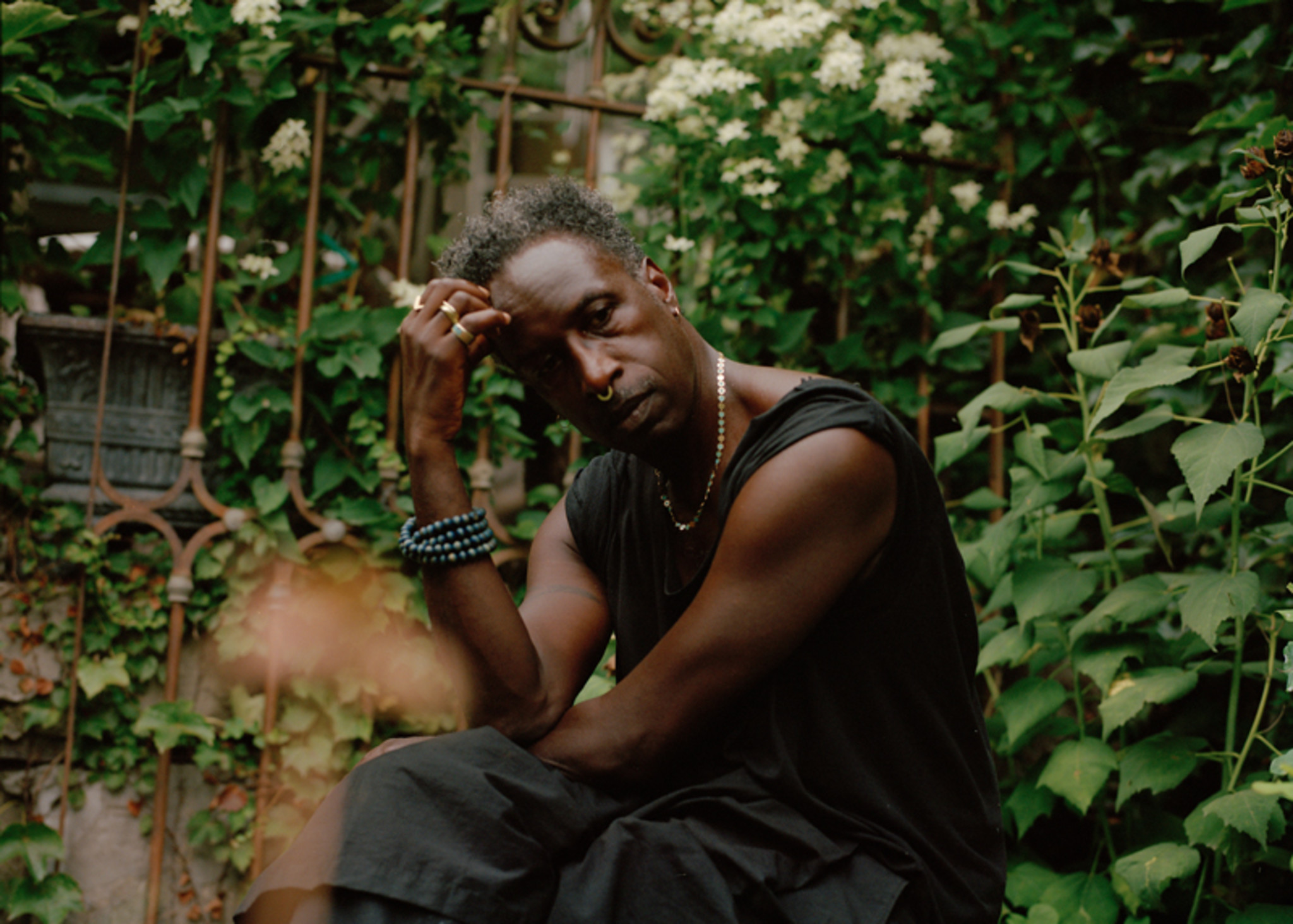
Martine Gutierrez
Plays the Mermaid,
the Siren, and
the Heroine
Blake Abbie speaks with artist Martine Gutierrez about her surprise performance in Canada and her meteoric rise to fame.
- By: Blake Abbie
- Photographed by: Grady Mitchell

Martine Gutierrez and I met at a fashion party at the infamous Halston House, tucked away on an unassuming street on New York City’s Upper East Side about six years ago. Introduced by a mutual friend, I’d say we were in, but maybe more honestly, out of our element at the time, being fickle fans of fashion events—ironic, maybe, as a fashion editor, I know. Fashion at its best allows you to transform, taking on a new persona. Maybe that’s what draws Gutierrez to its language in her output as an artist and actor, and my interest in its ability to take us out of the realities of the day. That night, Gutierrez and I darted in and out of the crowd, playing Mr. and Mrs. Smith (in trench coats, of course), exploring every corner of the house before taking the subway back to Brooklyn.
Gutierrez had just released Indigenous Woman, an art series-cum-magazine shot, styled, and creative directed by herself. Packaged in an oversize publication, the pages cover her artistic practice through commercial, fashion, pop, and historically inspired self-portraits. This magazine put Gutierrez on “a different type of radar.” Before its release, she had been creating hybrid-medium artwork (photo, films, music, performance) since her graduation from the Rhode Island School of Design: “It wasn’t mainstream,” she says of her earlier works, “as really only my friends saw it.”
Her shift from referencing pop culture into making it herself came just this summer when Gutierrez debuted as Vanesja on the HBO show Fantasmas. Gutierrez had previously acted for its director and writer Julio Torres, but this time, the role was written for her. “I was hands-on with Julio and pushed back at one point,” Gutierrez explains. “My character was originally written in the script as Martine, but this role isn’t a reflection of me in my identity politics.” So while identity has played the forefront of much of her work, now, she feels like evading the conversation of gender. “I think that’s the zeitgeist of things,” Gutierrez says. “So, that name came from me being obsessed with The Little Mermaid. Ursula as Vanesja, you know? That other bitch.” Gutierrez refers to the sea witch’s human persona. “That’s who I really model my femininity after. Ursula is octo-puss.”


Today we’re in my hometown of North Vancouver, snacking on vegan calamari, tucked at the back of a Greek restaurant just a couple doors down from the Polygon Gallery. Gutierrez’s flown a group of friends into town for a surprise performance to open her photographic show Anti-Icon: Apokalypsis at the institution. “Ursula’s the tranny,” Bhenji Ra, one of the performers interjects. “There are transsexuals and there are trannies. Ursula is ostracized from society, but wants to take over; she’s giving trans day of revenge. And the mermaids give trans day of remembrance. They’re wholesome, kind of like normative society. Ursula’s like, ‘This needs to be a matriarchal society. Take down the king!’” With Anti-Icon, a series of self-portraits of feminine and feminized figures from history and legend, Gutierrez creates a new lore. “They’re mythologies, to be half something. It’s the perception of a woman, until a closer look,” Gutierrez continues. “And all the negative connotations that come with that; it’s scary to be so open about it. And they drag men to the bottom of the sea.” And drag she does.
The group—or troupe, as Gutierrez calls us—is made up of longtime friends of Gutierrez’s: artists including the aforementioned Ra, as well as Young Gun Lee, Nash Glynn, myself, and Anti-Icon’s curator, Elliott Ramsey. The performance has been imagined as an homage to the epic of Odysseus and the sirens—or mermaids, of course—that call his boat to crash on the shores of their meadow-covered isles. The others take on the roles of the mythical creatures, whereas I am the sailor who succumbs to their beckoning. But with everyone donning a waist-length black wig, the audience is going to be left thinking: Which one was Gutierrez?
As Gutierrez’s star rises, she lifts her community around her. She has the ability to at once graciously invite but also lure people into her world; and how can you not when she offers a stage? I can attest to that, from acting/directing her performance Supremacy at the Whitney Museum last year, to singing the soundtrack to one of her films, to a sushi-eating cameo on Fantasmas—I’ve been privileged to be on her journey too. Gutierrez is deeply committed to her friendships; not only to finding ways to work together, but also holding a responsibility to nurture those who might have yet to find their path. She is mother.

Lee is her oldest friend here today. They met at RISD, both studying printmaking, an art that “people used to do hundreds and hundred of years ago.” Lee explains it was a practice that “gave [them] a lot of freedom for what [they] wanted to do,” which makes sense as Gutierrez would say that printmaking offered her a way to carefully and slowly build an image, to strategically craft each frame, which has influenced how she approaches her work today. “Back in school,” Lee remembers, “Martine was so obsessed with her images and wouldn’t let anyone have any sort of say. It started really young, she followed through.”
Through working with Gutierrez, you sense her need for experimentation and room for self-expression (within Gutierrez’s framework, always)—for spontaneity, but also fun. “Practice is about play,” Glynn reminds us. To be led fatefully by play: that’s how Ra and Ramsey both ended up in this show. Gutierrez clocked the Vancouver Airport on Ra’s Instagram story when she happened to have just landed for another artist’s residency, so Gutierrez called her to the project. And as the troupe felt ill-balanced, Gutierrez asked Ramsey to join the gossip of mermaids: “As I work with artists more and more, I seem to get pulled into artwork,” Ramsey laughs. “If it’s my job as a curator to help artists realize their work from time to time, being in the work is the best way to support that.”

We nod, as Gutierrez talks us through the show: “Being an artist is all about autonomy, having this kind of self control. You are the captain.” But the word artist is conceptually both a specific and a vague thing. Where is the line between mediums; what is the difference between the art market and the mass market? Everything’s so blurred nowadays, but to be an artist is ultimately about creating—and destruction too, Gutierrez reminds us. Now with an HBO show behind her, Fantasmas has placed Gutierrez on her biggest stage so far, with managers and agents clamoring to get a slot on her calendar. “There’s this currency around my image now,” Gutierrez sighs. This is after the Whitney performance and with MoMA having acquired her work, which were both monumental career milestones. “Are you feeling the pressure of change,” I ask, “to be or not be on every billboard?” By entering this new world, Gutierrez finds herself centered in the space she ultimately antagonizes in her own artwork. The artist has become the icon. “I’m really afraid of success, I’m realizing,” Gutierrez counters. “It’s scary to succeed and to be so visible. Is that what being an artist is? Industry success?”
I think a lot of us see ourselves in Gutierrez—I do at least. But how can you not in one of the multitudes of characters she plays, even in her daily life? “She had so many costumes,” Lee remembers of the constant changes. “Living as real Martine even felt like a costume. They were all different people with the same eyes.” There’s not only a flicker of yourself as a vision of Gutierrez floats by in a gallery or on television, but how she chooses to express herself, understanding the power of her own image and appearance. It’s hard, in respect to Gutierrez’s work, to separate the work of the artist from her being as her image entwined in the work. (And if she’s not the subject, it’s her mannequin doppelgänger, or performers in matching wigs.) Lee continues: “What you’ve become comfortable with is everyone else instilling themselves and their thoughts of you on you—then after you try to define yourself. It’s encouraging to see.” Gutierrez takes a moment and follows, “Yeah, because that’s how it has been since I was little. It’s part of the journey to claim what you are, to accept what you are. And then you got to denounce it, or at least take the little bits of what you like.” The definition is no longer important; it’s perception—but you can never really control how you're perceived by someone.
So while Gutierrez tries to undefine herself, she has found a fluid relationship to expression, even as the world continues to place her within the specific parameters of “trans woman.” She’s been a guide to understanding the swings of the gender pendulum and the idea that one must present in a specific way—like shifting away from high-femme. Post-identity, as she says: “Like any reign, there are wars and a peace treaty.” And even as she creates waves outside of the art world in pop television, she tells us that now “It’s not more interesting if you’re queer.” Doll-hood has been absorbed into mass culture. Glynn chimes in: “The whole ‘I love trans women!’ is over. It would be great, but you don’t have to, you’re not going to be canceled.” Choosing to name yourself and find and create community is a reality of the world. “But it was people’s illusion of safety.” Ra counters. “People are not gripping onto it or getting hard about it.” So finding yourself as a way to then throw it away; it’s maybe how Gutierrez approaches her neverending story of transformation. And with turning a shoulder to what others might think of her, she’s invited that community here to tell a new story. As this troupe finishes our hummus and gets the check, Gutierrez leaves us with one note for the performance tomorrow: “If you think you’re being cunt, it could always be more hard. Go harder.”

- By: Blake Abbie
- Photographed by: Grady Mitchell
- Performers: Blake Abbie, Nash Glynn, Young Gun Lee, Martine Gutierrez, Bhenji Ra, Elliott Ramsey
- Date: August 5, 2024