What’s Cracking
Why butt cleavage is having a moment in fashion.
- Written by: Viktoriia Vasileva
- Illustrations: Jaime Salgado

Every now and then, an edgy fashion brand, like Diesel, will show a couple of bottoms that sit low enough to give the audience a naughty peek at a model’s butt crack. Alexander McQueen, the very house that birthed the style with the “bumster” pants in 1993, attempted to revive it in SS23, and then again in SS26. These days, nudity is pretty much ubiquitous on and off the runway (see, for example, Bianca Censori), but somehow, butt cleavage still manages to elicit a reaction.
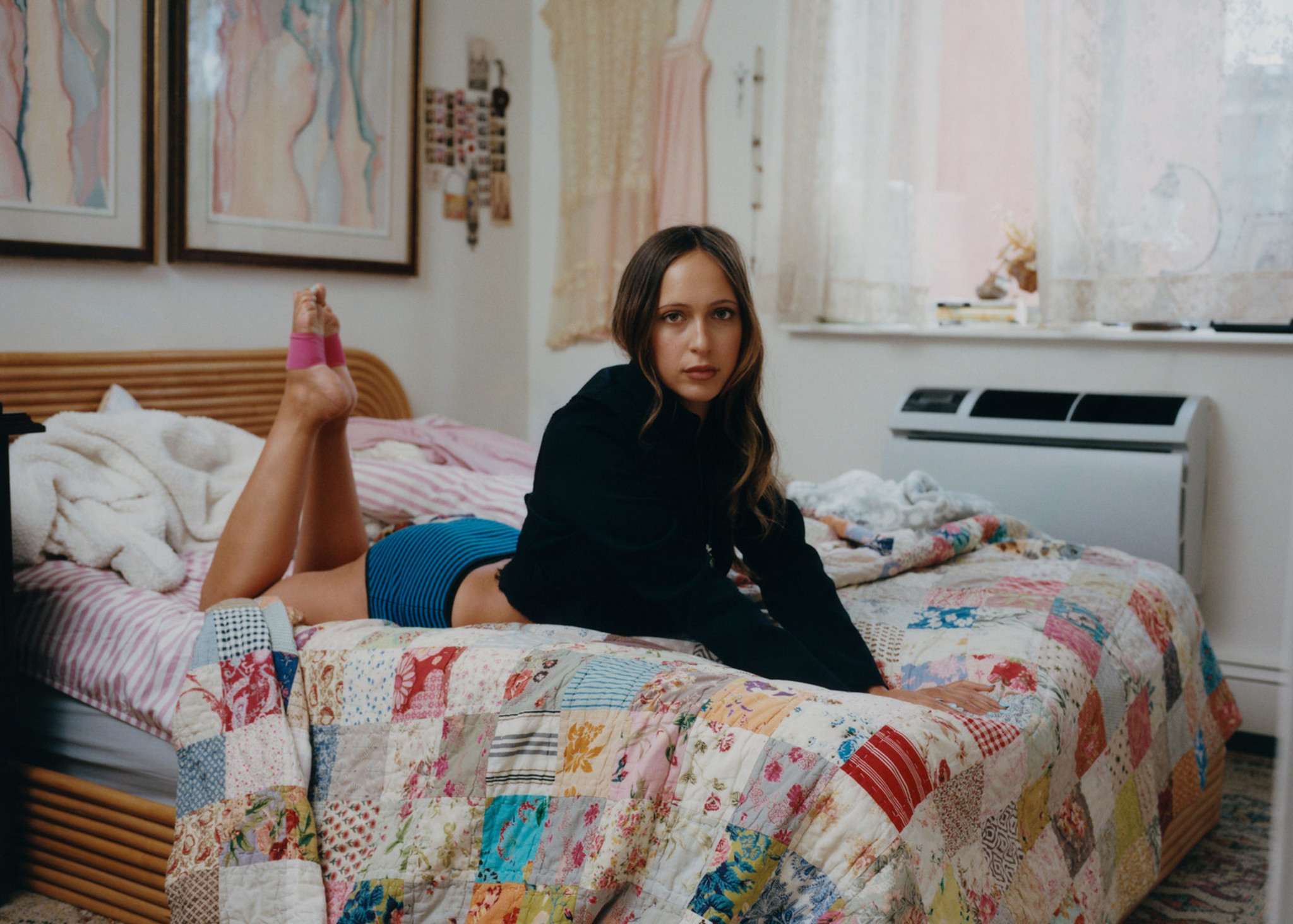
This year, the phenomenon feels particularly inescapable and weirdly a lot more…casual? Internet “it girls” Devon Lee Carlson and Lila Moss showed off a cheeky Cabris Suit from a small German brand Du Ciel that offers full coverage in the front and scoops the back an inch or so lower than expected, in their respective summer vacay Instagram recaps. London darling Mowalola showed an abundance of bumster-style skirts and trousers in black eel and python leather, perfect for a scene-y night soundtracked by the UK underground. Emily Dawn Long, a New York-based brand whose scoopy women’s tops and provocative unisex tees have become a de facto uniform for hot downtowners, leaned heavily into butt cleavage this fall at NYFW that culminated in a short film titled The Crack of Dawn in place of an SS27 show. Her dressier numbers—nightgowns and a silky skirt—feel reminiscent of the historic Mugler AW95 couture gown that featured a scandalously deep bum opening. And, not to be outdone, Mugler this season sent a slightly more casual snakeskin leather dress with a long tear-shaped back cutout down its runway in Paris.

Thierry Mugler Fall/Winter 1995 ready-to-wear (Photo by Pierre Vauthey/Sygma via Getty Images.)
The more attention I paid to how low waistlines have gotten and the kind of people and designers who are embracing them–industry tastemakers and buzzy downtown characters whose work and style is emulated by the masses–the more I wondered if a future where a generic take on bumsters could be found next to a tabi dupe or a micro mini skirt was really all that distant? Will someone’s butt crack soon catch me off-guard at a coffee shop in the Lower East Side? Will it even faze me?
For now, butt cleavage sightings remain as charmingly scandalous as they were when they first emerged between the 1950s and 1970s. Seductive gowns with dangerously low backs, featured in cinema classics like What a Way to Go! and Skidoo, occasionally resurface as viral posts on Instagram moodboards and as references for red carpet looks. Marilyn Smith, the researcher behind @looksonscreen on Instagram, recently shared a dress by Guy Laroche for Mireille Darc’s character in The Tall Blond Man with One Black Shoe. In the film, the actress turns away from the camera and reveals an open back cut so low that the seamstress working on the costume called it indecent. “There’s something kinky about the idea that [the audience] can see you, but you can’t see them,” Smith notes when she explains why the dress caught her attention. “You know you’re being looked at, but you’re the one acontrolling the reveal, provoking a reaction while literally turning your back on it.”
Nightgowns with dramatic backs and glute openings were worn by Hollywood starlets of that era as part of a common personal branding practice that involved accentuating what they considered to be their best physical features. Vikki Dougan, for example, and her publicist used gowns with shockingly low backs to help her stand out among competitors who often went for looks with an accentuated décolletage. When a contentious debate broke out about what Dougan’s Playboy profile from 1957 described as a dress that was “not only backless but seemingly seatless too,” as it showed a bit of butt cleavage at a chic Hollywood gala, she politely pointed out that she was simply following standard Hollywood protocol: “I’m not busty, so what’s a girl to do?”
The reason putting booties and other physical assets on display was successful at capturing attention in show biz is because, as any other form of nudity and experimental dressing that pushed against the norms established by the white, heteronormative conservative majority, it was intertwined with the larger cultural tension around the progressive political movements of the 20th century.
Showing skin and accentuating certain body parts emerged as a way for women, queer folks, and racial minorities to reclaim their sexuality and bodies and push against the patriarchy and conservative beauty standards. Radical self-expression seen in nightclubs, warehouse raves, artist parties, and other fringe cultural spaces, was a perennial conversation starter all the way through the early 2000s because it represented controversial values and ideas. No wonder it became a commonly cited source of inspiration behind the ultra-experimental pieces we’ve seen on high fashion runways, in street style, and ultimately, mass retail.
On the flip side, this historic dynamic created a media landscape where every previously unseen inch of bare skin shown publicly is automatically interpreted as deliberate rage bait or a political statement—regardless of whether that was the wearer’s intention. In a restrictive culture, the mere existence of marginalized groups and their attempt at self-expression is treated as a radical act. Even in circles that identify as progressive, there is often very little room for half-baked commentary and careless self-expression as we navigate the ongoing discourse around bodies and sexuality that have become increasingly more nuanced since the beginning of the 20th century. Duran Lantink’s debut collection as a creative director of Jean Paul Gaultier is a great case study on how objectively underthought experiments with nudity can quickly turn open-minded fashion insiders away.
Thankfully, it seems like the recent wave of revealing clothing and specifically butt cleavage is driven by designers who are much more interested in mastering their craft and creating pieces and larger visual and conceptual worlds that customers can connect with personally rather than dabbling in the broader cultural discourse in hopes of driving eyeballs to their work. It’s McQueen-esque that way: while the designer called the bottom of the spine “the most erotic part of anyone’s body, man or woman,” he also quickly clarified that the real motivation behind the design was “a technical experiment in how to elongate the torso.” Constructing a pair of pants that don’t fall off despite sitting extremely low on the wearer’s hips was simply a way for McQueen to flex his Savile Row tailoring skills.
One of the more visible contemporary designers popularising butt cleavage designs is Maria Sinkovskiy, the founder of a swimwear and intimates brand Du Ciel that makes those cheeky swim suits that Lila Moss and Devon Lee Carlson showed off on their IG girds this past summer. “I’d rather not make money for a year than put something out there that doesn’t feel like me,” says the designer. “And I think this is exactly why the brand works, even if the growth is slow.”
She describes what the Du Ciel world is supposed to look like: simple pieces with classy silhouettes and sexy twists that feel artisanal to the touch and linger in your memory, women who look confident and relaxed in soft lighting and beautiful spaces. She tried to make more wearable, straightforward swim and lingerie without butt cleavage and other risky details, she confesses, but they didn’t resonate with her audience: confident young women who live in the U.S., France, Spain, and Italy—the same women who happen to be natural tastemakers among their friends and on the internet. Sinkovskiy’s swim, in particular, is designed for the girls to show off—not in a way that attracts attention or makes a cultural statement, but in celebration of joyful, sun-filled moments they get to spend with their friends in gorgeous seaside places.
Unlike those girls, I couldn’t quite bring myself to pull the trigger on the Cabris Swimsuit–the one with a bum peekaboo–when I first came across it. Somehow, in my brain, mangled by the confusing western moral codes, it feels more revealing than a traditional bikini. But Sinkovskiy’s design language and visual choices strike the same chord that Emily Dawn Long and Mowalowa do with me–I can’t help but admire the precision it takes to create a piece, a photo, a world that feels both simple and interesting. This may be what my peers and I have been chasing all along: not a new silhouette, not a new way to add fire to the ongoing public and fashion discourse around public nudity, but material evidence that irresistible talent still holds up against growth hacks and ragebait.
“Does it mean showing a little butt cleavage at a coffee shop at 8 a.m. is okay as long as you master the presentation?” I offer up, laughing. “Everybody should express themselves however they want,” Sinkovskiy replies. “What I am struggling with is should you express yourself and not give a fuck about people, or is it actually nice to give a fuck sometimes?”
Viktoriia Vasileva is a freelance culture researcher, marketer, and writer of the Busy Corner newsletter.
- Written by: Viktoriia Vasileva
- Illustrations: Jaime Salgado
- Date: October 15, 2026