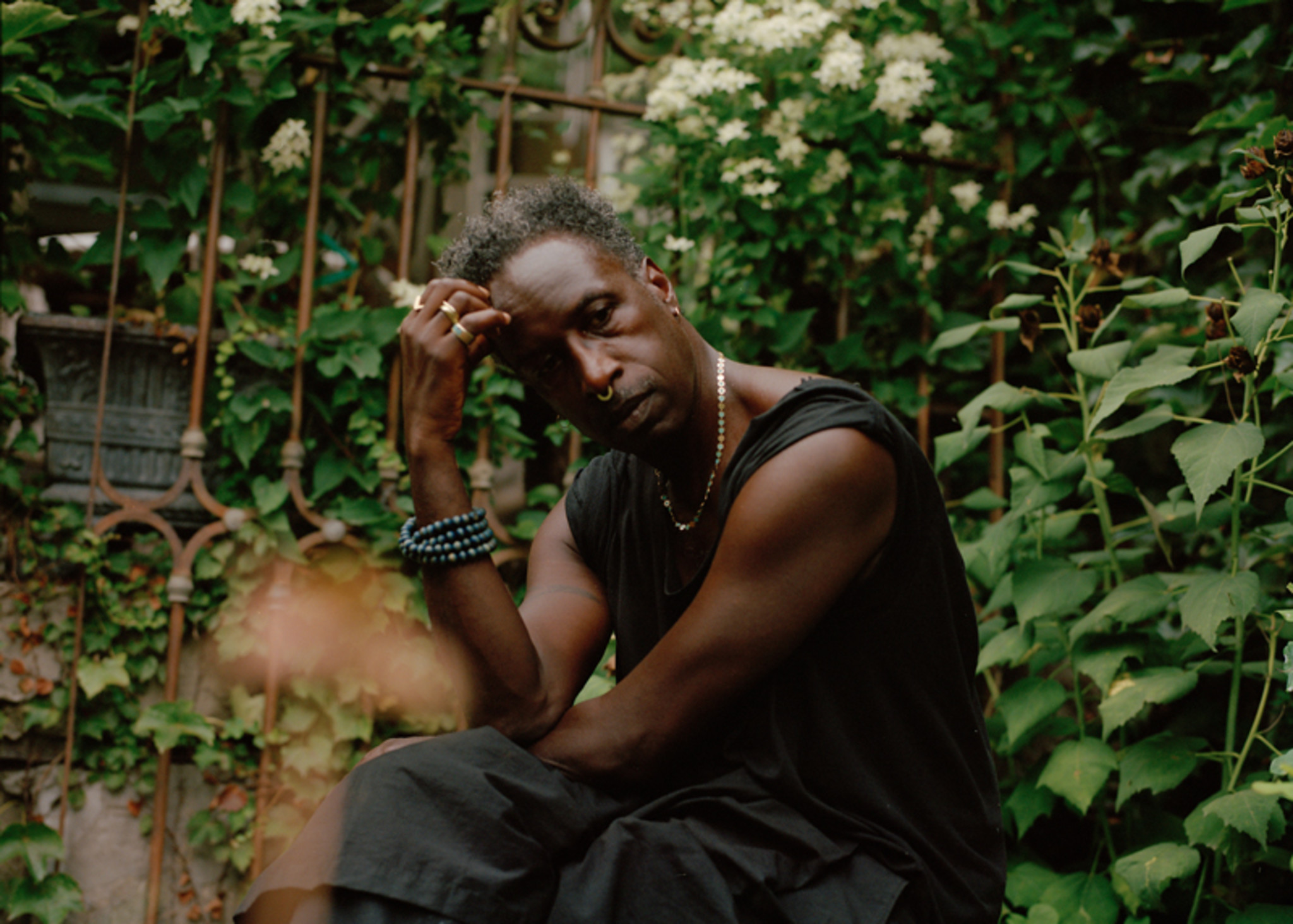
A Cowboy Rides into the Dark
At home with Texas artist R.F. Alvarez, whose sultry depictions of queer masculinity are taking on a gloomy new tone.
- Written by: Lauren Larson

R.F. Alvarez’s paintings are often moody and shadowy. A couple candles fend off the blackness encroaching on a group of friends. A pool takes on an eerie green in crepuscular light; a floral arrangement is somehow tragic. Alvarez often makes self-portraits, and even when he is painting himself enjoying moments of peace, there is often the suggestion of a storm just offscreen.
And yet here’s George, an eight-year-old retriever in a red bandana, crossing his owner’s bright Austin studio with his tail wagging and his head down, a missile seeking pets. Something sleek like a Dobermann seems more fitting.
“A wolf,” Alvarez suggests. He looks pityingly at George, who has planted his snout in the gap between my knees. He is aware of the incongruity between the dog’s personal brand and his own. “Have you seen my husband though?” he says.
He unlocks his phone and holds it up. His homescreen is a photo of a man who looks as if one of the characters on The O.C. had grown up to be a doctor. This is Chase Calvert, Alvarez’s husband of a decade, who is in fact en route to being a doctor. “He looks like a golden retriever,” Alvarez says. “Same disposition. Sweet and calm. And I’m a coyote.”
Alvarez, 36, wears blue jeans and a white linen shirt unbuttoned to the bottom of his sternum, showing a tangle of chest hair. He has deep brown eyes, a beard and mustache that are tidy but not try-hard, and dark curly hair like a Greek statue. I would paint a lot of self-portraits too.


Particularly since his 2023 show Eros with Alanna Miller in New York, Alvarez has become known for rich, sexy portrayals of queer intimacy. “Intertwined nude bodies are seen from below, offering a vantage point that is intimate, personal, and places the viewer inside the action,” Brooklyn Rail wrote of a painting, also called “Eros,” from that exhibition. “Indeed, throughout the show, Alvarez considers the perspective of the viewer, inviting them into his safe spaces.”
On their surface, the works he has completed ahead of his exhibition at Megan Mulrooney Gallery in Los Angeles running through November 1, are as intimate as those in Eros and other shows, but the viewer is at a detectable remove. Many of these paintings feature him and Calvert, though he does not show Calvert’s face. His husband is seen disappearing into their home while Alvarez lights a cigarette on the porch, or he is seen from the back, as the couple sits watching a candle burn down, two glasses of red wine un-drunk. “I like this idea of: you’re in the next room,” Alvarez says. “Chase and I are having a conversation, but you’re not privy to it. It’s between us,.” He stands before a painting in which he is pictured leaning against a doorway, watching as Calvert, his back to him and the viewer, removes his shirt.

R.F. Alvarez, Towards New Deltas, 2025.

R.F. Alvarez, A Picture of Us, 2025.
He has hung ten completed paintings in his studio, and a daunting scaffolding of frames without canvases leans against a barrier in the middle of the space. He has six more pieces to complete for the show by the end of the month. In their palette, at least, the finished paintings are less melancholic and mysterious than Alvarez’s previous works. Where previously he leaned on a deep aquatic green, a denim blue is the through-line to these pieces. But viewers who came to his art when he was depicting jubilant group gatherings – “friends gathered cozily around a table, cowboy hats illuminated by candlelight,” T Magazine wrote of Eros—may sense a shift.
“There’s a quietness and a darkness that has seeped into the work,” he says. He credits Mulrooney with helping him to navigate the tension artists experience between creating work that is easy to sell – landscapes and still-lifes, he explains, “dog portraits” – and work that feels more personal and, in some cases, not at all jubilant. Even a swan he’s painted looks a bit haunted.

R.F. Alvarez, Lone Swan, 2025.
“It’s dark times,” Alvarez says when I remark on a feeling of dread when I look at the painting of him and Calvert wordlessly studying a candle. Living in Texas, I’ve had similar moments of loaded silence with friends as we contemplate turns the state has taken: a parade of bills targeting LGBTQ+ people, the startlingly enthusiastic embrace of a Handmaid’s Tale future, extreme hostility towards immigrants. Alvarez grew up in San Antonio, and as a half-Mexican gay man he often felt alienated from Texas’s dominant identities. But when Calvert got into medical school in Austin eight years ago and the couple moved back to Texas from Los Angeles, he recalls, “I guess I naively thought we were done with this shit. And it just came screaming back.”
Alvarez has historically made his work very accessible to viewers. He is very transparent about his process, readily pulling up the reference photos he uses on his laptop – the photos themselves, taken by Mackenzie Smith Kelley, are as stylized as the paintings – and sharing TikToks of himself working. He enthusiastically credits the artists his work invokes, whipping out a tome from a stack of books in his studio to show a Caravaggio painting he loves. One of his shows included a wine tasting; another included a woodsy fragrance. “It’s sort of cowboy barn sex,” he says, grabbing a ceramic vessel and spraying it on one wrist. “There’s a feral horse note in there,” he adds. He made two paintings for a piece T Magazine published in 2024 by Mark Harris, reflecting on the “gay best friend” trope. He has none of the pretention of the shadowy, reclusive artiste.

And he breezily interprets his work for his audience. Before he was a full-time painter he did graphic and branding design, work which ranged from selecting logos to sculpting a company’s identity. Before starting his own firm he worked at an agency called RoAndCo, where he learned to apply Jungian philosophy – specifically the idea that archetypes always influence our psyches – to branding. “The idea is that you tap into stories you already know to tell your story,” he says.
He has a gift for drawing unexpected lines between these archetypes. “What’s up with my swan?” he says as I regard the painting. Next to the other pieces the swan appears jarringly rudimentary. It’s just a swan. Alvarez looks at it too. “Swans glide over the water, but they’re paddling furiously underneath,” he says. “They’re these beautiful calm creatures but they’re extremely mean. I wonder about the swan being, really, a perfect idealization of the cowboy.”
I am startled by the speed with which he has crossed the long, fragile bridge linking swans to cowboys. Alvarez seems to see the world through a kaleidoscope of metaphors, all of which can be connected if you sit with them long enough – if, for instance, you take the time to paint them. He laughs at me. “I think there’s something there,” he says twice, first with mock defensiveness and then again, more seriously.
Alvarez deploys the cowboy archetype often. Along with a heavy silver link bracelet, he often wears a cowboy hat in his paintings. He inherited both the bracelet and the hat from his grandfather, a paragon of cowboydom whom he always felt he was disappointing. The cowboy is not just an emblem of masculinity but of a particularly kind of stoicism. “Cowboy outfits are pretty cunty. There’s a machismo, a bravado built-in,” he says. “But the attitude is so much more quiet, calm, reserved.”

R.F. Alvarez, Gimme Shelter, 2025.
He began incorporating the inherited cowboy hat into his work, he says, as a way of reconciling his relationship with his grandfather and, by extension, a genre of masculinity that he felt separate from. In painting himself in the cowboy hat over and over—in almost every show he’s done, he’s included at least one self-portrait wearing it – he arrived at a realization: “This is all just camp. I can do whatever I want with it.”
Now he wears a cowboy hat casually. He disappears behind a wall that bisects the studio to retrieve it, rummaging among several cabinets. First he hands over another hat he inherited from his grandfather. This one, an ancient beige Stetson, is so worn that the crease has ripped from the crown, and the sweatband feels clammy from the accumulated oils. On the exterior band, too, the wearer’s deposits have visibly congealed. His grandfather is soaked into the fibers, Alvarez points out, like the paint soaked into his canvases.
He pulls back from the cabinets with a pristine black Stetson in hand. He puts it on and holds out his arms and hands like ta-da! “Isn’t it nice?” he says, laughing. It is; up there with Glen Powell in Twisters in the “guys looking great in cowboy hats” catalogue. Earlier we had discussed the sudden and ubiquitous popularity of western-wear, and now he raises it again. “I had to go through this heavy journey to feel comfortable wearing this thing, and everyone is just popping them on!”

R.F. Alvarez, Boats Against the Current, 2025.
In three of the paintings Alvarez has created for his upcoming exhibition, he wears a cowboy hat, but none of these feels especially celebratory. In one, he has painted six versions of himself – three of whom are in a cowboy hat – dancing. Some of their expressions resemble anger, despair, and frustration. He wears one in the painting in which he watches Calvert from the doorway, and in the gloomily contemplative painting in which he and Calvert, glasses of red wine untouched, watch a candle burning. In these pieces the hat is an accessory to angst.
This darker, more personal work, he says, is more difficult to discuss. He takes his black Stetson off as he approaches his paintings, setting it on the smudged surface of his table. “This is the first time I feel like I’m a little bit at a loss for words – what it is, exactly, that’s coming out,” he says.” And I wonder if that’s just the nature of creating art. You make something. You make and you make and you make, and then you take a step back and realize what you’re trying to tell yourself, right? But I think I’m still just in it, I’m sort of at a loss. I’m sort of just shocked at the changing state of things.”
He had begun to feel at peace with moving back to Texas; he had painted himself in his grandfather’s hat enough that it had started to look right. But then, he says, “the ball moved again.” He doesn’t know yet how to tell the story of the era he’s in right now.
But perhaps Alvarez doesn’t have to be such a ready storyteller anymore. Earlier in his career, he says, he felt obligated to explain himself, but now he’s reckoning with how much of himself he wants or needs to share, when the art itself is so intimate. “I always thought I was going to write extensively and explain, extensively, all the steps,” he says. “But I think I’m starting to pull away. I feel myself wanting to keep something for myself.”
Lauren Larson is a senior staff writer at Texas Monthly magazine.
- Written by: Lauren Larson
- Top Image: Mackenzie Smith
- Images/Photos Courtesy Of: R.F. Alvarez
- Date: September 16, 2025