Mary HK Choi Tries a New Perspective
On the occasion of her new novel ‘Pool House,’ the author sits down with writer Alexander Chee for a wide-ranging conversation about craft.
- Written by: Alexander Chee
- Photography by: Andy Jackson
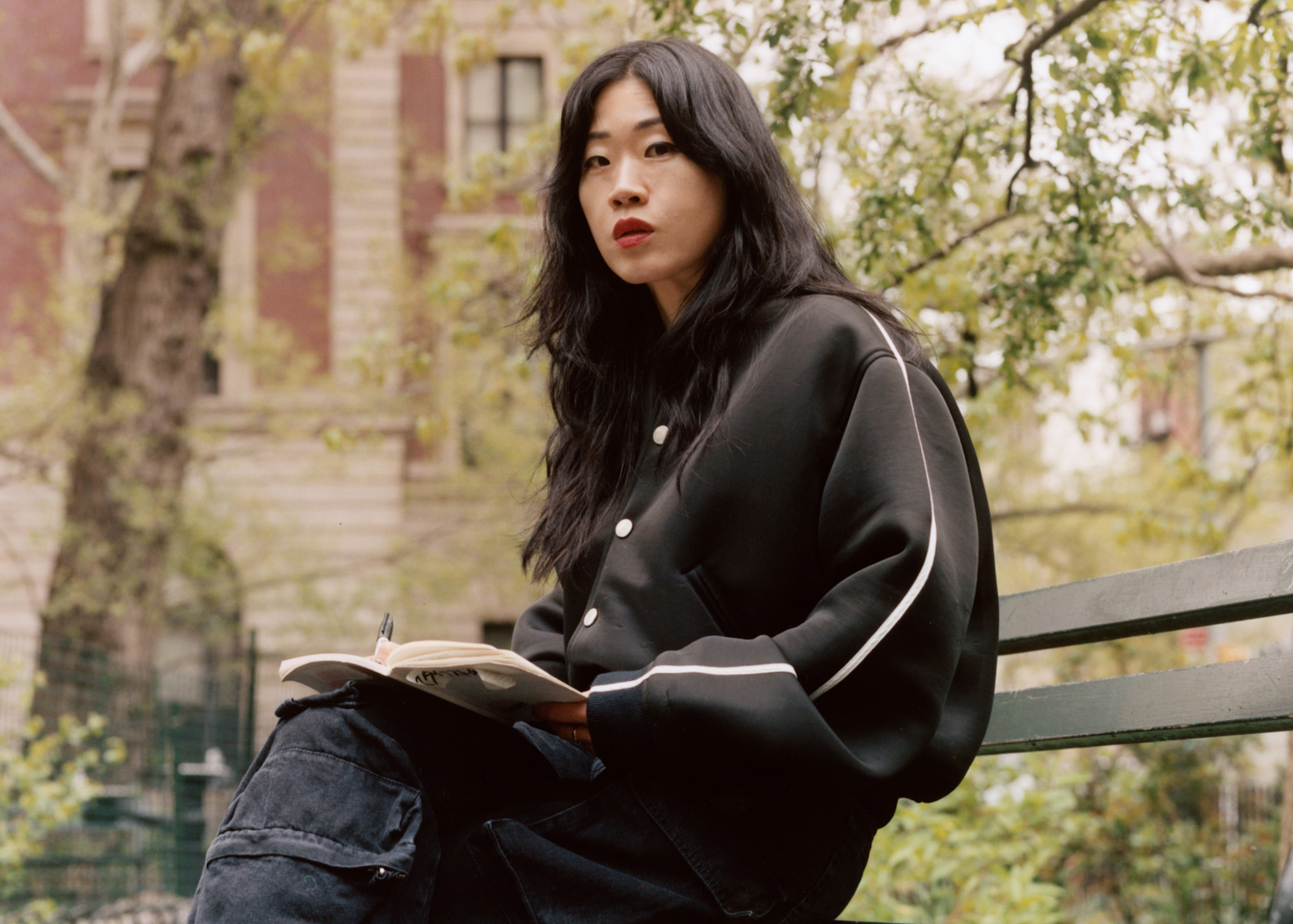
A few weeks ago, I put my advance copy of the novelist Mary HK Choi’s newest novel, Pool House, on the seminar table in my advanced fiction class, and one of my students’ eyes glowed as if I’d just casually set down something made of gold and diamonds. “She has a new novel coming out?”
“She does,” I said. “This is her first adult novel.”
She couldn’t stop looking at it and so I said, “I will give it to you when I’m done.” She smiled and thanked me. And I will keep this promise, I don’t dare do otherwise.
My student is just one of a legion of Choi fans who grew up reading her novels for young adults. These are novels you may have noticed for their beautiful eye-catching covers: Emergency Contact (2018), Permanent Record (2019), and Yolk (2021), all of which look ready for their boxed set, beautiful sisters, all illustrated by the artist gg. But Choi’s fanbase at this point includes those who love her for her time as the writer on Marvel’s Lady Deadpool one-shot, her career as a magazine editor and journalist for Complex and VICE and Missbehave, the podcast host and creator for Hey Cool Job, and then from frequent bylines at your favorite new publications and legacy publications as well.
In person, Choi carries herself as if she is someone who is not at all as nervous as she describes herself being as she launches this newest part of her career, a novel that chronicles the lives of Stevie, a young Korean American woman living in the pool house of her actor-mother Moon’s Los Angeles home while they rent the main house to make ends meet. Moon is one of those actors who LA used to create and protect, someone just famous enough to keep working but never famous enough to retire, and never, somehow, ignored. She is mourning the death of her lover, an actor who played her husband on a popular television show that was the primary source of her fame. Stevie is technically trying to escape her mother, not just her house but her gravitational pull, as Moon has now been around long enough that a generation of younger Asian American fans who drive Stevie crazy just for existing have embraced her as an icon. Into the push-pull of their love-you-must-get-away-from-you relationship comes the young man who played the TV son to Moon, someone who Stevie has always had a crush on and who has also always made her feel replaced. He shows up for the funeral. Thus are the stakes raised.

Mary wears The Attico black fern jeans
Pool House kept reminding me of two LA novels I think of as classics, novels I hadn’t thought about in a long time: I’m Losing You, by Bruce Wagner, and Resentment, by Gary Indiana, novels about the darkness of the American silver screen and the world behind that screen, but Pool House includes the very real experiences of the Asian and Asian American women there, who are almost never included in these stories. Not at their center. Even when they spend their lives there.
I met up with Choi on a beautiful afternoon at her apartment in New York City, a calm and inviting place not at all like a pool house, filled with books, art and a sense of color that seemed to organize my attention somehow, and only later did I wonder if perhaps it does that for her and her husband as well. We had just had a Korean take-out lunch she’d picked up for us as this conversation got underway. And while the interview has been edited and condensed, Choi gives good quote. It was hard to choose.
Alexander Chee
Mary HK Choi
This novel struck me to be an interesting way to have a conversation across generations about Asian and Asian American identity. And mothers.
And also that weird thing that happened within my lifetime where being Korean specifically became cool, to the point, actually, that it does something to the Asian American experience. It diminishes it so much further. So much is Korean, but from Korea. A presence that is more ubiquitous but more… otherized? Whereas Asian Americans are expected not to get caught up in the cut fruit diaspora, the stinky lunch experience. The fact that the mom is in her 40s, the daughter is 20, when Korean culture is cool, is interesting to me. And it’s like this weird incidental thing of them being Korean as well.
I don’t know if I’ll keep it in the interview but… the description of the mom made me think of Bai Ling.
Dude! You can include it. The comp on Moon is Bai Ling on the red carpet, 100 percent, where she always looks slightly unhinged, where even as Asians, we’re like, yes, our people are otherized, but she feels crazy even to us. And she’s exciting, and so beautiful, but so singular, one of one. So I gave [Moon] the career of a Bai Ling. And a Lucy Liu, by the time she’s getting cast in this TV show. Very Poison Ivy, Hand That Rocks the Cradle. Very Miramax meets Skinemax. Her ideas of fame, celebrity, feminism, are all caught up in this super Gen X way.
So where did she come from? Where did you dream her up?
It’s not a very original answer, but it does feel really truthful, which is, I wish I could say Moon is my mom, but actually, she’s just me. She’s my childhood. So informed by all the ingredients that came into my life in my most formative years. She has dysmorphia, disordered eating, is almost inured to patriarchy and the male gaze in a way that like, I don’t know… she feels like an iconoclast and she feels like she was a trailblazer and that she got to do so much, but also, at the same time, her world is quite limited.
Right. Sometimes you don’t realize you’re a trailblazer when it just feels like you’re lost.
Totally!

And then at some point someone’s like, Oh, you’re a trailblazer, and you’re like, “Is that what I did?”
Right. “That was my intention all along.” [laughs] But also a trailblazer is one thing, but she’s still sequestered to this hinter territory where actors who look this way can only reach a certain status, and so, yeah, you’re a trailblazer for that.
Right.
So Moon in many many ways is me, but Stevie is also me. In many ways I wanted to create some kind of reconciliation between all the sort of outmoded shortfalls of imagination that I had for myself that seemed so contingent upon my identity as an Asian Woman in America by way of also having been an Asian Woman who came of age in Hong Kong, as a Korean, as a part of a British Colony. My identity has always been so layered in a way that has always required so much assimilation and making and reading a room and role play, and so the conversation of that person, being an actor, fulfilling certain roles, not knowing how to be embodied outside of those roles. That was really interesting to me. So I gave Moon a lot of qualities that have always been significant to me both as pieces of what I thought was genuine identity and genuine interest and genuine love and passion that in many ways were also… disguises. Like Moon is into fashion because I was into fashion. And I was into fashion because it was helpful, useful.
A way to get attention. A way to play.
A way to get attention but only in the way I wanted. And even like that, it’s like being a trailblazer in the kiddy pool. All I see when I look around now are silhouettes and accessories and clothing directly from the ‘90s or the 2000s. Where I feel a sense of dislocation, like, holy shit, what year is it? And similarly, everyone is so thin again. Everyone looks like those Steve Madden bobble heads. Skinniness is like a mark of safety in the way that it was when everything was so conservative back then as well. So the fact that this book is coming out now is really trippy, because I already feel bifurcated by having made these two characters. They’re both parts of me across time.
My mother is why I’m a writer. I have to be the keeper of this information somehow. But I could never write my mother.


Mary wears The Attico black fern jeans
It’s obvious, I was going to say, that it doesn’t seem autobiographical.
It’s also, I love my mother so much that I don’t know that I’ll survive the betrayal of not getting to be precisely, exactly her. My mother has always felt like the most beautiful woman in the world to me. And her elegance is something I will never have. And her smallness is something that I completely prized. And she was always vain, dressing impeccably. Even now she complains that she can’t wear flats, despite neuropathy in one leg, because she’s only ever worn heels.
She’s always dressed with such care, such aplomb, and like, truly like a dignitary. She’s often cold, which actually means she’s dressed with a formality the people around her are not. She works in San Antonio, in a restaurant, and specifically she works back of house, and yet she’s always wearing something that looks prim.
When you say back of the house, do you mean the kitchen?
She will work in the kitchen, but I mean the cashier. The bookkeeping. But she will bus. She will watch the restaurant CCTV monitor on her phone and on her television at home. The second there’s a crowd, she’s in her car and there. She treats her life like a first responder. She deliberately lives five minutes from the restaurant. For most of my life my mother has been looking at another room than the one she is in, and certainly the one I am in, for any indication to leave. I had always thought of the mother in this book as a metaphor but I have seen my mother leave my side and then be in the television and I’m still watching.
So this is your adult debut.
Yeah, it’s scary out here. I don’t know how you do it. [laughs]
I feel like writers like Jackie Woodson, who have traveled this path, you’ve kind of raised your audience. People who grew up reading your books. Aren’t they going to be excited? I would hope so.
Yeah, I think they are. That’s what I find so moving about it. I’ve talked about this before but in all the false starts I’ve had with this book, after my dad died, suddenly there’s a man in the story. I had to write about it. I was so sad. I was grieving in a way, that I… it wasn’t that I was making space for it, I was completely obliterated. I felt the negative space. I didn’t understand how to process loss when I couldn’t account for how much I was allowed to have made him matter to me. I didn’t know my father — I know him, but he was incurious about me, he very rarely asked me questions, we very rarely spoke at length, and anytime I called home, he’d be like, “Here’s your mother!”
It was almost a joke that the last time I saw my dad, he was trached, in a hospital bed. We’d learned he had ALS, and he just kept aspirating. I had traveled so far to see him, and I’d quarantined, done all this stuff, and as soon as I saw him, he was so happy to see me, and then he was like, “Wow, you really should get going.” The way my dad says hi is, “You really should get going. It’s getting late.” It is 11:30 in the morning, and I just got here.
At the time, I had so much bitterness towards him, resentment that he hadn’t made an effort, and when he died, it’s that question of like, How close were you to him? What difference does that make? It is not warranted to feel as destroyed as I was, that was how I felt. I felt like I was bilking it. That actually led to me getting diagnosed with autism. Because I was like, the way I’m thinking is weird.

Oh, like, Am I neurodiverse?
Genuinely, I’m observing the way I’m thinking and I don’t understand it. It felt incomprehensible to me. All of these things delayed the book in different ways, it kept transmogrifying, it’d be moving along and this elbow would jut out of it and I’d be like, What the fuck. And so dealing with that was really tough. And so all of the muscle memory of dealing with my adult debut is that apparently is it supposed to almost kill you? [laughs]
So I say this to say that any of the readers who waited, or aged, or… grew with me, evolved alongside me. You know, I’ve had people be like “Oh I’m so happy, I went from being in college to being 30, or almost 30,” and they seem excited for the book, and I cannot believe they waited for me. Or that they’re welcoming me. I felt so late, so confused, so lost, so delinquent. That someone would be like “Oh my god you’re right on time”... the first time someone said something like that, I wept a little. That was hard. And people are gracious. And no one’s waiting for me because they’re living their lives. It’s been a weird however many years for all of us.
Right.
It is meaningful to me.
And other people have made this passage. It’s not common but you’re not singular.
Totally. This year, my friend Maurene Goo came out with her adult debut, and my friend Melissa Albert has hers coming out the week before mine. So I do have a cohort, which is really nice. But it’s also been uncomfortable, because it is so different. YA and adult, or literary fiction, on this side of it, is so different.
Talk about that a little bit. How was it different?
I feel a little like YA is insulated in this way that is really beautiful. I had a wonderful experience with my publisher, with my entire team, they were so available and nurturing, in a way that my limited experience suggests that maybe that’s how YA is. And in literary fiction, it’s almost like I’m in gen pop? I feel the number of books that come out week to week more acutely in this space. And because I’m not a professor, and I went to fashion school 22 years ago or whatever, I feel the community a bit less.
But the writing part, though. How was that different?
I scared myself. I usually love to write in first person, and I was like you’re not allowed to. And I know that’s not true. The way I know that that’s not true, so intently, and yet when I sat down to write this, I was like, “We have to try this other thing.” And then when my book started asking not only to be in third person but in alternating POVs, and then structurally these other little vignettes so we weren’t stuck doing all this exposition, I was like holy shit, we should have stuck to first and called it a day. [laughs] But this work just wanted something else and that was something I had to learn. I didn’t go to school for this, I had a lot to learn. I’m the first generation in my family to read and speak English. I wasn’t read to as a child. Wasn’t on the school newspaper or yearbook. Never wrote willingly until my 20s. And so…
Willingly! [laughs] “Must I write?”
“Surely!” So I feel like I don’t know how to be a writer in so many ways. And then when I was like “Now I’m writing a grown-up book,” I make the joke that it’s NC-17, but I got really scared. I felt really lacking. And I think that’s what also took it so long. I was almost done with the first draft less than a year into it and I took a writing class, and then that took me into a recursive circuitous course that took the next two-and-a-half to three years, just starting from the beginning over and over like it was a tic. I’d write 15,000 words and then scrap it, and I kept doing that over and over again, even though I had enough experience and enough proprioception to know you just have to get to the end. I’m big on vomit drafts, I usually get a first draft done in several months. I’ve done it once in five weeks. I know that’s how I gain enough momentum.
I don’t think I’ve ever done that. Wow.
It was ugly but I did it.
You know who does that is Kazuo Ishiguro.
Really!
I’ll fact check it but I’m pretty sure it’s how he gets monk-like and gets it all done. [author’s note: Kazuo Ishiguro wrote The Remains of the Day in a month]
That really shocks me about him because I revere him. I just assume that anyone good does it the opposite of me.

Mary wears The Attico black fern jeans
What you said about it reminds me of something that Garth Greenwell wrote in his recent newsletter about working on long projects. He quoted Janet Fitch saying a novel is like the dog that will only eat from your hand.
This novel was such a weird creature. Learning about its proclivities was so uncomfortable. It would only eat from my hand if I only dropped two on the floor for each bite.

Alexander Chee is most recently the author of How To Write An Autobiographical Novel. He teaches creative writing at Dartmouth College and lives in New Hampshire.
- Written by: Alexander Chee
- Photography by: Andy Jackson

