Eternally Colette
The Artist On Living,
Transformation,
and Timelessness
- Interview: Coco Romack
- Photography: Heather Sten

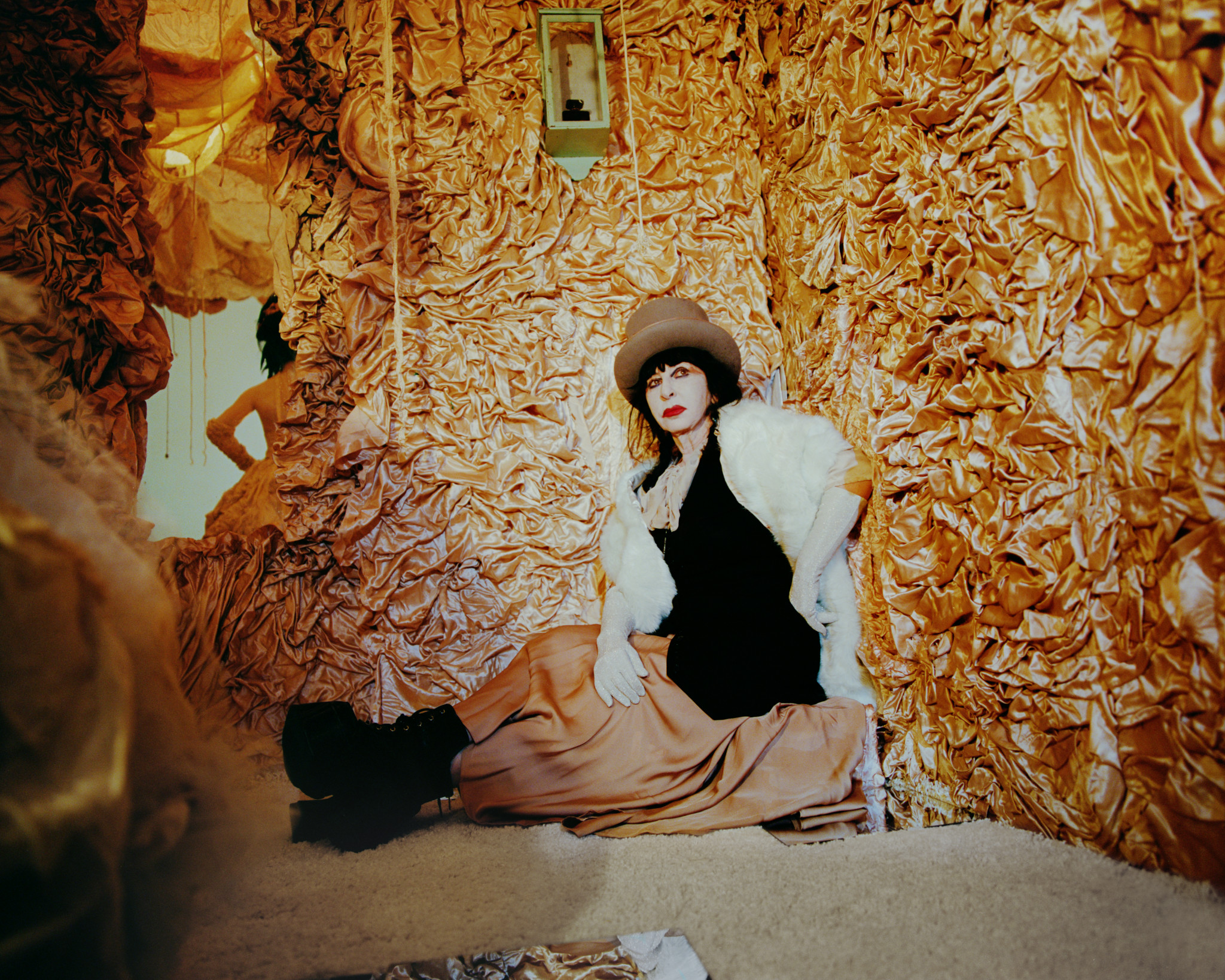
Colette has slept everywhere—in lavishly decorated storefronts or white-walled museum halls during illusory performances, sometimes behind glass but regularly before an inquisitive audience—though curiously not always at night. Those waking hours are when the mythic artist does some of her best dreaming. For much of the last year, she has dedicated the time to reassembling and repairing her archetypical artwork, a transportative installation she titled the Living Environment (1972–1983) that once served as the backdrop for over a decade of her intuitive practice; the remnants of this fabled salon had previously been in storage for nearly forty years. Entering the space “transforms you,” Colette recalls, appearing via Zoom, uncharacteristically on an early Sunday afternoon. Her face is powdered between two thick black braids, but she laughs through lips painted a brilliant red. “People come in and they alter right away. They don't have to meditate. They don't have to take drugs.”
The artist arrived in New York from France in the late ‘60s. By the early ‘70s, Colette was quickly becoming recognized for her tableaux vivant performances in boutique windows, and the quixotic glyphs she dodged traffic to paint onto the streets of Manhattan. She began to transform her Pearl Street home into an immersive, ever-changing work of art. What started as simple decoration—draping military parachutes, rope tassels, and eventually pink satin from the crumbling ceiling and walls—grew until every foot of the dilapidated downtown apartment was swallowed by fleshy fabric. In one photograph from this era, Colette stands posed toward the camera with her breasts bared, an embroidered petticoat lit from within, illuminating the space as if she were a fragile antique lamp.
Considering her own body to be a sculptural extension of the all-consuming surroundings, she would sew and wear custom garments that resembled the ruched silks of her home’s walls; these later informed a fashion line created in collaboration with the Italian designer Elio Fiorucci. Yet even as her influence bled into other industries, Colette was a polarizing figure, deemed by some to be either too superficial or too frivolous, and she never maintained consistent gallery representation. Seeing how famous artists’ work increased in value after they died, she staged a performance called The Last Stitch (1978) inside an installation at the Whitney Museum’s exhibition “Out of the House.” Piercing her left palm with a staple gun, the artist staged her own death surrounded by bunches of white cloth. She was reborn at PS1 Contemporary Art Center days later as Justine, the executrix of Colette’s estate and the first of many outlandish personas she has embodied since then.
Transformation, as ever, is Colette’s favorite distortion. For the past three months, she’s been obsessively sewing, stapling, and dusting things off, like an archaeologist unearthing the shards of her own past. Unveiled in November at Company gallery in the Lower East Side, these objects resemble relics. One lamp seems mummified behind a glass vitrine in a darkened room, brown and decaying after sustaining water damage during Hurricane Sandy. Concealed green light emanates behind sagging textiles that frame wall hangings and elaborately staged photographs. And standing inside a recreated portion of the installation is a life-sized sculpture of a younger Colette by the artist Cajsa von Zeipel, its flawless silicone skin at odds with the yellowing, tattered fabric bulging overhead. Finally revealing its age, the Living Environment shows it is truly alive.

Coco Romack
Colette Lumière
You were born in Tunisia but spent most of your childhood in France. Did you come from a creative family?
I did and I didn't. I came from an old-fashioned family and it was very restrictive. My father was an architect. My mother sewed a lot. But in terms of creativity, nobody really stopped me, or maybe I didn’t stop myself. I felt driven from the beginning, like I had a calling.
What is your earliest memory of making art? Was there any imagery you felt drawn to early on?
The beach, the colors of the sand and sky. I was doing little drawings in my diaries. Everything with me is organic, almost like being a medium and listening to a voice inside. If I pay attention, I'm able to transmit that in a wonderful way. I had visions when I was young and was always interested in metaphysics. I loved art, of course, and theatre. I always made up make-believe worlds.
Why did you initially decide to move to New York?
Seeking freedom. I was engaged and left my fiancé. I really liked him, and it would’ve been a convenient marriage, but I knew I wanted to be an artist. I felt I couldn't marry because I didn’t think I could have a real career and go through what I had to go through. It was a sacrifice from the beginning, but it was also no sacrifice because I wanted to do it. I remember now, way back, a painting I made around that time. I called it The Decision.

The Living Environment, 1981.
Where did the original idea behind the Living Environment come from?
I started as a painter and was interested in tarot. I would paint the High Priestess, the reincarnation of Nefertiti. They were ethereal and had these symbols, these little languages, from the beginning. Some of those paintings were very big and it would be as if I was inside the painting already. Eventually, I transformed my environment—my home, really—into a work of art. I started draping parachutes, and it became more and more obsessive. At a certain point, it became a sculpture; it was clearly an artwork. It would change, like a painting that kept being repainted. It was very private at the beginning and felt very naked. That's still the way I deal with things when I create.
Back then, you used to paint the streets.
I was hoping to make a film about this young woman who was looking for friends and communicating with outer space, Mars or one of those places, with this language. And then I saw that these diagrams on the street were beautiful on their own. I did a great room very early on at the Norton Museum in Miami where they took down all the Impressionist paintings, and the room adjacent was dedicated to my street art. I painted the whole federal highway. It was a scandal.

Justine’s special Christmas gifts, Elizabeth Wiener Gallery, NYC, December 1979.
Walk us through a typical Colette performance.
Jeffrey Deitch did a show very early on called “Lives” and included Andy Warhol, Joseph Beuys, and younger artists like myself. I created a landscape and became part of it. The landscape was an environment with fabric, silk, slides, sometimes objects, and a theme. Often, I would lie sleeping in some bedroom where there was an actual bed. That was classic Colette, and it was different from what other performance artists were doing. I always want art to lift us, to bring us somewhere else. Marina Abramovic and a lot of well-known European artists were into self-mutilation. But I never related to that. I was included because I was doing performance, and because I slept for hours, it was considered endurance. I wanted to produce the effect of a dream, and that was my reason for enduring, for lying still.
How would you prepare for a show like that?
It was some kind of trance I would put myself into. It would start like a meditation, so I was there and not there. I would shift, like you do in a sleep, at unexpected times, so I would not feel the discomfort so much. Sometimes it was a one-night thing. Sometimes it was four weeks, six weeks, and I showed up every day. There's always a little devil trying to wake me up.
At the Museum of Modern Art, I was doing my performance, Camille (1976). I had a very young audience and they were really wanting to get me to move. Oh, they were boisterous. I remember one much later, too. I was sleeping in a glass cabinet, which Tilda Swinton got well-known for doing—I like her as an actress very much, but I didn't like that—and I had my eyes closed. Some devil was shaking the cabinet.
Have you learned anything about yourself while revisiting this work?
I'm relearning my history. I want to make new work all the time, so it’s interesting bringing the new me to the old work. How the world has changed, even our culture and what's available with technology. But what I find powerful about great art is it doesn't matter what medium it is or how costly the materials. I'm really touched by how young people are relating to the old work. We didn't have Instagram, where everybody is an artwork, transforming themselves. That has become a norm, and you don't have to be an artist to have a persona or a new name.
When are you the most productive?
By nature, I'm a night person. When do I feel the most productive? When everybody leaves me alone. When I work on a show like this, even though it's my previous work, I still feel very vulnerable and I'm careful who I have around me. They have to be on my wavelength or better they’re not there.
Why are clothing and beauty an important extension of your practice?
Dressing up became part of the vision, part of the message. Of course, if you were an artist, you weren't supposed to look like that—you weren’t supposed to wear lipstick or whatever. When I started creating clothes, my style was being imitated. I did a window for Fiorucci in 1978 and it didn't take long for the entire store to have products that looked like mine.
Fiorucci was a wonderful man. He saw that and asked me to do the Deadly Feminine line, and I posed as Justine. And it changed. At a certain point, as Justine, there was the Victorian punk look that I had already begun as Colette, but it became more extreme—more Victorian and more punk. When I was being threatened to be thrown out of my loft, I came up with the idea of making clothes that looked like my walls with ruched fabric, which was not so popular then. I called it “walking architecture” because I would wear them religiously. It was like walking out of my cocoon.
Do you keep up with fashion?
I don’t, but I don’t follow art, either. My interest in fashion in the beginning was anti-fashion. I had my own way of presenting punk, rags and tearing, and then that became fashionable. Comme des Garçons, with everything uneven—I related to that. I think trends are not such an important thing in art, even though you have trends and you have movements. I'm beyond movements, beyond time. I want to be eternal.
Coco Romack is a writer, editor, and author living in New York.
- Interview: Coco Romack
- Photography: Heather Sten
- Photography Assistant: Kay Thebez
- Images/Photos Courtesy Of: the artist and Company Gallery, New York
- Date: December 14th, 2021