The Erotic
Uniformity of
Olly Shinder
The Central Saint Martins graduate and former CELINE intern on techno clubs in Berlin and defining culture through fashion.
- Text: Max Berlinger
- Photography: Roxy Lee

When Olly Shinder was young—well, younger, that is; he’s barely 25 years old—he saw a show at London’s Barbican performing arts center dedicated to the work of showman Jean Paul Gaultier. It was, in a word, mesmerizing. He remembers masks with hair pouring out of the eye holes, the sensually surreal images of Pierre et Gilles, the romantic rigor of those garments from Gaultier’s eyebrow-raising Fall/Winter 1993 collection “Rabbi Chic,” inspired by Hasidic Jews, and denim garments that were so shredded and reworked they looked like textiles from another dimension. “It really showed me the endless possibility of fun and craft and humor and beauty,” Shinder says on the phone from London, where he’s based.
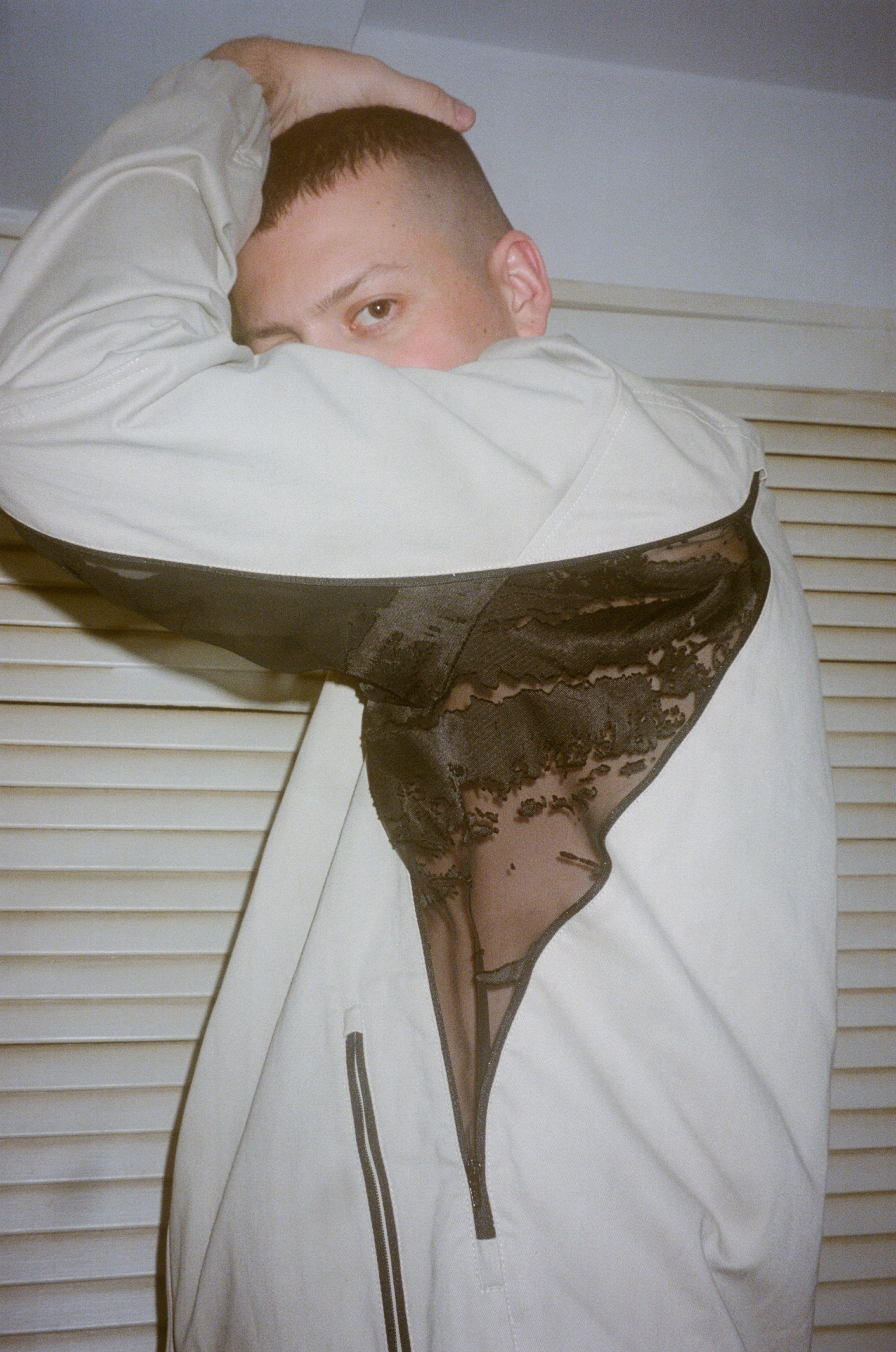
Olly wears Olly Shinder jacket. Top Image: Olly wears Olly Shinder shirt.
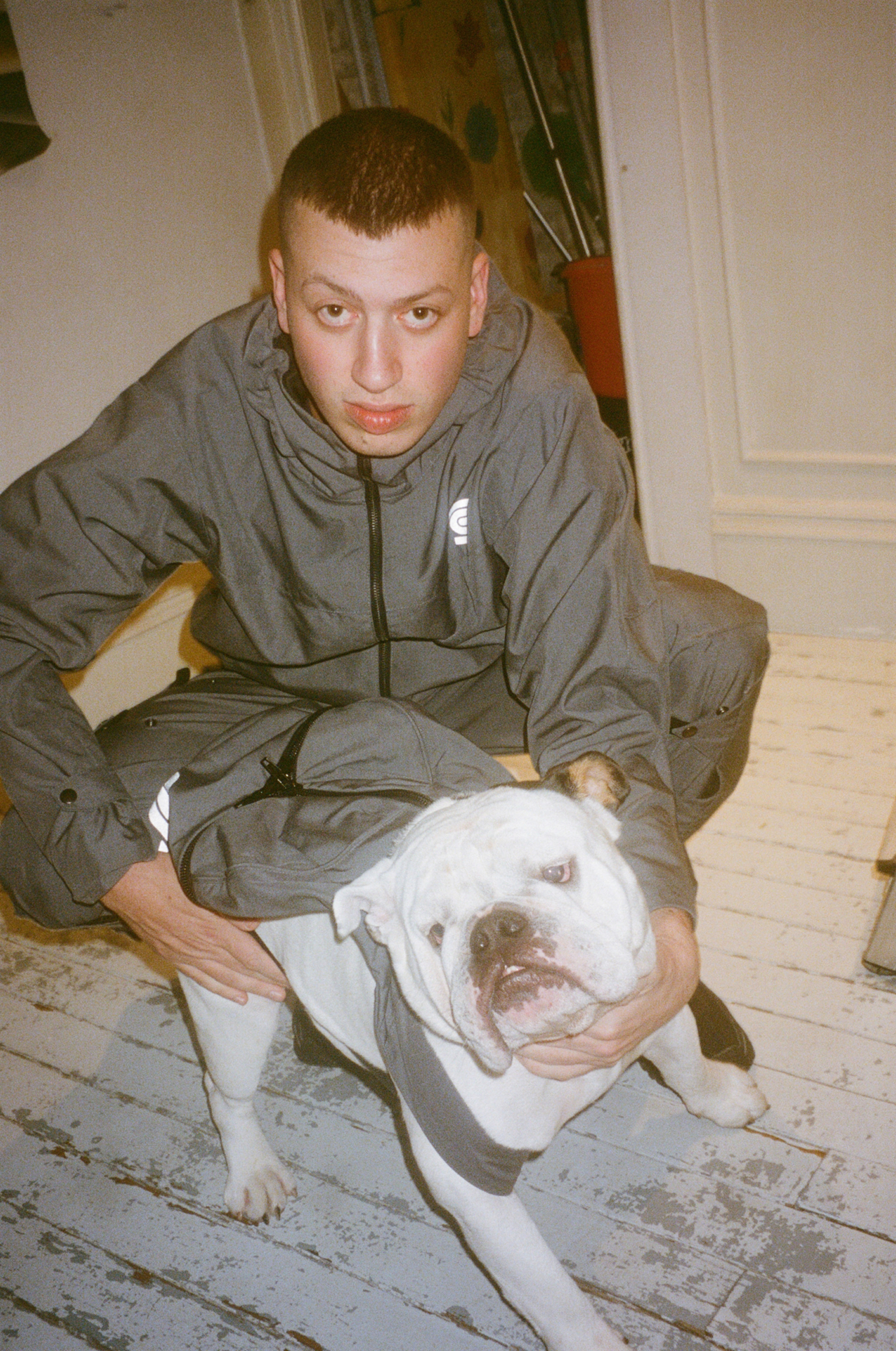
Olly wears Olly Shinder jacket and Olly Shinder pants. Tyrone wears Olly Shinder backpack.
Shinder’s own interaction with fashion up to that point had been quite different. He had grown up wearing a school uniform—a gray sweater with a pink stripe on it sticks out in his memory. A real drag, he recalls, especially for a young queer kid, but it conveyed to him something about the ways people—gay men, in particular—use clothes as a means of communication, and communion. Later, when he transferred to a school without a dress code, he fancied clothes from Abercrombie & Fitch, the brand that trafficked in a sort of wayward, horny frat boy aesthetic. Corn-fed Americana imbued with the undeniable frisson of homoeroticism. These experiences, too, left an indelible imprint on Shinder, mainly that by wearing a masculine uniform, you can telepath to the right people something glittering and beautiful about yourself. That queer identity is a game of dress-up. That codes of masculinity and femininity could be upended. That clothing can be its own secret language.
Just a few years out of the prestigious Central Saint Martins, Shinder continues to explore these juxtapositions with his own eponymous line—between ideas of blue-collar uniforms and queerness, between what our clothes say outwardly but, also, what they can express about our secret desires. Also woven throughout his work is his love of club culture, which he nurtured during stays in Berlin, and the inspiration he draws from his ragtag circle of London friends: artists, photographers, designers, editors, and the like.
To understand Shinder, perhaps it’s best to look at the two internships he took part in during his studies. One was on the traditional path, at the French label CELINE, then under the purview of designer Phoebe Philo, who had the entire fashion world in her thrall with her sensual, strange ideas of womanhood and femininity. The other, however, was at Snickers, a Swedish workwear brand that made clothes for blue-collar workers (the name derived from the Swedish word for “carpenter”). His clothing today could very much be read as an unexpected composite of those two extremes.
“I’ve always had a bit of an anti-fashion thing.”

Olly wears Olly Shinder jacket and Olly Shinder pants.
“I’ve always had a bit of an anti-fashion thing,” he says. At CSM, he found that he could stand out among his outlandishly dressed peers by wearing everyday clothes: gray tracksuits or unassuming apparel meant for manual labor. Things municipal workers might wear. The details, the functionality, the plain-spoken utility of it all interested him, but also, there was a sneaking subversiveness built in because during his stays in Berlin, he noticed queer men don workwear at the clubs. “They felt that it looked hot, it looked masculine, it looked sexy. And I wanted to explore that more deeply,” he says.
Shinder was immediately taken with Berlin on his first visit, at 16, especially bewitched by its notoriously vibrant, gay, and hard-partying nightlife scene. In addition to the fact that there was a certain irony to queer men dressing in a stereotypically “straight” style—think Tom of Finland cartoons come to life—he noticed that the workwear actually had a purpose there: It provided something functional to wear for hours of dancing (and, it goes without saying, doing drugs). “You’re out for a long time, some people go for, like, 15 hours! And it’s a techno club, you’re not going to wear heels and a little dress because it’ll get ruined. People want something hard-wearing that will last in that environment. But at the same time, people want to look fab,” he says.
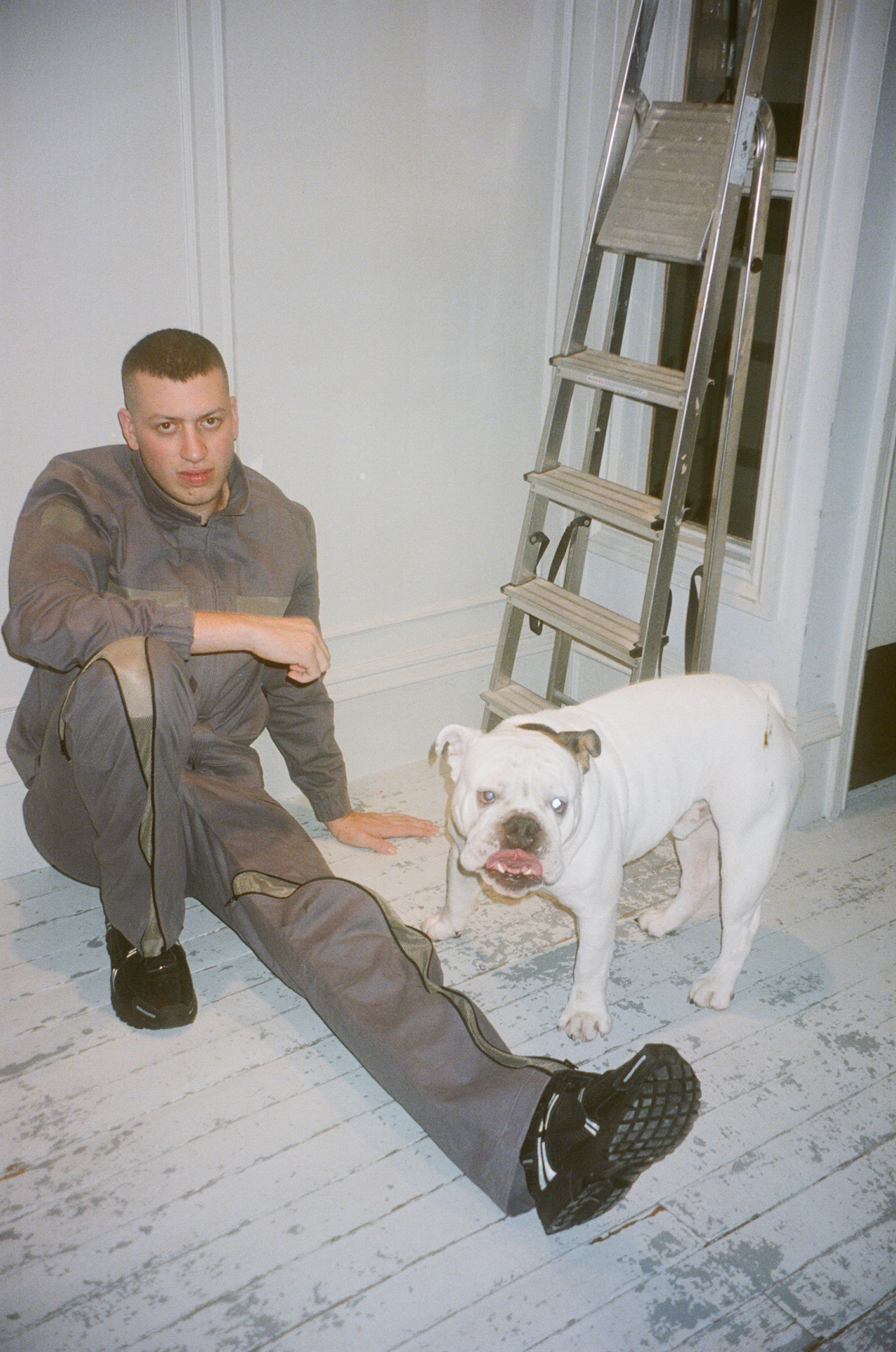
Olly wears Olly Shinder jacket and Olly Shinder pants.
Those dualities—queer versus straight, function versus fab—are already playing out in arresting ways in Shinder’s work. Utility-minded clothing might be made from a feminine silk crêpe, or military-inspired tracksuits might zip open to reveal suggestive mesh inserts that map the body like topography lines. Gym shorts or tank tops are made from nylon mesh with piping at the shoulder and hips that recalls roots, veins, or a hand grasping at the wearer’s flank or deltoids—they’re garments that are utterly aware of the body.
Other items playfully toy with workwear tropes—snap buttons and paneling on a shell jacket or pair of pants aren’t made for utility, but decoration, roving up and down sleeves or the torso, kinkily hinting at corsetry. The jacket, with its tough guy swagger, is lined in a winking ladylike satin. For his Spring/Summer 2024 collection he sent guys down the runway in high-vis fireman jackets with reflective panels, and then others with shorts so low-cut their asses were hanging out.
To heighten that carnal charge, Shinder enlisted the talents of Turner Prize-winning photographer Wolfgang Tillmans—known for capturing the wistful longing between young gay men—to shoot his first lookbook.
Shinder likes to think of his work in conversation with the world around it, that fashion cannot and should not be separated from life. As such, he’s built a network of like-minded artists who act as sounding boards and inspirations. “I like to surround myself with interesting people who are doing interesting things,” he says. “It’s conversations with these types of people”—filmmakers, emerging artists, magazine editors, musicians—“that gives me depth as a person. And with these different perspectives, we all inspire each other and grow together.
“It’s a techno club, you’re not going to wear heels and a little dress because it’ll get ruined. People want something hard-wearing that will last in that environment. But at the same time, people want to look fab.”
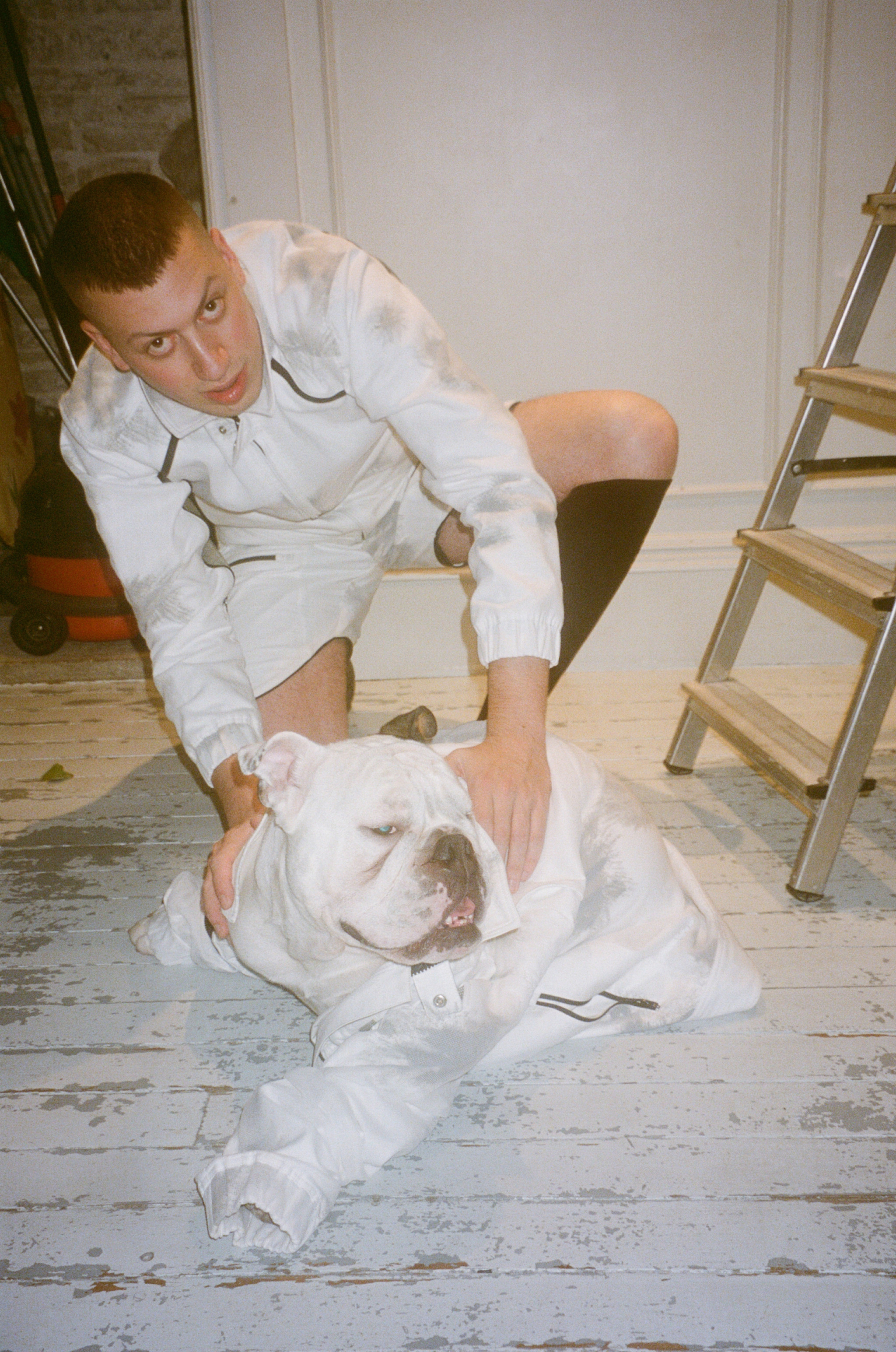
Olly wears Olly Shinder jacket and Olly Shinder shorts. Tyrone wears Olly Shinder jacket.

Olly wears Olly Shinder jacket and Olly Shinder pants. Tyrone wears Olly Shinder backpack.
“I’m just delighted I’ve gotten to meet all these people, it really drives the work,” he adds. “You have to work with people, you can’t do it by yourself. And it’s not a huge budget right now, so you have to be passionate about it. You spend this time with people, making new work, and solidifying these friendships. It’s this all-encompassing life-work thing.”
Indeed, he rolls his eyes at the idea of fashion siloed from the rest of the world, and thinks of it more as part of the mixed-up energy that makes up what we would broadly call the zeitgeist. “I like to work with people whose perspective isn’t necessarily from fashion,” he says, noting for his Fall/Winter 2023 lookbook he collaborated with the Polish art photographer Kuba Ryniewicz. “Again, it’s this anti-fashion thing. Something gets me a little sick with fashion as fashion; I’m looking for a different approach, to look at fashion as culture. I want to be adding to it, to change culture, to be making clothes that are out in the world, that are existing as part of the conversation.”
There’s a sense of urgency one feels when talking to Shinder—you can feel the thump of the club in his tone, or the thrum of London’s youth culture in his cadence. It’s a certain brashness of youth, to be sure, but also the sort of drive that it takes to succeed in this business. It’s the reason why, after graduating, he didn’t want to twiddle his thumbs working for some big house for a few years but, instead, launched his own brand right out of school, even if that meant doing so in the middle of an unprecedented global pandemic, shortly after the UK pulled out of the European Union, making production more costly and confusing.
“When I was at school, if I worked with someone, my work would be really affected by it, I’m a really sensitive person,” he says. “And after I graduated I had a year where I really got into myself, and I felt like I had built a world, the beginnings of a world, and I think the thought of going to work for someone and losing that really scared me. The feeling of losing these precious years where I can really build my vision, strengthen my voice before that’s institutionalized by a company.”
So there’s that purity or preciousness that Shinder is compelled to protect, but also a tenacity and drive. It’s a dangerous, exciting combination, but the exact sort of combination which can yield significant momentum. After all, when I ask what he wants to do with his brand, his answer is simple as it is bold: “I want to change the way people dress.”

Tyrone wears Olly Shinder backpack.
- Text: Max Berlinger
- Photography: Roxy Lee
- Art Direction: Nova Needham
- Casting: Madeleine Østlie | aamø
- Date: November 20, 2023

