Inside D.S. & Durga’s Music-Filled Scent Lab
David and Kavi Moltz built a fragrance empire using smell to construct tiny universes. Here’s a look into their process.
- Written by: Katie Stone
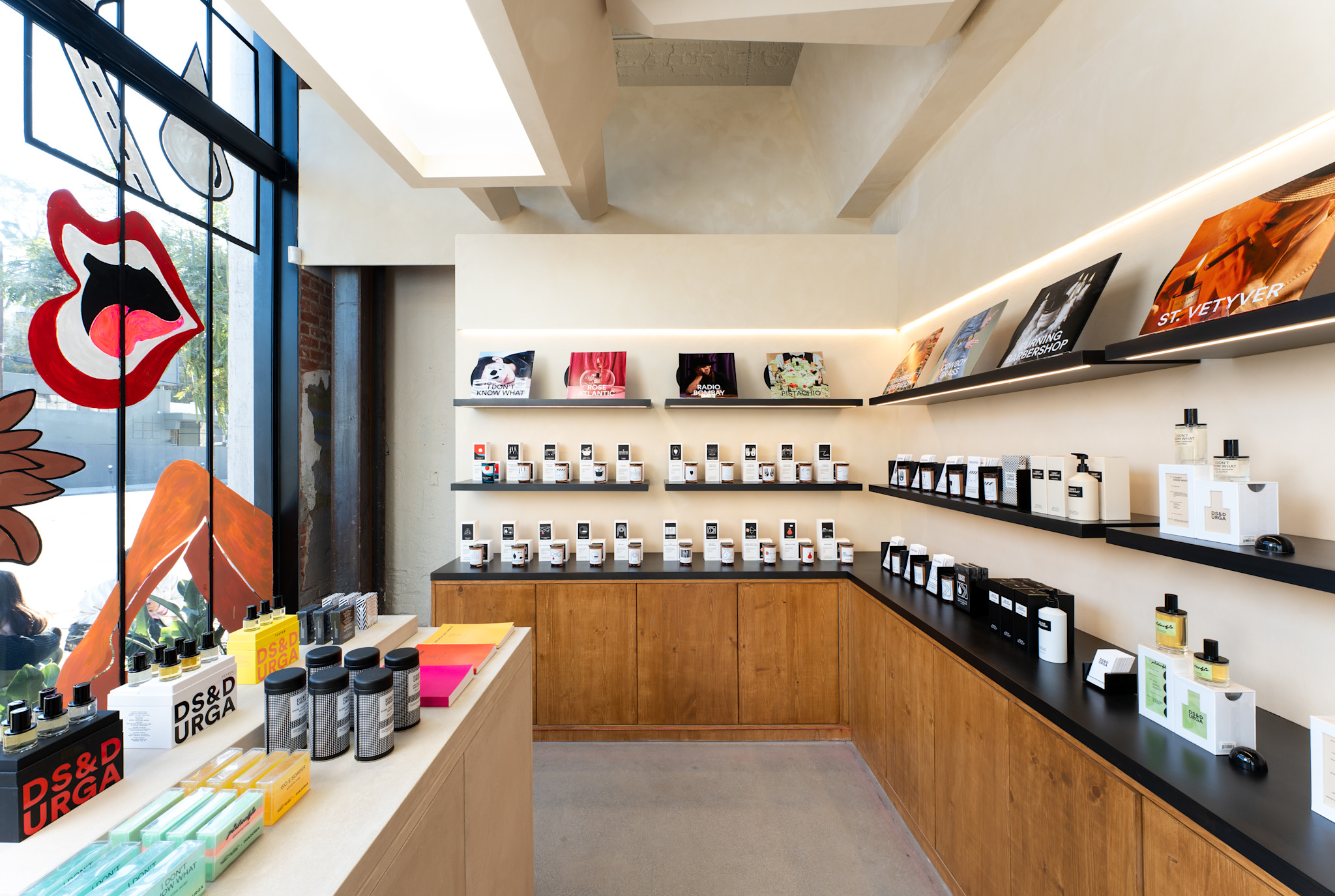
I first met David and Kavi Ahuja Moltz about a year ago. The co-founders of D.S. & Durga were previewing their Halloween launch, a “Murder Mystery Layering Set.” Not only was I unfamiliar with a “layering set,” I’d also never heard of a fragrance brand launching a Halloween-themed product. Color me intrigued.
As daylight streamed into their Mulberry Street store, the life-turned-business partners presented the olfactory equivalent of a game of Clue in which participants would layer miniature-sized scents for the other players to systematically guess. The game was accompanied by an animated video designed by Kavi, which featured Tim Burton-style renderings of David and her as they raced around London in an attempt to solve the aforementioned murder mystery. The other journalists and I were stunned, completely wide-eyed and utterly enthralled by this elaborate murdery mystery game, this world they’d managed to create.
Spend a few minutes in one of their stores or browsing their website and you’ll find that world-building is central to D.S. & Durga’s existence. Each of their scents (courtesy of David), has its own unique visual identity (courtesy of Kavi) along with a personal playlist (a team effort). The fragrance notes are both literal and metaphorical—take, for instance, Crushed Balls, their limited edition tennis scent, which features “rosemarin” and “sporty accord.” The packaging features an intricate backstory, David’s version of the liner notes you’d find in a record.
Their references combined with their sense of humor are the real secret sauce that sets them apart from the sea of stodgy, pretentious perfume bottles on the market. Kavi and David are just serious enough about their scents—serious enough to create something special, without crossing the threshold of humorlessness.
More than just fragrance artists and branding geniuses, Kavi and David, are, most importantly, a very fun hang. I took a trip to their scent studio last year, the place where all the magic happens, to talk to them about their creative partnership, their office set up, their Notes app scribbles, and the role music plays in everything they do.
Katie Stone
David Moltz, Kavi Ahuja Moltz
So what are we listening to right now?
DM: This is the soundtrack to Nosferatu, the Werner Herzog movie from the ‘70s. This music’s by Popol Vuh, they’re one of the greatest Krautrock bands of all time. They did the music for Aguirre, the Wrath of God—it's like the most beautiful ambient rock music there is.
Are you mostly listening to ambient music?
DM: Mostly classical. I mean, I have a ton of it on record and I loved it since college. It's definitely one of my favorites. I do think Krautrock is always good. There's certain music that's good at any time, like reggae, I would say. Delta Blues, classical. These are things that almost always sound good.
What's the relationship between listening to music and smell?
DM: Music and perfuming are the two invisible art forms, right? You can't see them, but they definitely have an architecture. With songs we know this, but with fragrance, it’s kind of the same thing. It's invisible, so you have to interact with it in a way that I often think is somewhat like a precursor to interacting with things spiritually because if you have no visual, taste, or touch. A lot of it is left up to some sort of imagination or like a collective unconscious.
When I'm making a fragrance, I'm not like, “Oh, I have to listen to reggae while working on a Jamaican perfume.” They’re not one in one out. But early DS is very influenced by records. We liked to say our perfumes are like records where you have the perfume, but you have the description and the notes on the back, and inside you have the liner notes that's even more written about it. Like, wouldn’t you want to hear Beethoven tell you all about Beethoven's Ninth? So that was very early D.S. & Durga–just thinking about [scent] in lots of detail and making a whole world of it.
Now, when you listen to certain records, does it evoke a memory of creating a certain fragrance?
DM: Not a certain fragrance, but there’s definitely stuff that I remember listening to back when we were in Gowanus [at our former office]. I do think I'm suffering from that thing where as you get older, time gets…
KAM: Compressed?
DM: Yeah, compressed. To me, it wasn’t that long ago that we were in Gowanus making our first perfumes, but that’s like 15 years ago. I think I'm very bad with linear time in general, even like scheduling and stuff. It's very hard for me to see into the future in the past.
That’s interesting because so many people struggle with the exact opposite.
DM: I get struggling with the future. I mean, something will loom over me, like oh God on Thursday, I have to have this like event— you know? I feel like our life as married business owners with two kids who play sports… Nothing ruins your life like kids playing sports. It’s insane.
The jigsaw of the day for all New Yorkers, it's just so much going on and so many things to do and remember. My life is the calendar. My life is the Notes section, too. The second I think I have to do something, I just go into my Notes and put it down.
What are some recent Notes you wrote down in the app?
DM: In here? We got a lot. Here we go:
I just made a note about the newsletter that I just sent out. It’s about natural vs. synthetics. It made me think—I want to do one called the new reverence” that’s my stance on the industry. Because I'm writing this book, and the editor is, like, “we need to talk about the [fragrance] industry, and like, she had written this thing that's like, ‘“We're gonna go all Bourdain and tear this thing apart.” And I’m like, “Whoa that is not me.” I’m the opposite. I don’t want to disrupt! I feel like disrupting brands are just boardroom rebels. They’re like “we’re gonna disrupt this!”—but they’re really just part of the same thing. Whereas for me, our rebelliousness is that we’re reverent and respect and honor the stuff that came before this. We want to continue to add to that.
The next one is groceries.
Scent names. I have a whole list of taglines that could be campaigns. Yesterday I thought of “Not for the sheep.”
KS: Are the fragrance names based on things you're working on, or are they just sort of things that come to mind?
DM: Come to mind. The best one that I just came up with is “Skeleton Eats Pretzel.” I was inspired by that Grateful Dead ‘72 album (it’s just a skeleton eating a pretzel) and I thought, “Wouldn’t that be a great name for a perfume?
KS: What musicians would you say are the biggest sources of inspiration?
KAM: I get inspired by concert visuals. Sure, music, we love music, but we also go to a lot of concerts. We’re about to come out with a scent, and the campaign for it just so happens to be so similar to what they showed at the Oasis concert. Like the gritty, black and white, lo-fi ‘90s art magazine aesthetic. I was like, “This is crazy.”
When we go to a show, I take a million pictures of the set design and the production. We love themes. That’s why I loved Oasis, and the Pulp show too. It’s all about getting deep into a theme, which speaks to the way we think about our world-building with perfume. For each perfume, we build out a whole visual identity, and playlists, and everything. I love taking one idea and expanding on it ad nauseum.
DM: I mean, Gustav Mahler, he’s just so grandiose. Also, this guy Alan Hovenes, whose record is over there, that is just so integral to how I think about perfume. This record, I remember reading the back—and this is just written by, I don't know, the guy who did the copywriting for the back of this record, but it says “he has found new ways to utilize archaic materials.” That was what started DS. We'll take this old ass like formula from the back of a book and totally refashion it into this new thing.
I want to talk a little bit about the office. When you moved in here, how did you decide how you’d lay it out?
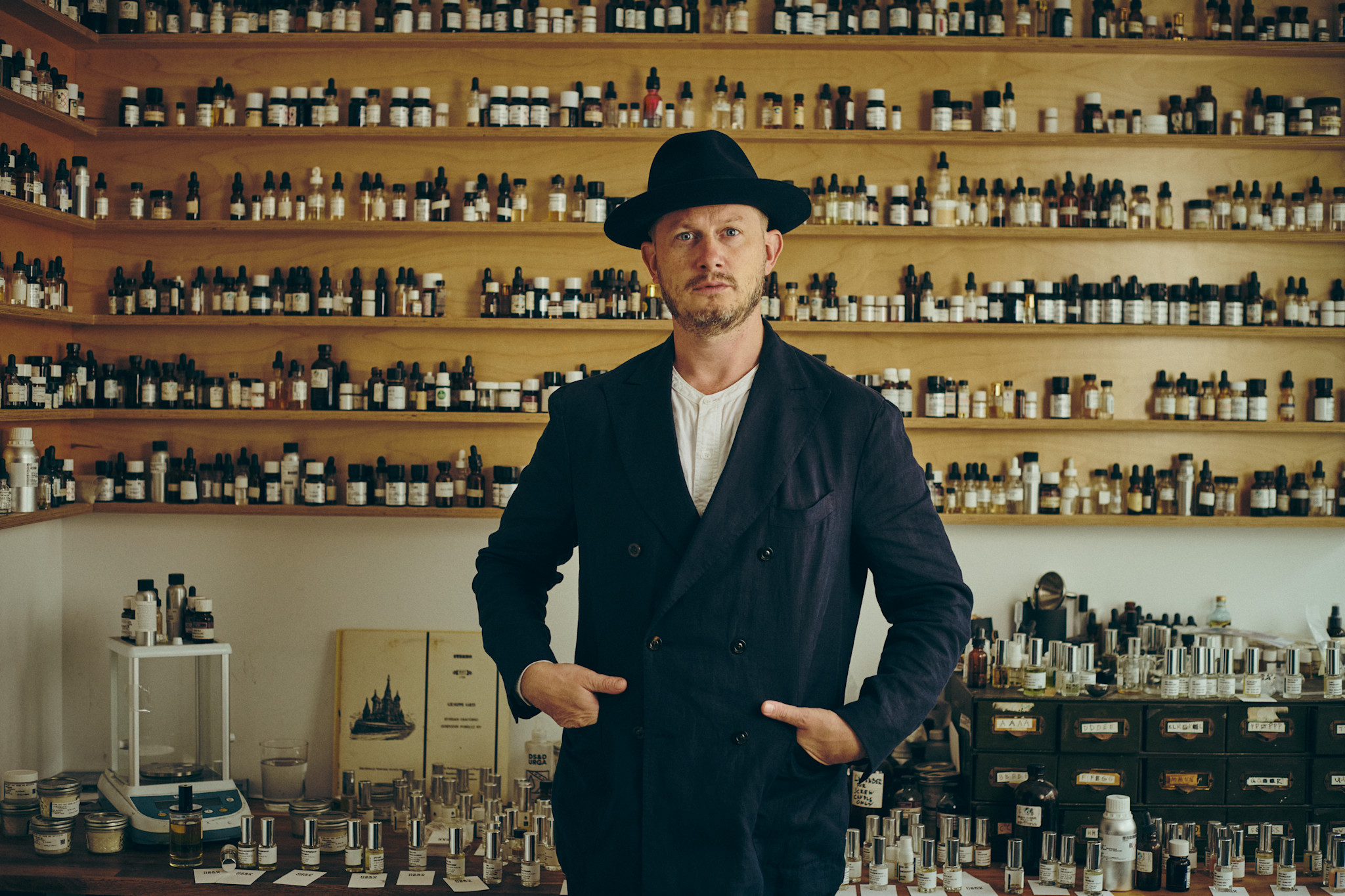
DM: So this is our third office, and it’s pretty much always been like this. I’ve always had this thing on the wall. I’ve always had the records. I’m a guy who loves making visual vignettes, even in our house. So these shells and rocks [points to natural objects] are from my hometown. There’s wood, plants, and ephemera over there.
This Chesterfield came from this guy—I remember, we drove out to New Jersey to get it for our house, not for DS & Durga, and he was like, “Dude, you know, I really love this. It was my father’s. If you ever resell it, just get back in touch.” We’ve had it for years because it’s been in every office we’ve had. It’s a very peaceful place.
KAM: We call this whole place the studio, but I call this [room] your lab. I will say, when we first moved in here and built out this space, we made all the other executives, including me, have these glass door offices, and David was like, “Oh no. I want complete privacy.”
DM: I need privacy. I can’t stand people looking at me while I’m working. Also, I thought this was the worst location—it’s the back corner with no sunlight, so I took it on purpose. But now it doesn’t seem that way.
KAM: It’s your own private enclave back here.
DM: I think privacy is so important to really focus on something.
What about organization? How do you keep organized in that… thing?
DM: Oh this thing? It’s very organized. It’s all alphabetical in my own little fragrance families. So this is musk, this is violet, gradience, -aldehydes, and this is all woods and resins the whole way around. This one is green materials and then on this side it’s flowers, flower aroma chemicals, fruit aroma chemicals, and herbs and spices on top.
KAM: We reference this visually in retail stores. We have shelves that have raw materials to show the fact that we’re perfumer owned, and everything is made in-house. It’s such an important part of our brand story.
DM: We talked about building out your office space to be more of a design capital with all of those design books laying about. [Kavi’s] a little less of a setter-upper. Like, there are paintings on the ground that have yet to be hung up.
KAM: I aspire to be more of a setter upper.
Kavi, then you’re the visionary.
DM: She’s the buyer. She’ll be like, “I ordered this table,” and I’m like, “well where is it going?”
Do you have a hard time thinking with clutter?
DM: No, and I know this about myself. I’m messy—Kavi is also messy—we’re messy people, but we’re not dirty. We just think, “If you’re going to wait to do yoga until the space is all set up, don’t. Just do yoga.”
KAM: That's true. I would rather be a tidier person, but when I show up to my office, I know that I can either take time to tidy up my office, or I can just get my work done.
Last question. Top five favorite albums of all time?
KAM: This sounds like our dinner conversations… Um, Joy Division, Substance.
DM: Bruno Walter doing Mahler’s Ninth.
KAM: The Cure, Pornography.
DM: Grateful Dead, Europe 72.
KAM: Velvet Underground, Loaded.
DM: Muddy Waters, The Real Folk Blues.
KAM: New Order, Technique.
DM: Van Morrison, It’s Too Late to Stop Now. Um, I need a Dylan in there. I’m sorry but I have to go for a sixth with Dylan. Highway 61.
KAM: I might say the Strokes. Room on Fire. That’s five.
Katie Stone is a brand consultant and writer. You can read more of her work on her Substack Plant Based.
- Written by: Katie Stone